

October 26, 2025, 7:12 am | Read time: 5 minutes
The Griffon Korthals, officially known as Griffon d’Arrêt à Poil dur Korthals, combines rustic hunting passion with family gentleness. With its distinctive, wiry appearance and deep bond with humans, it is much more than a hunting dog. However, despite its friendly nature, it is not a dog for everyone—its temperament demands exercise, purpose, and a sensitive hand. This profile clarifies who this unique pointing dog is truly suited for.
Origin
The roots of the Griffon Korthals trace back to the late 19th century. Eduard Karel Korthals, a Dutch breeder residing in Germany, aimed to create a powerful pointing dog. Over 15 years, he selected various European hunting dog breeds, with the now-extinct Boulet—a woolly Griffon—among the ancestors. To darken the light coat, which was unsuitable for hunting, shepherd dogs and poodles were crossbred. The result was a resilient, obedient, and weather-resistant hunting dog with a unique appearance.
In 1886, the first standard for the Griffon d’Arrêt à Poil dur was established. Despite later discussions about a split within the Griffon types, Korthals’ original concept prevailed. The FCI currently lists the breed under number 107 in Group 7 (pointing dogs), Section 1.3 (continental pointing dogs of the Griffon type). Although bred in Germany, the Griffon Korthals is officially considered a French breed and is now widespread across Europe and North America—though it remains a rather rare sight.
Appearance & Coat
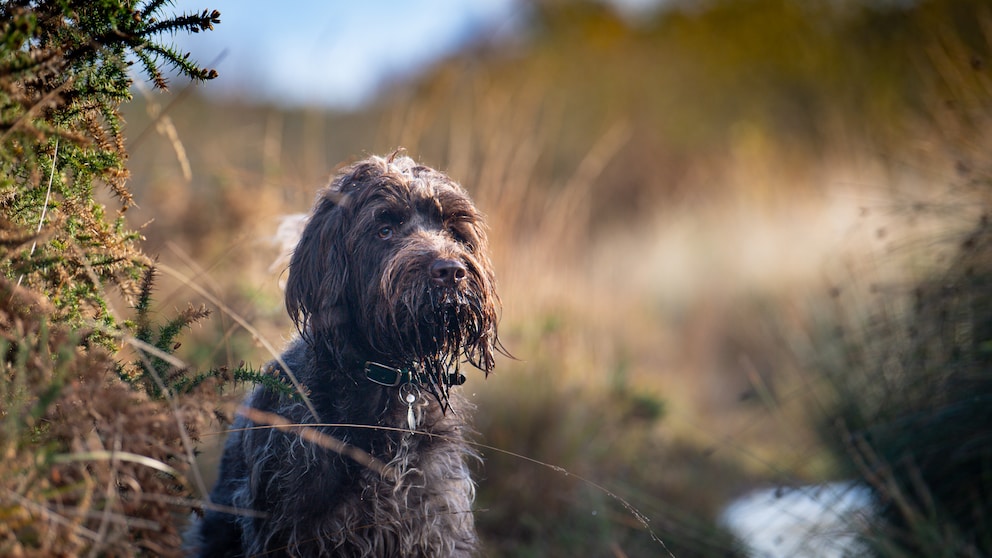
The Griffon Korthals is a medium-sized, robust dog with pronounced musculature. Its body is longer than it is tall, giving it an elegant yet stable appearance. The head is elongated, with a long, square muzzle. Its distinctive, bushy eyebrows, pronounced beard, and mustache give it a determined expression that contrasts sharply with its gentle nature.
The coat is medium-length, hard, and feels like wild boar bristles to the touch. It should neither be curly nor woolly. Beneath the wiry topcoat lies a dense, fine undercoat that provides optimal protection against moisture and cold. The Griffon Korthals typically appears in steel gray with chestnut markings, solid chestnut, or in combinations with white—sometimes speckled or interspersed with individual white hairs. The tail is medium-length, heavily haired, and carried horizontally. Males reach a height of 55 to 60 cm at the withers, females 50 to 55 cm. The weight ranges between 23 and 27 kg.
Character & Temperament
The Griffon Korthals is described as an intelligent, sensitive, and family-friendly dog. It has a close bond with its human and defends home and family with calm vigilance. Despite its sometimes stern look, it is a good-natured and child-friendly dog. It possesses the typical mix of independence and trainability characteristic of pointing dogs.
In its nature, it shows pride, willingness to learn, and a strong need for harmony. At the same time, it tends to make its own decisions, which requires a structured environment and consistent, empathetic leadership. The Korthals does not like to be alone—closeness and contact with its person are essential. With appropriate activity, it is a calm, balanced companion that is also suitable for family life.
Training
Training the Griffon Korthals requires patience, clarity, and a delicate touch. Due to its sensitivity, these dogs respond well to structured routines and gentle consistency. Consistency without harshness is crucial—too strict measures can lead to insecurity.
Its high intelligence ensures quick learning success but also demands variety and creative training approaches, as the dog can quickly become bored. Early recall training is particularly important to keep the hunting-motivated dog under control. With sufficient activity, the Griffon Korthals integrates well—even in families with children.
Proper Care & Maintenance
The Griffon Korthals is not a city dog. It needs plenty of exercise, space, and mental stimulation. A house with a fenced garden and (secured) access to nature is ideal. Long walks, hunting tasks, or search games keep it physically and mentally balanced.
Coat care is generally straightforward but requires regularity. Brushing several times a week prevents matting, especially on the beard, legs, and hindquarters. Trimming—plucking dead hair—is advisable and should be done one to several times a year. Ear and nail care should not be neglected to prevent infections and injuries.
Nutrition
The nutrition of the Griffon Korthals is generally uncomplicated. High-quality, as natural as possible dry food is suitable, provided it is free of artificial additives. Alternatively or additionally, wet food can be given. However, dental care should not be neglected, as soft food puts less strain on the teeth.
The most species-appropriate but also most labor-intensive feeding method is raw feeding (BARF), where fresh components are individually assembled. Home-cooked food is also possible, provided it is balanced and unseasoned. Regularly chewing bones supports dental care regardless of the food choice.
Landseer: A Family Dog with Remarkable Social Skills
Why the Drentsche Patrijshond Is Considered a Hidden Gem from the Netherlands
Susceptibility to Certain Diseases
The Griffon Korthals is considered an exceptionally robust breed. Typical hereditary diseases are currently unknown. Its life expectancy is about 12 years or more, with good care, even significantly longer.
Thanks to its dense undercoat and rough, water-repellent topcoat, it copes well with different weather conditions. Neither cold nor heat bothers it excessively. The risk of obesity is low with sufficient exercise. Regular check-ups at the vet and an active life are the best prerequisites for a long, healthy dog life.
The Griffon Korthals at a Glance
- Size: Males 55–60 cm, Females 50–55 cm
- Weight: 23–27 kg
- Character: Sensitive, affectionate, intelligent, hunting-motivated
- Coat: Harsh topcoat with dense undercoat
- Special Feature: Suitable for active people with a house and garden, ideally with hunting experience