

September 12, 2025, 4:16 am | Read time: 6 minutes
Small but powerful: The German Jagdterrier is known as an uncompromising working dog with a strong hunting instinct. Its fearlessness and endurance are legendary–as is its independence. But is this rugged canine even suitable as a family dog? Anyone who wants to keep one must know: The German Jagdterrier is not a beginner’s dog but a passionate specialist with clear demands. What makes it so special–and what you need to consider–can be found here.
Origin
The German Jagdterrier is a relatively young breed originating in Germany. Its development dates back to the first third of the 20th century when a group of passionate hunters and terrier enthusiasts deliberately created a new breed intended solely for hunting purposes. The goal was a versatile, robust, loud-trailing, and water-loving hunting dog, particularly suited for ground hunting.
Initially, Fox Terriers and English Terriers were crossbred. Later, Fell Terriers, Welsh Terriers, and Old English Terriers were added to the genetic foundation. The aim was always a high-performance working dog–beauty played no role in selection. The breeding focus was consistently on temperament, courage, eagerness to work, and physical endurance.
After World War II, the German Jagdterrier quickly gained popularity among hunters. To this day, it is primarily used for hunting. Many breeders only place their puppies in experienced hunting hands, as the German Jagdterrier is a specialist with clear requirements for care and handling. A working test is a prerequisite for breeding approval.
Appearance & Coat
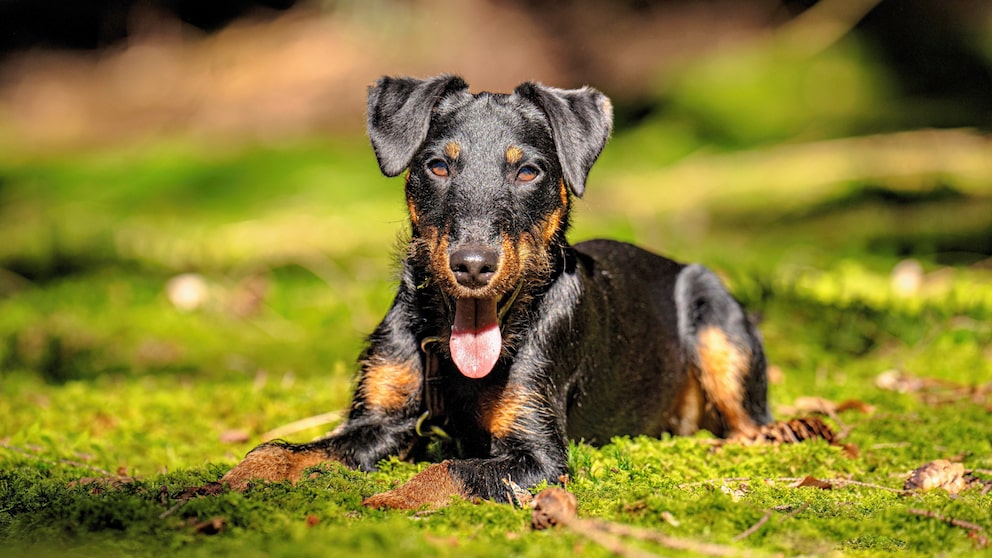
The German Jagdterrier is a compact, muscular dog with a sporty, functional build. Males reach a shoulder height of up to 40 cm and weigh 9 to 10 kg; females are slightly smaller and lighter, weighing 7.5 to 8.5 kg. The overall appearance is geared towards performance and endurance, a result of targeted performance breeding.
Characteristic is the dense, weather-resistant coat, which comes in two varieties: rough-haired or smooth-haired. The dominant colors are black, dark brown, or black-gray mottled with sharply defined tan (red-yellow) markings. Entirely red specimens are also possible. White markings on the chest or paws are tolerated but not desired.
The strong muzzle with a powerful bite underscores the hunting nature of this breed. The high-set, slightly folded ears give the facial expression attentiveness and determination. Overall, the German Jagdterrier impresses with a powerful, work-oriented silhouette without unnecessary daintiness.
Character & Temperament
The German Jagdterrier is primarily a passionate hunting dog–brave, enduring, intelligent, and very independent. These traits make it a valued companion in the field but also place high demands on its owners. Its determination and eagerness to work are remarkable, as is its pronounced desire for freedom.
It shows loyalty and attentiveness to people and can be very sociable with consistent leadership. With appropriate activity, it can integrate well into family life–especially in hunting-active households. It usually accepts children without issue, provided its needs for exercise and engagement are met.
The German Jagdterrier has a high threshold for stimuli, combined with strong initiative. This mix requires clear rules and confident leadership. Inconsistency often results in dominance behavior or unwanted hunting instincts in everyday life. It is not a dog that will submit without questioning its owner.
Training
Training the German Jagdterrier requires consistency, expertise, and patience. Its high intelligence and independence make it capable of learning but also demanding. Early socialization, combined with clear structure, is essential to avoid problematic behavior. Positive reinforcement combined with clear boundaries yields the best results.
Targeted training, ideally with a hunting focus, enhances its talents and strengthens the bond with the owner. Understimulated or inadequately managed Jagdterriers tend to exhibit excessive territorial behavior, control behavior, or uncontrolled hunting. Therefore, this breed is not suitable for beginners. In experienced hands, however, the German Jagdterrier becomes a reliable and eager partner.
Proper Care & Maintenance
The German Jagdterrier needs an environment that meets its energy, hunting instinct, and love of freedom. Pure kennel housing is as unsuitable as a life on the couch. Ideal living conditions are provided by hunting-led households with plenty of space, clear tasks, and close human connection.
Daily, intensive activity in the field is essential. Long walks alone are not enough–the German Jagdterrier needs real challenges: tracking, retrieving, water work, or ground hunting. Without these stimuli, it will find its own tasks–often to the dismay of its surroundings.
However, it is easy to care for in terms of its coat: regular brushing suffices, regardless of the hair type. A secure environment is particularly important–its desire for freedom often leads to escape attempts if the bond is lacking. A close relationship with the owner and mental stimulation are therefore indispensable.
Nutrition
The German Jagdterrier has a high energy requirement due to its activity and musculature. A balanced diet with a high meat content is recommended. High-quality wet or dry food with good digestibility, along with balanced minerals and vitamins, forms the basis.
It is important to provide a diet tailored to age, activity level, and weight. For dogs used in hunting, the energy requirement can be significantly above average. Fluid intake should not be underestimated during intensive work in the field. Treats and training snacks should be used wisely to avoid obesity and maintain motivation in training.
Why the Cairn Terrier Is Anything but a Beginner’s Dog
Why the Smooth Fox Terrier Needs Tasks to Be Happy
Susceptibility to Certain Diseases
The German Jagdterrier is considered a particularly robust breed with high resilience. However, there are some genetically predisposed health risks. Particularly relevant is the so-called lens luxation–a hereditary instability of the eye lens suspension, which can lead to lens displacement and, in the worst case, glaucoma. A genetic test is available to identify carrier animals early.
Also, the patellar luxation (kneecap displacement), not uncommon in small breeds, can occur but is rare. Regular veterinary check-ups, especially ophthalmological examinations, are recommended. Thanks to strict performance breeding, the German Jagdterrier is overall a very resilient and long-lived companion.
The German Jagdterrier at a Glance
- Character: brave, hunting-driven, independent, loyal, intelligent, eager to work
- Size: up to 40 cm shoulder height
- Weight: Males 9–10 kg, Females 7.5–8.5 kg
- Coat: smooth or rough, dense and easy to care for
- Special Features: very strong hunting instinct, high need for movement, not suitable for beginners