

December 9, 2025, 10:04 am | Read time: 5 minutes
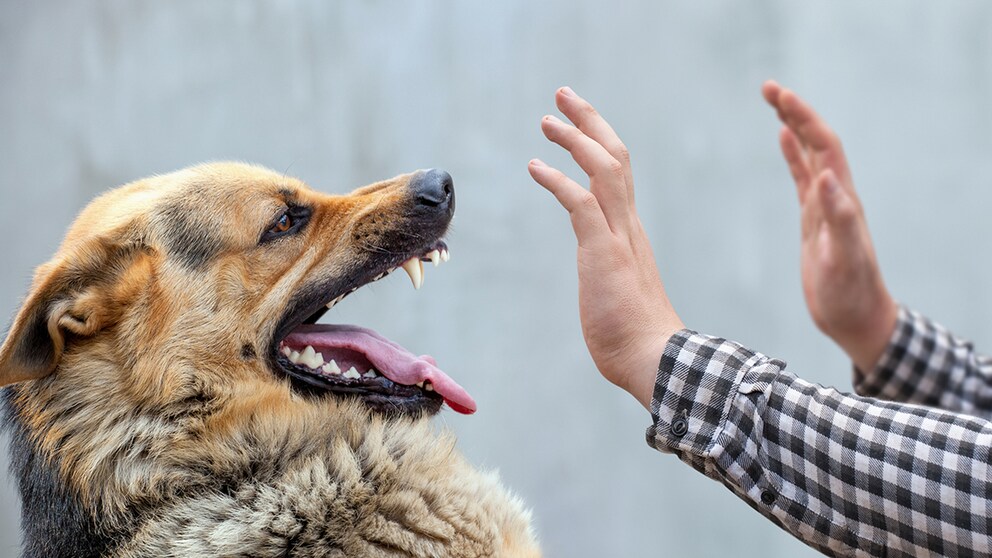
A dog appears to be lying relaxed on the couch—peaceful, calm, secure. But then the door opens, someone enters, and suddenly the dog jumps up, growls, and might even move forward. Outsiders often see this as an aggressive dog or even call it a “problem dog.” For owners, it’s a shocking moment that hits them in the gut. What triggered this sudden aggression? Dog trainer Katharina Marioth explains and offers advice.
No Dog Is “Bad”
The answer is rarely “because he’s bad.” In most cases, aggression is not the root of the problem but the last desperate measure of a dog that sees no other solution. It’s like a red warning light on the dashboard—and smashing the light doesn’t fix the engine.
Many forms of aggression in dogs stem from fear. When a dog feels threatened, it usually tries to escape or remain as inconspicuous as possible. If this option is taken away—such as by a leash, a confined space, or restraining hands—it may switch to defense mode. Not because it’s “dominant,” but because its survival instinct kicks in.
Fear Eats Logic—Aggression Follows
Dogs are extreme security enthusiasts. They need clarity about their surroundings to feel safe. Unexpected stimuli or sudden touches by strangers can trigger strong insecurity and thus fear—the ideal breeding ground for stress, overwhelm, and ultimately aggression.
Overstimulation is a silent enemy of inner balance—and a common cause of fear and aggression in dogs. Whether it’s construction noise, running children, pushy dogs in the park, or frantic hands: a multitude of simultaneous stimuli can quickly overwhelm a dog’s nervous system. Initially, nervousness appears, but the signals become clearer over time—licking, yawning, averted gaze, tense body. Ignoring these signs of fear risks the dog eventually responding with aggression.
Pain—the Silent Trigger No One Sees
More often than many think, pain is behind aggressive behavior. And because dogs are masters at hiding weakness, these pains often go unnoticed for a long time. Joint problems, dental issues, ear infections, tense muscles, or internal diseases can make a dog more irritable, avoid touch, or quickly go on the defensive.
The signs are often subtle, and owners must pay close attention. Often, you’ll notice a changed posture or less desire to play, frequent licking of certain areas, avoiding certain movements, and a short whimper when getting up. Viewing aggressive behavior through the lens of health spares your dog unnecessary suffering—and yourself unpleasant surprises.
When Retreat Is Not an Option
A dog without the option to retreat is like a person in a dead end: eventually, the only option is to “go through the door.” This is especially true in situations where it feels cornered—whether by people, other dogs, or simply too little space.
Why Many Dogs Allegedly Bite Suddenly

Trainer: “Most People Overlook This Problem in Dogs”
The Story Behind Aggressions
Behind every seemingly “sudden” reaction is a backstory that we often only recognize at second glance. The dog in the café that snaps at the waiter who suddenly reaches under the table. The female dog that suddenly gets loud on the leash after a strange dog repeatedly gets too close. The older male dog that growls when children hug him in his sleep. Not “bad behavior.” But: “Please stop, I can’t take it anymore.”
To prevent it from getting to that point, you can do a lot today to give your dog security and defuse critical situations:
10 Things to Prevent Aggression
- Create fixed routines–predictable processes provide security.
- Learn your dog’s stress signals–and take them seriously.
- Respect your dog’s personal space–no forced cuddling, no enforced contact.
- Provide retreat spaces–and ensure they are off-limits to disturbances.
- Avoid overstimulation–better three relaxed stimuli than twenty at once.
- Train positive associations–turn “fear” into “anticipation.”
- Give your dog choices–self-determination reduces stress.
- Seek support from a non-violent trainer.
- Ensure appropriate activity–body and mind need tasks.
- Be the calm you wish to see in your dog.
Conclusion: A Dog That Feels Secure Has No Reason to React Aggressively
Aggression is not a monster that suddenly bursts out of a dog. It’s a cry for help—often triggered by fear, stress, or overwhelm. Recognizing the subtle signals before the situation escalates can sustainably change coexistence.
In the end, it’s simple: A dog that feels secure and doesn’t live in constant fear has no reason to react with aggression. And those who understand their dog’s behavior need not fear its reactions but can build trust.

About the Author
Katharina Marioth is the founder of the brand Stadthundetraining and the KEML principle. She is an IHK- and government-certified dog trainer and behavioral assessor for dangerous dogs in the state of Berlin. In her daily business, she works closely with veterinarians, scientists, and other specialists on dog-related topics. With her knowledge and skills, she secured the title of Dog Trainer of the Year 2023 in the Sat.1 show “The Dog Trainer Champion.”