

February 16, 2026, 3:47 pm | Read time: 7 minutes
Hybrid dogs, also known as designer dogs, have been experiencing a real boom for years. In addition to Goldendoodles, Labradoodles, and Cockapoos, there are now numerous other crossbreeds that supposedly combine “the best of two breeds.” One of them is the Whoodle. But which dogs were crossed here–and what should you really know about this mix? PETBOOK introduces the breed.
Origin
The name already provides a clear hint about the involved breeds. The Poodle is frequently used for designer crossbreeds. It is considered intelligent, eager to learn, and sheds relatively little hair. The second part of the name refers to the Irish Soft Coated Wheaten Terrier, a rather rare, spirited terrier breed in Germany with characteristically soft, wavy fur.
When the Whoodle was first intentionally bred is not documented. Like many so-called Doodle mixes, it likely emerged during the designer dog trend that has been ongoing since the 1980s. There is no official recognition as an independent breed. There are neither binding breed standards nor overarching, uniformly regulated breeding guidelines from major canine umbrella organizations.
Designer dogs like the Whoodle are often marketed with promises of being particularly healthy, allergy-friendly, or balanced in character. However, this is more of a market trend heavily influenced by demand and marketing. There is no reliable scientific basis for these general claims. The Whoodle–like many Poodle mixes–is often advertised as “suitable for allergy sufferers.” This designation is misleading. Allergies are not triggered by hair but by certain proteins in saliva and skin flakes. Therefore, a dog that sheds little hair is not automatically suitable for allergy sufferers.
Since there are no uniform breeding standards, health, temperament, and appearance can vary significantly. Those interested in a Whoodle should carefully examine the breeding conditions, available health certificates, and whether their own living circumstances truly match an active, high-maintenance dog.
Appearance & Coat
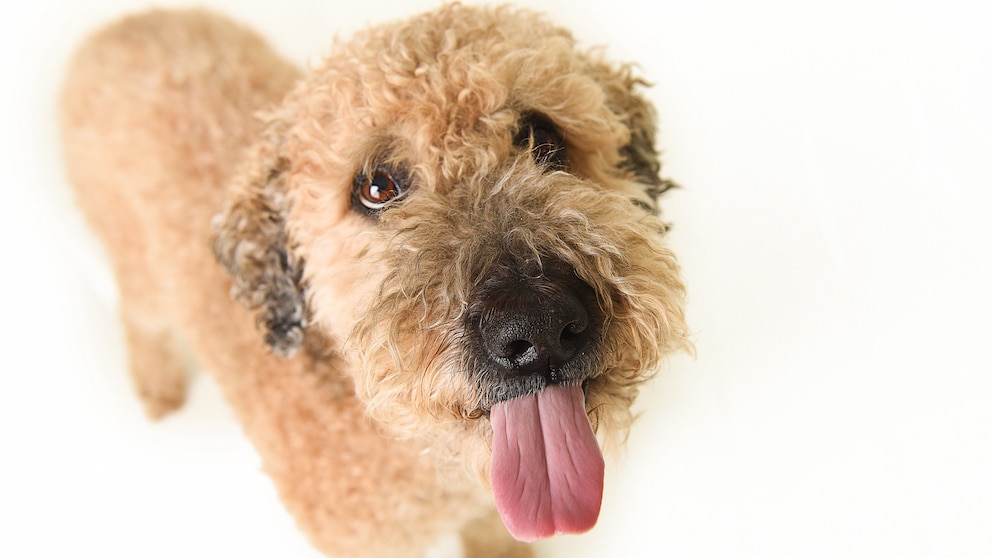
Visually, the Whoodle often combines features of both parent animals–though with sometimes significant differences. As a crossbreed, even puppies from the same litter can look very different. Coat texture, body structure, and size depend heavily on which genetic traits prevail.
Typically, the coat is wavy to curly, reminiscent of the Poodle, combined with the soft hair of the Wheaten Terrier. How large a fully grown Whoodle actually becomes largely depends on the size of the Poodle used. While the Irish Soft Coated Wheaten Terrier usually weighs between 14 and 18 kilograms, Poodles come in very different sizes–from the Toy Poodle at only about 2–3 kilograms to the Miniature Poodle and the significantly larger Standard Poodle.
Problems arise when very small Poodle females (Toy or Miniature) are bred with a significantly heavier Irish Soft Coated Wheaten Terrier. Such a size discrepancy poses considerable health risks for the female–especially during pregnancy and birth. Oversized puppies can lead to severe birth complications, cesarean sections, or even life-threatening situations. From an animal welfare perspective, this is highly problematic and can be classified as detrimental breeding.
The weight of a Whoodle can also vary greatly and exceed 20 kilograms. Color-wise, beige, cream, brown, or black tones are possible, sometimes even spotted variants.
Character & Temperament
Both Poodles and Irish Soft Coated Wheaten Terriers are considered smart and people-oriented. Poodles are among the most intelligent dog breeds, while the Wheaten Terrier is described as spirited, attentive, and lively. Accordingly, the Whoodle is often characterized as affectionate, eager to learn, and family-friendly.
However, it should be noted that character traits in mixed breeds cannot be reliably predicted–and, of course, every dog has its own personality regardless of breed. While some animals are strongly Poodle-like and particularly cooperative, others may exhibit more of the independent Terrier traits. Terriers often bring a pronounced hunting instinct and a certain independence.
Due to their close bond with their caregivers, many Whoodles are reluctant to be left alone. Gradual acclimation to being alone is important to avoid later separation stress. At the same time, these dogs need plenty of physical and mental stimulation–long walks, fetch games, or dog sports cater to their need for activity.
Training
The combination of intelligence and eagerness to learn can make training easier. Many Whoodles show a clear “will to please,” or desire to please their humans. However, this does not replace consistent and structured training. The Terrier component can manifest through independence.
Early socialization, attending puppy and young dog groups, and positive, reward-based training are recommended. As with any dog, ultimately the quality of leadership and bonding determines the living together, not the mix.
Care & Maintenance
The Whoodle’s coat is generally high-maintenance. The extent of the effort depends on which coat texture prevails genetically. If the dog has a pronounced Poodle curl, the coat grows continuously and sheds little hair. Dead hair remains in the curly coat–quickly leading to matting if not regularly cared for. If the Whoodle has the soft wavy coat of the Wheaten Terrier or a mix of both textures, the coat can be particularly prone to tangles.
Therefore, careful, regular coat care is crucial. Depending on curl intensity, the coat should be thoroughly brushed down to the skin several times a week, or daily for strongly curly textures. This is less about “styling” and more about skin health: matting can be painful, impair skin ventilation, and promote inflammation. Additionally, a professional cut or trim is necessary at regular intervals, often every six to ten weeks.
Those who choose a Whoodle should be aware that these dogs are often more demanding in coat care than many traditional breeds. Regardless of the grooming effort, the Whoodle needs plenty of exercise and mental stimulation. Both parent breeds are considered active and sporty, so daily long walks, play, or training sessions should be a fixed part of the routine. Pure “apartment living” without sufficient activity does not do justice to this mix.
Nutrition
No specific breed-related nutritional requirements are known. High-quality, balanced food–whether wet or dry food or a well-planned raw diet–usually meets the needs. As with many smaller to medium-sized dogs, maintaining a healthy body weight should be a focus.
The Kerry Blue Terrier Tests the Patience of Its Owners

Maltipoo: Who Is the Designer Dog Suitable For?
Susceptibility to Certain Diseases
The Irish Soft Coated Wheaten Terrier is generally considered a robust breed but can be prone to the following conditions:
- Protein-losing diseases (PLE/PLN)
- Hip dysplasia
- Allergies
In Poodles, the following breed-specific conditions may occur:
- Patellar luxation
- Progressive retinal atrophy (PRA)
- Other eye diseases
Contrary to popular belief, mixed breeds of two breeds are not automatically healthier but often combine the genetic predisposition to certain diseases from both parent animals. Without targeted health examinations, genetic diseases cannot be ruled out and may indeed be passed on.
The Whoodle at a Glance
- Character: eager to learn, people-oriented, active; depending on the expression, with terrier-like independence
- Size: strongly dependent on the size of the Poodle used; possible from smaller variants to medium-sized dogs (significantly larger when bred with a Standard Poodle)
- Weight: depending on parent animals, about 8 to over 20 kilograms
- Coat: wavy to curly, usually sheds little but is high-maintenance and prone to matting; color variants from cream and beige to brown and black, sometimes spotted
- Exercise needs: high
- Average life expectancy: 12 to 15 years
- Special features: Reluctant to be left alone, size and temperament are not precisely predictable in mixed breeds; significant size differences between parent animals can lead to animal welfare issues