


November 11, 2025, 1:03 pm | Read time: 5 minutes
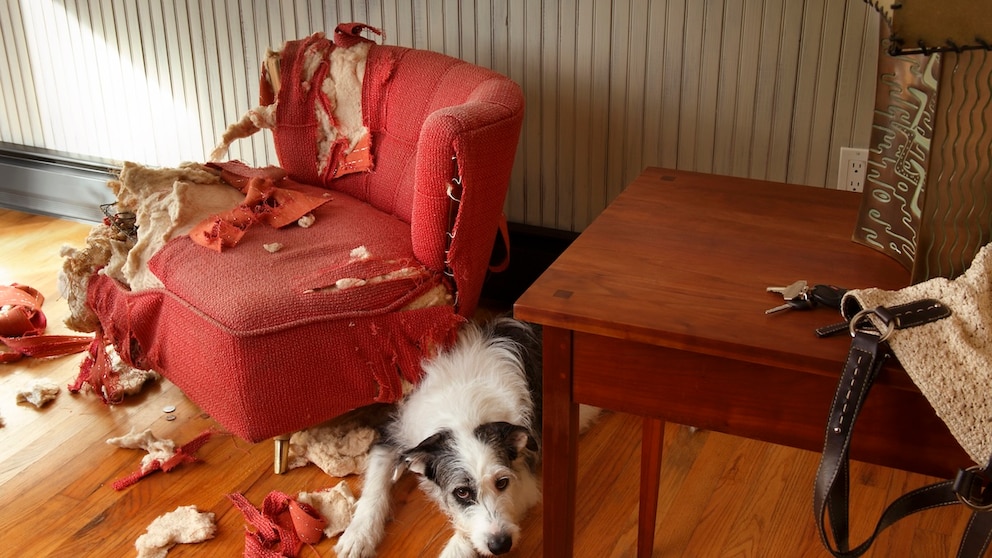
Videos of dogs wreaking havoc in living rooms, tearing up sofas, or gnawing on walls circulate by the thousands on social media. They’re often shared with laughing emojis and headlines like “Five minutes alone!” But for the affected animals, it’s anything but funny. Dog trainer Katharina Marioth explains why our four-legged friends destroy homes when left alone—and how to properly train separation anxiety.
“At first glance, it might look funny when the sofa looks like it exploded,” says dog trainer Katharina Marioth. “But for the dog, there’s massive stress behind it.”
Such scenes are usually a clear sign of separation anxiety. “When dogs destroy things, chew through doors, or scratch walls, we’re almost always talking about stress reactions—and in the absence of humans,” she explains. In older dogs, dementia can also play a role: “Some simply forget where they are once they’re alone. That also creates fear and confusion.”
Why Destruction Has Nothing to Do with Revenge
Many owners believe the dog acts out of anger or spite when it shreds the sofa or chews shoes. A mistake, Marioth emphasizes: “When dogs destroy furniture, it’s stress relief. They need to release their pressure somewhere and choose something that smells like them or feels good.”
The behavior can vary in intensity. “If a dog ‘only’ takes apart the armchair, it shows that he’s still able to redirect the stress,” says Marioth. “But once we see panic behavior—digging through walls, biting through doors or floors—a behavior specialist is needed. That’s no longer for amateurs.”
In extreme cases, veterinary support with behavior therapy and possibly medication may be necessary.
Why the Crate Is Not a Solution
Many owners react reflexively when their dog destroys something at home alone: They quickly lock it in a crate. But according to Marioth, that’s not a solution. “As trainers, we’re not allowed to recommend that anymore,” she explains. “If the cause is separation anxiety, the stress only increases.”
Instead, a gradual training process must be established—professionally guided and well-planned. “It’s important that the dog is not left alone at all during the training phase,” says Marioth. “That means friends, family, maybe the employer, or a dog daycare must help.”
This management phase usually lasts four to six weeks. During this time, the actual alone-time training is built up in tiny steps, starting with seconds and repeated rituals.
First Aid for Separation Anxiety
- Never leave the dog abruptly alone, but gradually reduce presence in tiny steps.
- Create rituals: a set goodbye phrase, consistent routine.
- No punishment after destruction! The dog acts out of fear, not spite.
- Use aids: soft music, pheromone collars, or supplements can help.
- For severe symptoms (shaking, whining, destructive rage), definitely consult a trainer or veterinarian with behavioral experience.
How to Properly Acclimate Puppies to Being Alone
Especially with young dogs, being left alone is often approached incorrectly, says Marioth. “I often get calls from people saying, ‘I have three weeks, then I have to go back to work—my puppy must be able to stay alone for six hours by then.’ And I say very clearly: No. I categorically reject that. It’s too fast, too much.”
For puppies, being alone is initially unnatural. If they destroy things during this phase, like table legs or shoes, it usually has nothing to do with separation anxiety but with teething or exploratory behavior. “This often happens even in the owner’s presence,” Marioth explains. “It’s more about: ‘Oh, this feels good, I can bite on it.'”
It’s important in any case that the dog knows a safe retreat. “If it has a crate, cave, or protected place from a young age that it perceives as safe, it can help.” However, she emphasizes: “The crate must never be used for confinement—it must remain open so the dog can decide whether to go in.”

Why Many Dogs Struggle to Stay Alone

How Long Your Dog Can Really Be Left Alone
The Critical First 30 Minutes
According to Marioth, the first minutes of being alone are particularly crucial. “Our scent concentration drops exponentially in the first 30 minutes. After that, it remains relatively constant for a longer time,” she explains. For the dog, this means: This first half-hour is the most emotionally challenging phase, where it realizes its human is not there.
Therefore, this period must be particularly carefully structured in training—with positive experiences, clear routines, and gradual exercises. “You can additionally support this with music or familiar sounds. A consistent soundscape helps some dogs enormously to calm down.”
“The Dog Did Nothing Other Than What He Had Learned”
Finally, Marioth shares an anecdote from her practice. “A client called me because his dog had dismantled the entire car while he was briefly shopping.”
At first, she suspected classic separation anxiety—until the owner explained what he usually did when he left the dog alone: “He always hid a sock with three treats somewhere in the house for the dog to find.” This time, in the car, he had forgotten the sock.
“So the dog did nothing other than what he had learned—he took apart the car to find the hidden sock,” Marioth says with a laugh. “It wonderfully shows how important routine and context are in training. Dogs don’t commit acts of revenge—they act based on experience and emotion.”

About the Expert
Katharina Marioth is the founder of the Stadthundetraining brand and the KEML principle. She is a certified dog trainer and behavioral assessor for dangerous dogs in Berlin. In her daily work, she collaborates closely with veterinarians, scientists, and other specialists on dog-related topics. With her knowledge and skills, she secured the title of Dog Trainer of the Year 2023 in the Sat.1 show “The Dog Trainer Champion.”