


September 15, 2025, 8:59 am | Read time: 4 minutes
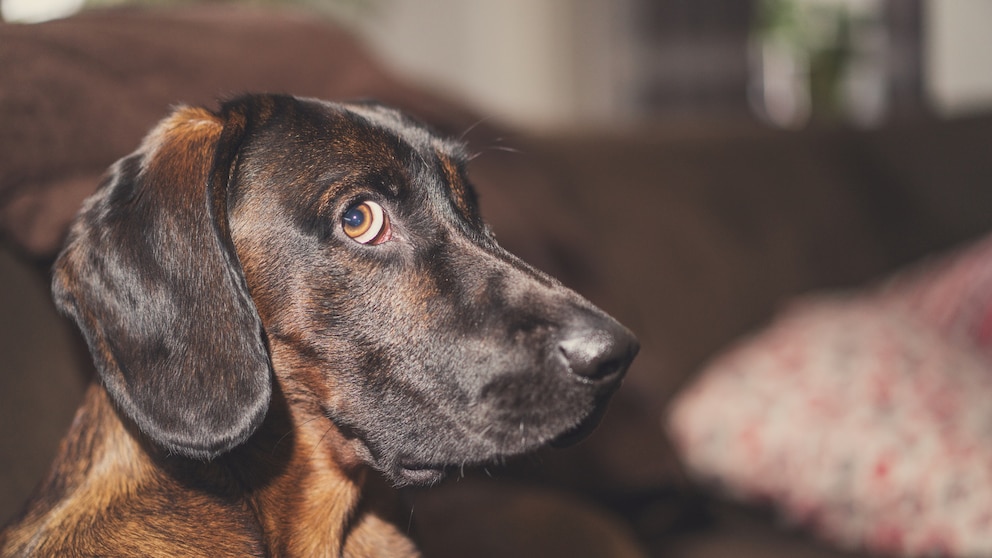
“He knows exactly what he did!” Many dog owners claim this about their pets when they’ve misbehaved again. Left alone for a short time, the dog might have shredded the sofa cushion or peed on the carpet. Guiltily, with a sad look and drooping head, he trots toward his humans as they enter the home. But can dogs actually feel shame? PETBOOK editor and behavioral biologist Saskia Schneider reveals the answer.
Was that me? Dogs can quickly give the impression with their look that they are ashamed of what they’ve done. But are these animals really capable of such a complex emotion? Or are we projecting our own moral standards onto them?
Overview
What Does It Mean to Feel Shame?
Shame is described as a painful feeling of embarrassment caused by remorse, exposure, or the realization of one’s own failure. We also feel shame when we recognize that we’ve done something indecent, dishonorable, or ridiculous.
The feeling of shame is closely tied to values and moral concepts, which can vary by culture. For example, burping at the table might be embarrassing for us, while in other cultures, it’s seen as a compliment to the chef.1
Shame Is a Complex Behavior
Feeling shame is a very complex emotion that requires an understanding of values or morals (what is right and what is wrong?), realizing that one has just broken these, and then deciding that this happened out of one’s own weakness and was a mistake or is regretted.
To what extent dogs are capable of all these steps is highly questionable. Moreover, it’s doubtful that dogs—as complex and highly socialized as they are—have a concept of morality.
Dogs Don’t Have a “Guilty Conscience”
Dogs can clearly distinguish and learn which behaviors are desired and which are not. But when they make a mistake or do something forbidden because the roast smells too tempting or the urge to chew is too strong, they don’t have a guilty conscience like humans do.
Why It Seems Like Dogs Feel Shame
Dogs are empathetic creatures that can interpret human emotions very well. They immediately notice when we’re angry and try to appease us with their behavior. They approach us with a crouched posture, lowered head, and the typical dog look. We humans often interpret this behavior as an admission of guilt. Several scientific studies have shown this.
In a 2021 survey as part of their study, a Hungarian research team found that the majority of dog owners perceive their dogs’ behavior in certain situations as guilty and believe that the animals know when they’ve done something forbidden. The main trigger for this is the dog’s “guilty look.”2

Is It OK to Sometimes Find My Dog Annoying?

How Religion Shapes Our View of Animals
Where the “Guilty Look” Really Comes From
U.S. psychologist Alexandra Horowitz examined this “guilty look” in her study. She showed that dogs did not display a “guilty look” more often when they did something forbidden—in this case, eating a forbidden treat unnoticed—than when they did not.
In contrast, other studies observed that dogs mainly look guilty when their owners scold them, Horowitz writes in the publication of her results. This suggests that the dog’s guilty look is more a reaction to the owner’s behavior than an awareness of wrongdoing.3
Conclusion
In summary, guilt and shame are complex behaviors. Feeling them requires an understanding of cause and effect over time. However, dogs live in the here and now and usually react directly to things. It’s highly unlikely that they connect their owner’s reaction to something that happened hours ago.
Yet, although many study results suggest that dogs are not capable of feeling shame or guilt, we can never be completely sure. After all, the animals can’t tell us how they felt or what they thought while waiting for us to come home and find a chewed-up shoe.
However, a new insight from the Hungarian researchers showed that the dog’s guilty look can lead to owners scolding their pets less. The theory that dogs try to appease us with their behavior seems to hold true.4