

August 22, 2025, 8:36 am | Read time: 9 minutes
PETBOOK author Manuela Lieflaender completed training as a problem dog trainer at a renowned dog school. Today, she views many of the methods taught there critically. Here, she shares her experiences.
Where the Hell Have I Ended Up?
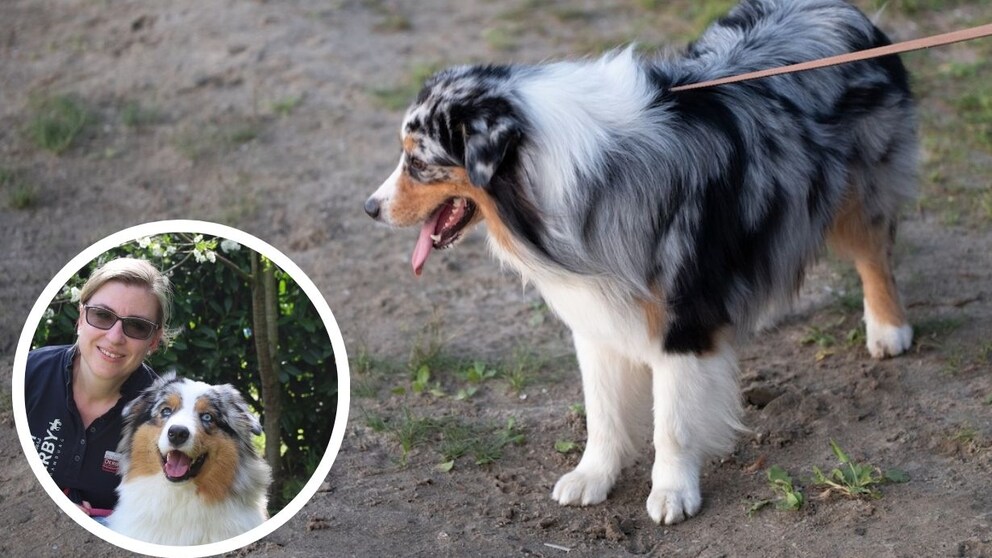
“The dog has been beaten.” What? I was shocked. The man dressed in black made two hand gestures, one in front and one to the side of the dog’s snout. My young Australian Shepherd backed away with her head. Bam, labeled “abused dog.” Where the hell have I ended up? I was standing in a seminar room in Gelsenkirchen, with about 30 participants seated at the tables.
“That’s not true,” I shot back at the guy, genuinely angry about his unqualified statement. “Then she’s at least been roughly handled.” It was pointless. At that time, I didn’t know I had stumbled into a “practical day” for aspiring dog trainers. What I also didn’t know: An hour later, this very guy would decide whether I could train at his institute. This was going to be interesting.
I Won a Casting and Got to Do the 3,000 Euro Training
An invitation to a casting had brought me to this seminar room on the edge of a park in Gelsenkirchen that day. The winner of the casting was to receive a scholarship for training as a problem dog therapist. It was the classic scenario: You had to apply in writing beforehand, as if you were applying for a specific job. In the end, there was a selection process in which, besides me, 20 other applicants participated. Each was to demonstrate five nonverbal commands with their dog and was then questioned by a three-member jury about their goals.
At home, I practiced getting Hailey to sit or lie down through eye movements. With a head movement, I could have her sit next to me and similar things. I was proud that we managed to show these tricks in front of an audience that day. In the room were the aspiring dog trainers, the casting participants, and the jury. With the reasoning that I had the “necessary drive for independence as a dog trainer,” I won the casting and was allowed to complete the 3,000 euro training as a problem dog therapist for free. Hallelujah.
Why this institute in particular? Well, because I’m lazy. A report on the TV channel Sat.1 made me aware of these dog trainers at the time. With their “system,” they relied on nonverbal communication with the dog. This was based on body language and physically active work, which meant restricting movements.
Also interesting: Dog Trainer for Extreme Cases: “Dogs are better than humans? That makes me sick!”
The Training Institute Seemed Like a Cult Engaging in Brainwashing
This method was as simple as it was effective, so much so that I could implement it with my dogs in front of the TV. That convinced me. Nonverbal communication was a new topic at the time, slowly gaining popularity. Until then, there were almost only trainers who threw a treat bag and considered that a training method.
What few people know: Most participants in a dog trainer training do not dare to take the step into self-employment in the end. Strange, isn’t it? I couldn’t understand that before my training. Until the moment I reached my limits during the training series. The reason: The training institute seemed like a cult engaging in brainwashing.
For Melanie, It Was Immediately Clear: Hailey Is a “Problem Dog”
When the training to become a problem dog therapist began, I was, as always, too early. My dog and I were still in the courtyard of the seminar building when a striking black Mercedes with a blood-red logo parked in front of me. The light blonde woman who got out of the luxury car was dressed entirely in black. The same blood-red logo that was on the windshield of the Mercedes was emblazoned on her jacket. With this look and the coldness the trainer exuded, she could have been the singer in a black metal band. But this black attire had nothing to do with dark music. It was the corporate identity of this institute that trained problem dog therapists. Everything here was dark and serious.
Hailey “expressed” what I was thinking and barked at her. Wow, Melanie (name changed by the editors) immediately showed off her dog trainer skills and tried to work with the Aussie. Unsuccessfully. The more she engaged with the dog, the more Hailey wanted this woman to just disappear. Maybe she already sensed that a trial was about to come upon us.
For Melanie, it was immediately clear: Hailey is a “problem dog.” Just like the dogs of the other participants, by the way. My dog was no longer allowed to make her own decisions, it was said. Reason: She was overwhelmed by it. As a control freak, she had to stay on a leash even in the apartment. I was about to start explaining something about breed-specific traits, but she wouldn’t accept it. “Breed-specific traits” were just an excuse for dog owners. They were all dogs that all learned the same way, and therefore, “the system” would work for everyone.
It Was Awful, and It Was a Mistake
Well, I was a participant in this training. I wanted to become a problem dog trainer, so I tried her training. It was awful, and it was a mistake. The fun of walks was utterly lost for Hailey and me. This controlling and pushing away from sniffing spots was pure stress for the dog and me. Taking the animal everywhere in the apartment meant we could no longer relax. The “training” massively strained the relationship between Hailey and me. I decided: Enough is enough, and took off the leash.
“You Have to Give Up Your Dog!”
The next drama didn’t take long to arrive: In class, the topic of “multiple dog ownership” came up. According to the trainers’ philosophy, multiple dog ownership was an absolute no-go. Well, what can I say? I was, of course, a multiple dog owner. Immediately, I was told I should give up Hailey. Excuse me?! Yes, yes, she was still young, and my Pomeranian, the first dog, was already five years old.
“Imagine your boyfriend brings his lover home and tells you that she now lives with you and has the same rights as you. That’s how your Pomeranian feels.” Every week, they pressured me again to give up the Aussie. “Cult leader” Rainer, the inventor of the “system,” added: “If you don’t give her up, she’ll eventually kill your Pomeranian. Do you want that?!” His brown eyes glared at me angrily. Even the other aspiring dog trainers urged me to listen to the two trainers. They supposedly knew what they were talking about. Little spoiler: No, I didn’t give up any of my dogs, and none were “killed.”
“You Don’t Support Our System!”
You can accuse the training institute of many things, but it was never dull. Once, we had to let ourselves fall with our eyes closed and standing. Rainer and Melanie explained that we should trust them to catch us. The fact that I was the only one who refused made Rainer angry. “You don’t support our system,” he snapped at me.
After class, they asked me for a one-on-one conversation. They had expected more from me as a scholarship holder. I should consider whether it would be better not to come anymore. Nope, I didn’t see it that way.
Anyone Who Found a Dog “Cute” Was First Educated
Meanwhile, the brainwashing continued. In class, many videos of dogs with muzzles were shown. Anyone who found a dog “cute” or otherwise expressed emotions was first educated. “Light on!”
The huge alarm signal light was always on a participant’s table and had to be turned on. Then it blinked excitedly and rotated. At the exact moment, all participants had to shout “Emotion alarm, emotion alarm.” The reasoning was that one must stand “neutral” towards problem dogs. Emotions were out of place there.

Author Explains: “Why I Reject Traditional Dog Training Today”

Elvis Goes Wild on the Leash! How TV Dog Trainer André Vogt Helped Us
Some Participants Were So Depressed That They Dropped Out of the Training
We were constantly told that dogs are “selfish predators.” Moreover, we should abandon the idea that they love us. We, the participants, didn’t want to accept that. We cited examples, trying to prove that our dogs do love us. But Melanie and Rainer could derive a selfish motive from everything the dogs did.
But not only was the joy of dog ownership supposed to take a hit. Now it was the humans’ turn: Humans fundamentally do not keep dogs appropriately, it was said. This was conveyed to us repeatedly and illustrated in all facets until we hung our heads sadly. Melanie sent us home visibly satisfied.
For some participants, the training was over at that point. They were so depressed that they no longer wanted to become “problem dog therapists.” I stuck it out until the end because much of the training was useful for my work with dogs and humans.
My 7 Most Important Learnings
Despite the many negative experiences, the training to become a problem dog therapist was comparatively thorough. The extent of the training is shown by the four-hour (!) theory exam and the subsequent practical part. A big plus: While other providers only offered theory at the time, practical days were offered here, where work with dogs could be done.
My 7 most important learnings from my training as a problem dog therapist:
- “Misbehavior” exists only from the human perspective. From a dog’s perspective, everything is right. If a dog shows “misbehavior,” an alternative must be offered.
- Instead of “waiting” for wrong dog behavior to correct it, the focus should fundamentally be on the correct behavior the dog already shows. Focus on the positive.
- Don’t forget: The dog must first be allowed to learn what correct behavior is from our perspective.
- Working with “voice” is counterproductive if you don’t have your emotions under control.
- “Talking to death” leads to the dog no longer listening.
- Food can reduce stress in dogs. Comparable to the effect chewing gum has on humans. Movement also reduces stress.
- Snout grip, being put on the back, and other training methods done by hand not only destroy the dog’s trust but also lead to counter-aggression. Remember: Aggression causes counter-aggression. Calmness causes calmness.

About the Author
Inspirational stories are Manu Lieflaender’s great passion. The certified dog psychologist and horsewoman’s thematic portfolio includes guide texts as well as reports on pet-friendly travel destinations and in-depth experience reports.
Can’t get enough of Elvis and his owner? Visit dog journalist Manuela Lieflaender on Instagram.