


September 29, 2025, 3:24 pm | Read time: 6 minutes
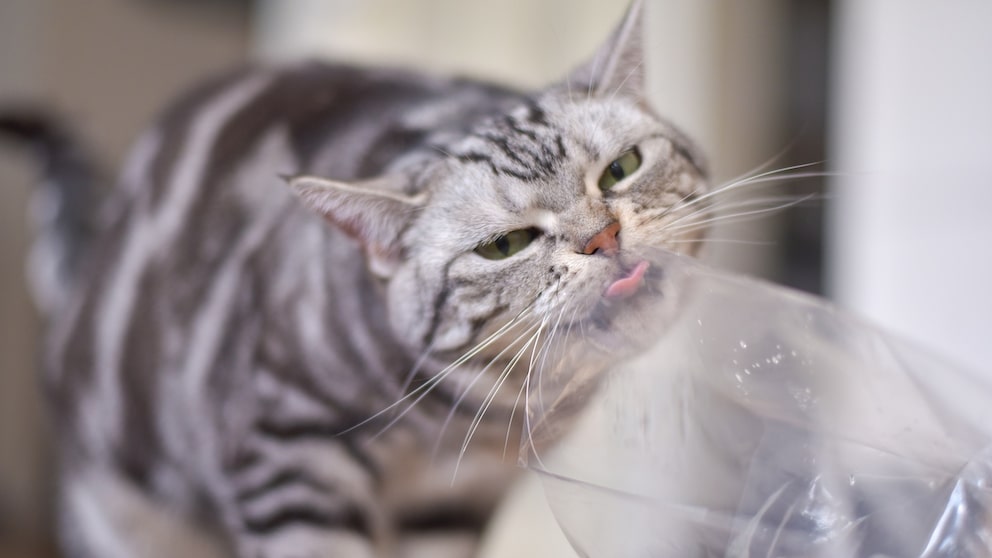
As soon as a shopping bag rustles somewhere, the cat sticks its nose in—and starts licking. For many owners, this seems bizarre, and some are unsure: Is it harmless play or an obsession? PETBOOK editor and cat behavior expert Saskia Schneider explains why cats find plastic so fascinating and when it becomes dangerous.
My cat Marie used to love licking the plastic wrapping of my mini salami. She would chew on it for minutes. As a child, I didn’t think much of it and assumed it was mainly due to the sausage flavor. But Marie also passionately licked the faces of my sister’s Barbie dolls. Barbie’s boyfriend, Ken, was particularly appealing to her. Today, I know it wasn’t just a quirk. Many cats like to lick plastic—even if it hasn’t contained any meat.
6 Reasons Why Cats Like to Lick Plastic
Scent of “Prey”
Not only mini salami wrappers, but also plastic bags often carry food residues (such as fats, oils, meat, or fish odors). Some plastics also contain substances like stearates, gelatin, or cornstarch, or release scent molecules that are attractive to cats—this can encourage licking.1
Interesting Texture and Temperature
Plastic is smooth, cool, and feels unusual on the tongue. Many cats enjoy this tactile variety. It’s important to remember that animals perceive surfaces and textures only through their tongues or paw pads. Kittens, especially, explore many new objects with their mouths—similar to toddlers.2
Crinkling Sound Activates Hunting Mode
Besides the texture, it can also be the crinkling that encourages cats to lick plastic. Many animals love crinkling sounds. The crinkling of foil likely resembles the rustling of small rodents in leaves. A sound that cats instinctively respond to, triggering their hunting instinct. Often, the bag or plastic wrap becomes a play object.3
Curiosity & Understimulation
Cats are experts at exploring their surroundings and new objects within them. However, boredom or insufficient stimulation can lead them to seek new stimuli—including plastic bags and wraps.
Compulsive Behavior & Stress Relief
What begins out of curiosity can develop into an obsession, especially in under-stimulated or stressed animals. Licking itself is calming and releases endorphins. Some animals develop routines or even addictive behaviors, especially if it’s the only thing that brings them joy besides eating. In an environment where animals receive enough stimulation through play and external stimuli, the risk of plastic licking becoming an obsession is low.
Pica Syndrome
If cats obsessively lick plastic, chew on it, or even start eating bags or wraps, it could be a sign of Pica. This refers to the consumption of non-edible materials. The causes range from nutrient deficiencies to medical or psychological issues and are not yet fully understood. If a cat increasingly chews or eats plastic, a veterinarian should be consulted.4
Why Playing with Plastic Can Be Dangerous
As harmless as it may seem at first glance, playing with plastic bags or wraps can pose serious dangers to cats. Suffocation and strangulation risks should not be underestimated: If a bag covers the head or neck, the cat can panic and may not be able to free itself. Getting caught in handles or loops can quickly lead to injuries.5
Additionally, chewing can create sharp edges that injure the mouth or throat. If plastic is swallowed, it can lead to intestinal blockage or internal injuries, which can be life-threatening. Therefore, plastic should never be offered as a “toy substitute”—even if cats find the crinkling effect fascinating. Safer alternatives include special crinkling tunnels or crinkling toys designed for cats that pose no health risks.
When Should I See a Veterinarian?
Seek veterinary advice as soon as your cat not only licks but also chews on plastic or might have swallowed something. Especially if vomiting, loss of appetite, changes in stool quantity or consistency (constipation, diarrhea, blood), abdominal pain, lethargy, gagging/pawing at the mouth, or breathing problems occur.
Even if the behavior suddenly appears, is very frequent, or is difficult to interrupt, it should be checked. A visit is also urgent if contact with toxins is possible, such as antifreeze on packaging.6

When Dogs Suddenly Eat Objects: Causes and Treatment of Pica Syndrome

6 Reasons Why Cats Love to Play with Wrapping Paper
How to Prevent Your Cat from Licking Plastic
Generally, there’s no need to worry if a cat occasionally licks plastic. However, if the behavior becomes obsessive or there’s a risk of swallowing parts of the material, it should be stopped. There are several ways to do this:
Remove Stimuli and Secure the Environment
- Consistently put away plastic bags, wraps, and packaging—preferably in closed cabinets/boxes.
- Switch to cloth/paper bags where possible (offer paper bags without handles if the cat is allowed to climb in).
- Never allow play with plastic bags—there is a suffocation/strangulation risk.
Offer Safe Alternatives
- Crinkling toys or tunnels for cats (with safely integrated crinkle material), cardboard castles, catnip, or valerian toys.
- Chew alternatives: appropriate chew toys for cats, cat grass.
- Puzzle and activity boards satisfy hunting and food-seeking instincts.
Sufficient Mental Stimulation–Daily
- 2–3 short play sessions per day (such as play wand, prey simulation, laser with a treat/toy at the end).
- Set up a cat-friendly environment: elevated viewing spots, climbing/scratching furniture, and changing “adventure stations” at the window.
Redirect Behavior Instead of Scolding
- Entice the cat away with treats/toys, and remove plastic without comment.
- No punishment—this increases stress and can reinforce impulsive behavior.
Check Nutrition & Health
- Provide a complete, age-appropriate cat diet (nutrient gaps can promote Pica).
- Regularly check teeth; if frequent licking/chewing occurs, have a vet check for Pica/underlying conditions.
Reduce Stress
- Fixed rituals and a predictable daily structure provide cats with security.
- Retreat areas, gentle social interaction instead of constant entertainment.
- For sensitive cats, fine-tuning the environment helps (identify sources of stimuli, possibly use pheromones for support).
Beware of So-Called “Deterrent Sprays”
Some suggest treating plastic with deterrents like essential oils, citrus, or rosemary. Use such scents sparingly and never directly on surfaces the cat licks. Certain substances or essential oils can lead to severe poisoning.
Conclusion
Licking plastic is usually a mix of a preference for attached scents, an interesting texture, and the hunting stimulus for cats. Sometimes it can also be a stress outlet or an indication of Pica. As long as the cat doesn’t chew on plastic or swallow parts, it’s likely just a quirk.
Nevertheless, cats should never play with plastic items unsupervised. As an owner, you should also offer sensible alternatives that keep the animals actively engaged daily—and stay vigilant. If the behavior is frequent, sudden, or compulsive, or if your cat shows symptoms of illness, it should see a veterinarian.
About the Author
Dr. Saskia Schneider is a biologist with a Ph.D. During her studies at the Free University of Berlin, she focused on zoology and animal behavior. In addition to training as an editor, she completed training as a behavior consultant with a focus on cats.