


June 25, 2026, 8:52 am | Read time: 4 minutes
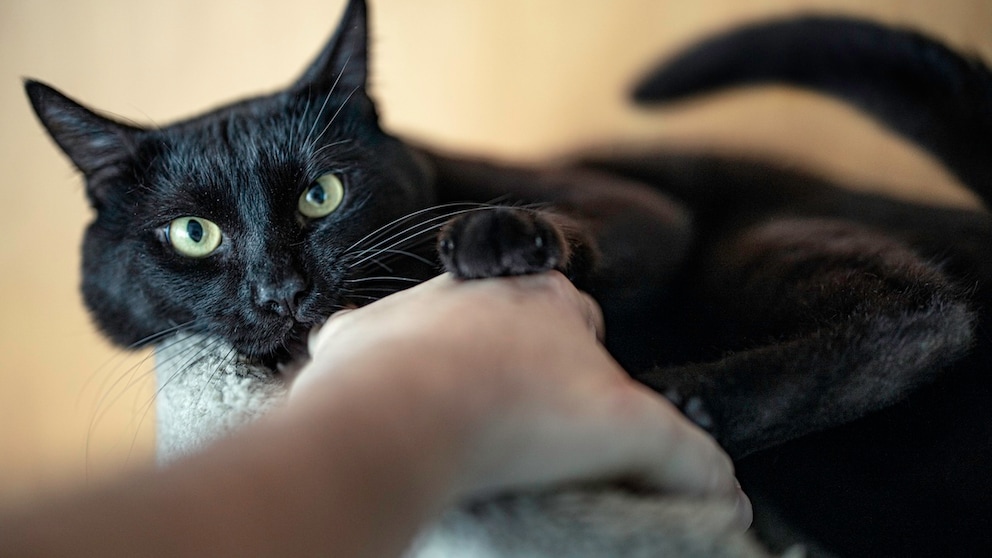
Cat paws look cute, but for many animals, they are considered a real taboo zone. PETBOOK editor and cat behavior expert Saskia Schneider explains why touches there are often unwelcome, what might be behind it, and why a closer look is worthwhile for owners.
Cat Paws Are Extremely Sensitive
Our cats’ paws are extremely sensitive. They are not just for walking. In particular, the paw pads serve various functions and act as sensory organs. They contain many nerve receptors, allowing cats to detect even the slightest changes in texture, pressure, and possibly vibrations through their paw pads. Therefore, the paw pads are particularly sensitive to temperature, pressure, and pain.1
However, this does not mean that touches on the paw are generally unpleasant for the animals. Some cats even love to be massaged on their paws and between the pads. Some even push their paw into their owner’s face to demand touches. This usually requires a lot of trust.
Injuries to the Paw
Cats can generally hide pain well. Therefore, it may go unnoticed for a long time if the animals have an injury to the paw. Some don’t even limp when they have stepped on something like a burr. If a cat that usually enjoys being touched on the paws suddenly shows defensive behavior, a paw injury is likely.
A very sad reason why some cats don’t want to be touched on the paws is if their claws have been removed. Fortunately, this practice has been banned in Germany for years. However, there are still cases where cats have had their claws removed. Especially animals adopted from abroad may have suffered this cruel fate, as in other countries, particularly the U.S., the so-called “declawing” is still allowed.
Bad Experiences
If a cat has once experienced pain when its paw was touched, it usually won’t allow it again. A main trigger is when owners try to cut the cat’s claws themselves. Especially with dark claws, it’s hard to see where the so-called “quick” (the blood-supplied part of the cat’s claw) begins. Cutting too deep is very painful for the animal and can even cause heavy bleeding.
But cats that get their claws caught somewhere, tear them out, and then associate the situation with their human, who was just trying to help, often won’t tolerate their paw being touched anymore.

Should you cut your cat’s claws?

Cat Suddenly Limping? Here’s What Could Be Behind It
Arthritis and Pain
Older cats also usually don’t like their paws being touched. This can be partly because seniors generally have less patience than kittens or young cats. Additionally, the risk of developing arthritis increases with age. This can also occur in the paws and lead to pain. Especially in damp weather, the animals can react sensitively.2
Also interesting: Cat sniffs the food but doesn’t eat? This is the reason
Certain pedigree cats even have a genetic predisposition. Scottish Fold, a breed banned in Germany, not only have folded ears. The mutation that causes the folded ears also leads to bony formations in the joints of the front and hind paws. This can cause painful knots and bumps.3
How Can I Get My Cat Used to Being Touched on the Paws?
If you have a cat that is reluctant or refuses to be touched on the paws, you should work with a lot of positive reinforcement. First, you need to find out what is the ultimate reward for your cat. Usually, these are certain treats (cooked chicken is a favorite for many), but it can also be a special game or a petting session. Use this to teach your cat: Every time I touch your paw, something great happens.
Start with small steps. First, just move your hand close to the paw and observe from what distance your pet pulls the paw away. That’s your starting point. Reward any stillness of the paw with the jackpot–even if your hand hasn’t touched the paw yet. This way, you gradually get closer. Alternatively, or in parallel, you can practice giving paw with your cat.
Important: Conduct short but multiple training sessions a day and stop while your cat is still cooperating–at the latest, when the animal wants to leave the situation.
About the Author
Dr. Saskia Schneider is a biologist with a doctorate. During her studies at the Free University of Berlin, she focused primarily on zoology and animal behavior. In addition to training as an editor, she completed training as a behavior consultant with a focus on cats.