

April 24, 2026, 7:02 am | Read time: 4 minutes
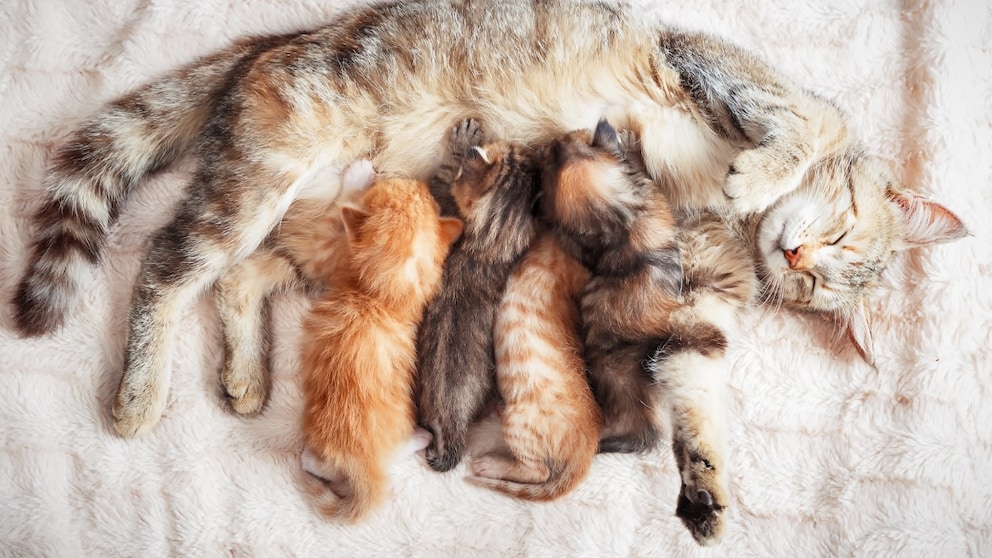
One litter—many colors: Anyone who has seen multiple kittens from a single litter knows they often look very different. Black, white, tabby—even long-haired and short-haired kittens—all in one nest. But why do siblings born at the same time in cats look so different, while human siblings often resemble each other? The answer lies in the complex genetics of coat colors—and a unique feature in the reproductive system of cats.
Genes in Competition–The Complex Inheritance of Coat Colors
The variety of coat colors and patterns in cats is enormous. Various breeding organizations recognize dozens of variants—from simple solid colors to elaborate patterns like the rosette-shaped tabby of Bengal cats or the ticked coat of Abyssinians. All these appearances result from the interplay of numerous genes.
These genes control different traits: Some influence base colors, others patterns like tabby fur, and still others regulate the presence of white spots or hair length. Some gene mutations can overshadow all other colors. Additionally, some coat colors are sex-linked because they are located on the X chromosome. This is why tricolor patterns like calico or tortoiseshell are almost exclusively found in female cats.
The crucial point: Even a few combinations of these genes can produce completely different external features—even in closely related cats. For example, a male cat from a litter may have only one or two coat colors, while his sister may display a completely different coat pattern with up to three colors.
Kittens from One Litter Can Have Different Fathers
But that’s not all: Another biological factor contributes to even more diversity within a litter. This unusual but common phenomenon in cats is called “heteropaternal superfecundation.” This term describes the possibility that a single litter of kittens can have offspring from multiple fathers—a circumstance that is not so rare in the animal kingdom.
The background is the so-called induced ovulation. Female cats release eggs only after mating with a male. During this time, several eggs can be ovulated in a short period. If the cat encounters other males during this phase, they can also fertilize eggs, resulting in a litter of mixed genetic origin.
The genetic relationship among such siblings can vary greatly. Each cat receives half of its genetic material from the mother and the other half from the father. The mother does not pass on her entire double set of chromosomes, but only a randomly selected part. If the littermates have different fathers, they share some maternal genes but differ completely in paternal ones. In the end, they may be only a quarter (25 percent) related to each other—and look correspondingly different.

Up to 100 Times a Day! 8 Facts About Lion Mating

Why Male Mammals Often Die Earlier
Evolutionary Advantage of Genetic Diversity
Why exactly heteropaternal superfecundation is so common in cats is not yet fully understood scientifically. However, there are plausible explanations.
On one hand, induced ovulation in cats could be a particularly resource-efficient strategy. Since eggs are released only after mating, no unfertilized eggs are “wasted”—the body conserves energy.
Moreover, a litter with multiple fathers can also bring advantages. It ensures more genetic diversity in cat families, which can increase the offspring’s chances of survival.
How Often Are There Multiple Cat Fathers?
How often litters from different males occur depends on the cat’s living situation. It is often said that, especially in urban areas, where many males live in close quarters and their territories overlap, the likelihood of different kittens in the litter is significantly higher.
However, whether multiple paternity occurs depends primarily on the social environment. A frequently cited study from 1999 analyzed 37 cat litters from three different free-living populations in Lyon and Rome. The result: In two colonies with loose social structure and intense male competition, 78 percent and 83 percent of the litters had multiple fathers. In a more stable population with dominant males, the proportion was only 11 percent.
This shows: It is not the urban-rural divide, but the social organization within a population that influences how often females mate with multiple males. In groups with strong competition, multiple mating can be an evolutionary strategy for females. Not only to increase genetic diversity and improve reproductive chances, but also to reduce the risk of males attacking their kittens. 1