



February 12, 2026, 4:55 am | Read time: 5 minutes
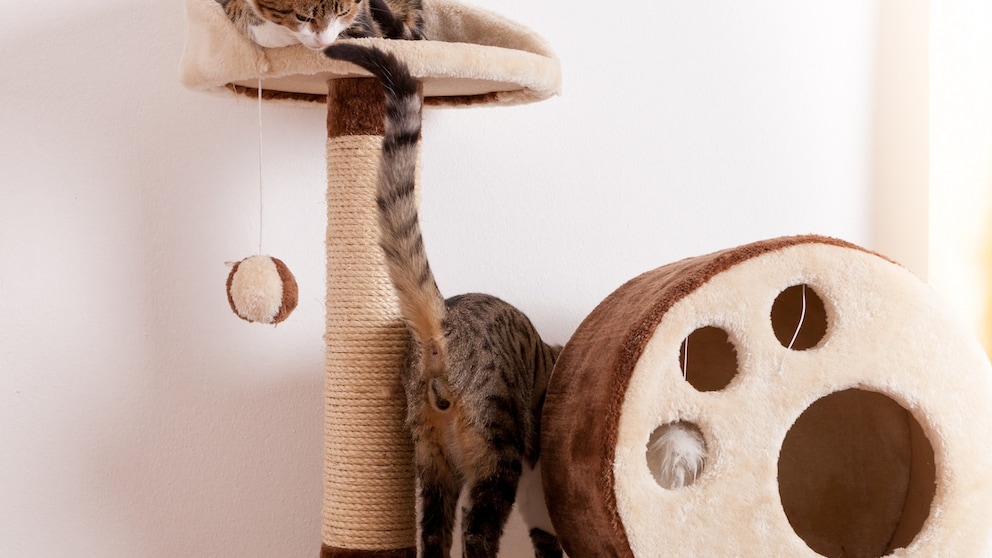
Two cats are lying on the scratching post. The one on top is dozing comfortably on its platform, its tail dangling loosely and swaying back and forth. The cat below watches for a while—becoming increasingly attentive—and eventually bites. The cat on top jumps up in surprise, feeling either confused or briefly annoyed. Does the biter know that the tail belongs to the other? PETBOOK editors Saskia Schneider and Louisa Stoeffler share their insights.
Cat Says the Tail Belongs to the Other–PETBOOK Experts Weigh in
A scene familiar to many in multi-cat households. But what’s behind it? Does the “biting” cat actually know that the tail belongs to the other? Or is a body part really being mistaken for a toy? This question was posed by two PETBOOK readers.
Assessment by Saskia (PETBOOK Editor Specializing in Behavior)
“I find the question super interesting—and would also say that adult cats basically know that it’s the other cat’s tail.”
Saskia sees two typical scenarios:
a) The cat knows the tail belongs to the other—and bites intentionally to start a game or “activate” the other.
b) It theoretically knows—but is so focused on the movement at the moment that it reacts instinctively.
“With kittens, the situation is a bit different: Their body awareness and the distinction between self and ‘the other’ are still developing. Young animals often play more clumsily and impulsively—boundaries blur more quickly.”
Assessment by Louisa (PETBOOK Editor and Cat Sitter)
“I would say: Yes—the biting cat very likely knows that the tail belongs to the other cat. Still, it can happen that the prey or play drive ‘takes over’ when something is constantly moving. What’s crucial is what happens afterward.”
Louisa clearly distinguishes between harmless everyday situations and potential conflicts:
- Brief scare, then calm again → usually a normal interlude.
- Hissing, fixating, chasing, or repeated biting → can indicate stress or tension and should definitely be observed by the owners. Perhaps a second scratching post is worthwhile.
Cats Have a Very Good Body Awareness—Including Their Tail
In essence, it can be stated: Cats possess a very fine body awareness (proprioception)—the ability to “feel” and control body parts without looking. The tail is not decoration for cats but a highly functional body part:
- Balance & coordination (climbing, jumping, turning)
- Communication (mood, intention, excitement)
- Finest movement control
This means: A cat “understands” the tail as part of its body—and usually recognizes when a tail belongs to another cat. But: Recognizing doesn’t automatically mean it won’t bite.
Movement Triggers Hunting and Play Programs–Even Without “Malicious Intent”
Often such behavior is play, sometimes stress or redirection, the so-called “redirected aggression,” less often a sign of discomfort or medical factors. Even Louisa’s cat Remo has chased his own tail because of this.
Especially in the scratching post situation, the tail acts like a classic trigger:
- It hangs within reach.
- It moves slightly and repeatedly.
- The lower cat is in a state of attention, perhaps also boredom or observation.
This can activate the “prey program”: A moving object prompts grabbing. Even if the head “knows” it’s the roommate, the body can react reflexively—similar to Saskia’s point b).
Multi-Cat Dynamics: “Play,” “Boundary Test,” or “Stress Relief”
Additionally, the social component plays a role: In multi-cat households, tail biting can also be a small boundary test (“I can disturb you—I want interaction”). It doesn’t have to be dramatic—cats resolve much through micro-signals.
What’s crucial, as Louisa also emphasized, is how both cats react afterward. Here, one must distinguish:
Rather Harmless (everyday/play):
- One-time bite, brief scare, then calm
- No chase sequence, no pursuit
- Both cats continue to use the same scratching post without avoidance
Rather Critical (conflict/stress):
- Frequent repetition, increasing intensity
- Hissing, growling, fixating, body tension
- The upper cat avoids places afterward or seems “on guard”
- Injuries occur or loose tufts of fur are found when the owners come home

Why Do Cats Suddenly Kick with Their Hind Legs?

Playing Catch and Hide-and-Seek With Cats? It’s Possible, Says Expert
What You Can Practically Do
- Management at the scratching post: If possible, offer an additional resting area/level so that the “tail in reach” isn’t constantly hanging.
- Redirect energy: Especially the “biting” cat often benefits from short hunting play sessions (wand, prey toy)—ideal: 2–3 minutes, but more frequently.
- Resource check (multi-cat rule): Multiple feeding stations, water, resting places, and enough litter boxes—competition increases stress and makes such impulses more likely.
- If there’s an injury to the tail: Better to have it checked once too often—cat bites can quickly become infected.
Conclusion
Yes, it’s very likely that the cat knows it’s the other cat’s tail. But: Movement + reach + hunting instinct can be stronger than “good intentions.” Whether it’s harmless banter or a stress signal is shown by how the situation progresses afterward.
Does your cat exhibit astonishing behavior? Whether it’s strange quirks, touching traits, or questions about living with multiple cats—we’re eager to hear your story. Write to us at redaktion@petbook.de and describe what makes your cat so special. We might feature your question in one of our upcoming articles!