

August 6, 2026, 7:51 am | Read time: 8 minutes
They grab, hold on, and kick with their hind legs: Many cats display what are known as bunny kicks. While this may seem like a cute quirk, it often has a surprising meaning. As PETBOOK editor Louisa Stoeffler knows from her cat Remo, these kicks don’t always mean what many owners suspect.
Why My Cat Does Bunny Kicks
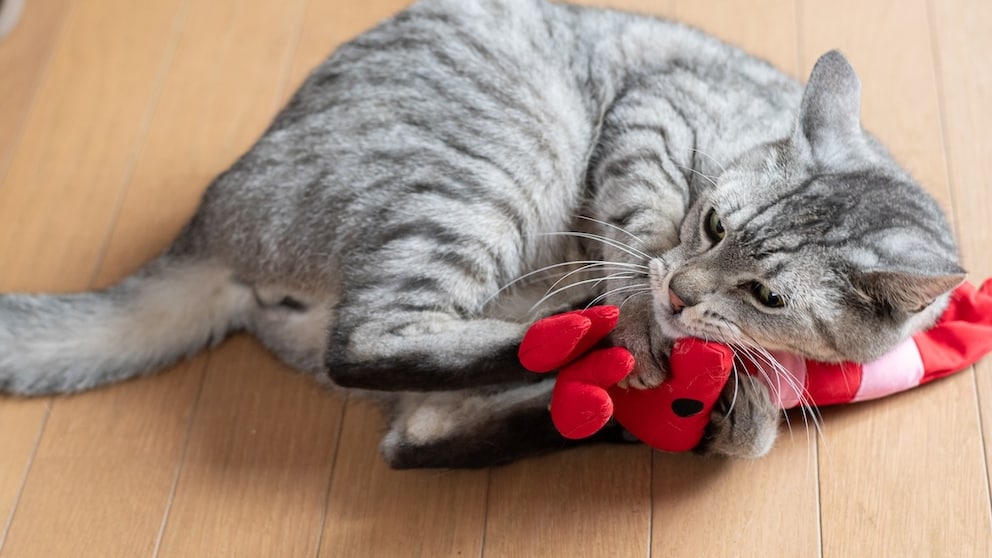
My cat has been doing bunny kicks almost since the first day with me—I got him from a shelter, and this behavior was part of his play from the start. Notably, he almost always does this alone. He usually grabs a toy, holds it with his front paws, and kicks it with his hind legs, completely absorbed in his own little hunting ritual. A few days after he moved in, he even played with just his feet. I attribute this to the lack of playmates, leading him to learn to play with himself in this way. But see for yourself:

I have the impression that for him, it’s a kind of “encapsulated play behavior.” Remo probably had little opportunity in the shelter to play extensively with other cats and learn boundaries playfully—something many cats practice with their littermates as kittens. Instead, his play drive today is strongly focused on objects, or he simply plays with his feet.
Occasionally, he also does bunny kicks on my arm. But here, Remo never uses full force, never in a way that would be painful or seem aggressive. On the contrary, Remo seems more exuberant, highly focused, and electrified rather than angry or stressed. His body language remains relaxed, with no hissing, growling, or tense posture.
Precisely because Remo is extremely playful overall, his bunny kicks don’t seem problematic to me but rather like an outlet for excess energy and hunting instinct. As long as he doesn’t hurt anyone, accepts clear breaks, and can be easily redirected, I see this behavior as part of his personality—not a sign of aggression.
What Are Bunny Kicks Anyway?
But back to the original question: What is it anyway? A bunny kick is the strong, rhythmic kicking with the hind legs while the cat holds its “target” with the front paws. The movement resembles the kicking of rabbits—hence the name. In nature, this maneuver is an effective part of hunting: The cat fixes its prey, holds it, and inflicts maximum damage with the hind legs.
Even house cats still carry this instinct within them—even if their “prey” is just a stuffed animal, a blanket, or a toy.
Kicking as a Survival Strategy: The Bunny Kick in Nature
The kicking performed with the hind legs is not a novel or breed-specific behavior but is found in all cat species. The reason: It is an evolutionarily developed technique that serves to ensure survival—whether in catching prey, defending against enemies, or fighting for mates.
Especially for wild cats, the bunny kick plays a crucial role in subduing larger prey such as rabbits or squirrels. With targeted kicks, they inflict so much damage on their prey that escape becomes impossible. They don’t necessarily have to kill the animal—many cats save their prey for later or play with it first.
In the competitive struggle between two unneutered male cats for a female ready to mate, the bunny kick is also used. Here, it is an effective fighting technique to drive away the rival. The physical confrontation usually remains short due to the effectiveness of the kicks—the defeated cat retreats, while the winner gets to mate with the female.
Why Cats Do Bunny Kicks—Three Common Reasons
1. Play Behavior and Excess Energy
As described in the example of Remo, many cats’ bunny kicks arise from pure play instinct. They let their hunting instinct out on an object in a controlled manner. This behavior is particularly common in very playful cats—or in animals that learned early on (or had to) to play alone.
The fact that the bunny kick is also observed in play behavior is because young cats train this movement early. Already as kittens, they tussle with each other, using their hind legs—but without aggression or intent to injure. This way, they playfully learn how to catch prey or defend themselves later.
2. Setting Boundaries and Overstimulation
Bunny kicks can also occur when something becomes too much for a cat. This can happen during petting, holding, or in very intense play situations. The kick then serves to create distance.
Typical accompanying signs are:
- a twitching tail
- tense muscles
- flattened ears or dilated pupils
In these moments, the bunny kick is not an attack but a clear message: “Please stop.” Cats whose boundaries are regularly respected often show this behavior in a controlled manner and without intent to injure.
3. Instinctive Defense and Protection Reaction
The bunny kick is originally a defense technique. When a cat rolls onto its back, it is not protecting its belly—it is making it a weapon. With hind legs, front paws, and teeth simultaneously, it can effectively fend off attackers.
The belly is particularly sensitive for cats. If it is touched without permission or the cat feels surprised, a bunny kick can follow reflexively. This is not a breach of trust but an instinctive self-defense.
Bunny Kicks in Multi-Cat Households: Play, Hierarchy, or Real Fight?
In households with multiple cats, bunny kicks are particularly common. Many owners are unsure when their cats hold each other, kick, and seemingly fight. In fact, this behavior is not automatically a sign of aggression—the key is how the cats interact with each other.
Escalation Level 1: Social Play
In playful wrestling, cats naturally use bunny kicks. This behavior resembles the play of kittens with each other and serves to practice hunting and defense techniques.
Typical characteristics:
- The cats take turns (sometimes one kicks, sometimes the other)
- There are no injuries
- No prolonged pursuit of one animal
- Body language remains relaxed, ears are not constantly flattened
- After wrestling, the cats separate calmly or even groom each other
In this phase, there is no need to intervene. Cats learn social boundaries here and regulate the intensity themselves.
Escalation Level 2: Tense Confrontation
If the play shifts, bunny kicks can become harder and more one-sided. Often, one cat is more dominant, while the other increasingly wants to escape.
Warning signs:
- One cat tries to get away but is repeatedly pursued
- Distinct hissing or growling
- Rigid body posture, flattened ears
- Bunny kicks become stronger and longer
In this stage, one should remain attentive but not physically intervene yet. Often, it is enough to resolve the situation with a noise, a distraction (such as throwing a toy, calling names), or spatial separation.
Escalation Level 3: Serious Fight
When bunny kicks become part of a real fight, intervention is necessary. Now it’s no longer about play or social clarification but about defense or attack.
Clear warning signs:
- Loud screaming, screeching, or panicked hissing
- One cat is under the other and cannot escape
- Fur flies, claws are constantly in use
- No breaks, no role changes
- After the fight, one cat remains fearful or withdraws
Important: Never separate cats with bare hands. It’s best to use a pillow, blanket, large towel, or loud noise to create distance. Afterward, the animals should also be separated spatially to reduce stress.
When Bunny Kicks Are Unproblematic
Bunny kicks are considered normal when:
- they are mostly directed at toys
- the cat appears relaxed
- no injuries occur
- the cat can be easily redirected
- the behavior has been known for a long time and does not suddenly change
In the case of Remo, for example, the bunny kicks are clearly part of his play behavior. He shows no aggression, accepts breaks, and remains approachable at all times. In such cases, there is no cause for concern.
Cats learn early in contact with conspecifics how hard they can kick. If the playmate reacts by running away or resisting, they regulate their strength. Therefore, bunny kicks between cats are often more controlled than toward humans—whose skin is much more sensitive. As long as no cat feels permanently oppressed and no injuries occur, bunny kicks in multi-cat households are part of normal social communication.

11 Reasons Cats Hiss

8 reasons why cats arch their backs
When to Take a Closer Look
A vet visit or behavioral assessment is advisable if:
- bunny kicks suddenly appear
- they become unusually intense or frequent
- the cat hisses, screams, or appears panicked
- touches on the belly are consistently repelled
- other behavioral changes occur
In rare cases, pain or discomfort can be the trigger. For example, with abdominal pain. If there is a corresponding suspicion, a veterinary practice should be visited immediately. Only there can a well-founded diagnosis be made and appropriate treatment begun.
Conclusion: Bunny Kicks Are Not All the Same
Whether a bunny kick is harmless play or serious defense is not determined by the movement itself but by the context. Those who observe their cat closely, read its body language, and provide it with sufficient appropriate play opportunities will usually experience bunny kicks as what they often are: a controlled expression of instinct, energy, and personality.
In multi-cat households, especially: Not every fight is a dispute. Recognizing escalation levels and knowing when restraint is better than intervention protects not only the cats but also their relationship with each other.