


April 30, 2026, 11:28 am | Read time: 7 minutes
Can animals ask questions, or is that a skill reserved only for humans? For a long time, the latter was considered scientific consensus. However, more and more pet owners report astonishing observations that challenge this notion. This is also the case with the dog Bunny and the cat Flounder. What they demonstrate with so-called soundboards appears to many observers to be more than just trained behavior. In a PETBOOK interview, the owners of Flounder and Bunny share moments that initially made even them doubt and now offer a new perspective on animal communication.
Apes Never Asked Questions Themselves
For a long time, behavioral research assumed that only humans were capable of asking questions. There were–and still are–hardly any well-founded scientific studies on this. Insights into such abilities mostly come from working and training with animals.
Researchers taught apes like gorillas or orangutans sign language to communicate with them. However, although the apes understood questions, they never asked any themselves.1
First Documented Cases Were Two African Grey Parrots
The first bird known to have asked a question was an African grey parrot named Alex. When he saw himself in the bathroom mirror in 1980, he asked, “What is that?” to which lab student Kathy Davidson replied, “That’s you.”
Much more famous today is the African grey parrot Apollo, who captivates over 1.4 million followers on Instagram with his account “apolloandfrens” and regularly asks questions like “What’s that?” and “What color is that?”
Soundboards Enable Animal Communication
While communication with parrots is straightforward because they mimic our language and can actually form words and entire sentences, it becomes more challenging with other animals to determine if they can ask questions or would if they could.
However, for several years now, soundboards have become increasingly popular as communication systems for pets like dogs, cats, and even small animals. Numerous accounts can be found on social media. Among the most famous are those of the dog Bunny and the cat Flounder.
“Where Friend”–When Grief Becomes a Question
For Nina Leipold, the owner of Flounder, it was a deeply emotional moment that changed her view of animal communication, as she tells PETBOOK in an interview. For a long time, she was unsure how to interpret her cat’s expressions. But then an event occurred that changed everything.
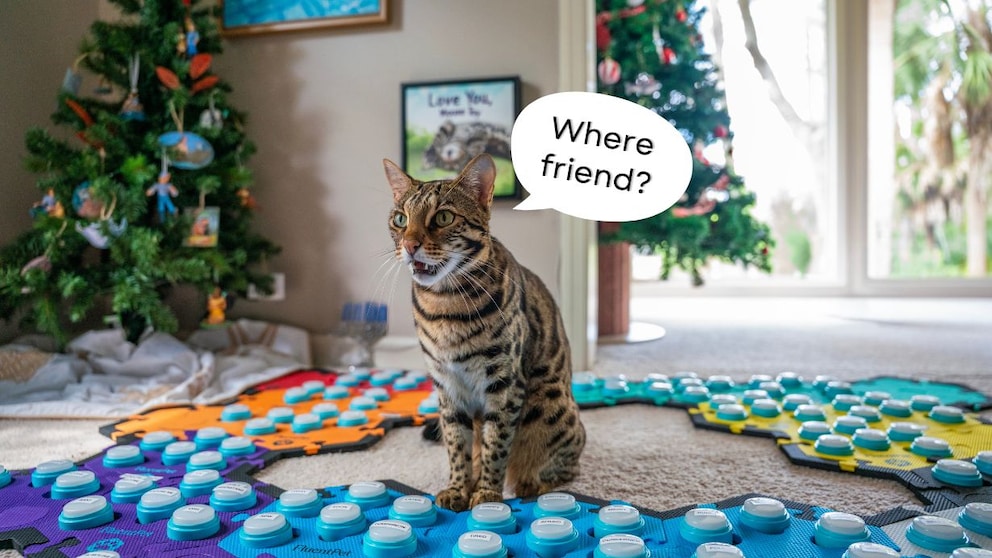
The day after the death of her fellow cat Fiki, Flounder began searching the house for him. When she couldn’t find him, she finally pressed two words on her soundboard: “Where friend.”
“I believe that Flounder is capable of asking questions,” Leipold says today. This moment made it clear to her that it wasn’t just learned routines or simple needs but an active search for information. Flounder wanted to know where her companion was.

Curiosity Beyond Words
Even in less dramatic situations, Flounder shows a remarkable form of curiosity. After integrating the word “Wingapo”–a “hello” from the Powhatan language she picked up from the Disney classic “Pocahontas”–into her vocabulary, she one day combined several buttons into a sequence: “Why”–”Pocahontas”–”Wingapo.”
For Leipold, it seemed “as if she was trying to understand why Pocahontas used a different word for ‘hello.'” A cat wondering about language differences? Such moments make even skeptical observers pause.
When Is It a Question and When Just a Wish?
One of the central challenges is distinguishing genuine questions from mere requests.
Leipold describes clear differences: “Requests are usually accompanied by words like ‘please’ or ‘want,’ and questions often contain question words like ‘why,’ ‘where,’ or ‘hmm?'” But context is always crucial.
It’s also important to her that Flounder’s communication isn’t based on mere repetition. “I make sure not to repeat sequences when demonstrating, so she doesn’t view communication as a series of steps to be learned.” For her, it’s clear: It’s not about training but expression.
“Maybe a Question. Maybe Something Question-Like.”
Alexis Devine, the owner of the dog Bunny, who is among the most famous “talking” dogs in the world, goes even further. Her analysis is as nuanced as it is philosophical.
First, she draws a fundamental line: “A request aims at an action. A question aims at information.” When Bunny presses buttons like “WANT OUTSIDE” or “GO PARK,” it’s clearly a command. But there are situations that go beyond that.
She describes how Bunny, upon seeing a moose out the window, presses “WHAT ANIMAL” on her own, without prompting. For Devine, this is more than a reflex: “I understand this as a genuine request for information.”
It becomes even more intriguing when the first answer isn’t enough. “If my answer doesn’t satisfy her, she asks again or rephrases the question (…). This isn’t a learned association that repeats.” A behavior reminiscent of genuine inquiry.
Particularly striking for Devine are situations involving absence. For instance, when her father John visited and then left, Bunny asks the next day: “WHERE JOHN.”
For Devine, this is a key moment: “It requires something that associations alone can’t explain: a mental model of the world where ‘John exists somewhere but isn’t here.'” Her conclusion remains cautious but clear: “This isn’t a request. Maybe a question. Maybe something question-like. Certainly not just conditioning.”
Communication as Relationship, Not Trick
Critics often argue that such interactions could be influenced by unconscious human cues. Devine fundamentally disagrees with this view.
“Every conversation (…) is inherently relationship-oriented,” she explains. Communication is always an interplay, a mutual response. “Mutual responsiveness isn’t a flaw in communication but the very structure of communication itself.”
Leipold also meets skepticism with calmness and an invitation: “Try it out.” She herself was initially “a big skeptic.” But it was her own experience that convinced her: “I had to experience it myself and let Flounder prove me wrong.”
What Do Animals Really Understand?
Perhaps the most challenging question is about understanding. Do animals actually know what they’re saying?
Devine shifts the answer to the philosophy of language. Meaning doesn’t arise in words alone but “through relational contexts” and shared use. In this “language game,” as she describes it, drawing on Wittgenstein, Bunny’s understanding is “as real as mine.” A bold thesis, but one that compels reflection.

Cat Watches “Cats” Musical on TV–What Does She Really See?

Cat Puts Toy in Bowl–Is She Really Trying to “Feed” It?
A New Way of Listening
Perhaps the greatest insight isn’t in what animals can do but in what we’ve long overlooked.
“Soundboards don’t reveal new abilities in dogs. They bring us back to truly listening,” says Devine. For her, these tools show less about the animals’ abilities and more about a lost human skill: listening attentively without immediately interpreting.
Leipold has also learned through Flounder how much she previously missed. Cats, she says, are “much more attentive than I ever thought” and can be interested in surprisingly many things.
Between Fascination and Caution
So the question remains: Do animals really ask questions? There is no definitive answer. Even Devine remains cautious. But the examples of Bunny and Flounder show that the line between human and animal communication is less clear than long assumed.
When a cat presses “Where friend,” when a dog asks “WHERE JOHN,” or when an animal ponders “Pocahontas Wingapo,” it at least gives the impression of something we’ve long attributed only to ourselves: genuine, curious questioning.
And perhaps that’s the crucial point. Not that we can definitively prove that animals ask questions. But that we begin to consider them as potential questioners at all.
My Assessment as a Behavioral Biologist
“I’ve been following the account of ‘Flounder the Cat’ for several years on YouTube and Instagram. Initially, I was very skeptical, but the cat Flounder shows so many quirks and behaviors that no one could have even remotely trained or conditioned. She is certainly a particularly intelligent cat, but there are other accounts, like that of the cat Elsie, which also show very complex communication. I am now firmly convinced that we massively underestimate the intelligence of our pets and many wild animals.”