

October 20, 2025, 8:53 am | Read time: 6 minutes
Many cat owners eventually face the question: Should I have my cat neutered? But what exactly happens during the procedure, when is the right time, and what persistent myths surround the topic?
What is Neutering?
The word neutering comes from the Latin verb “castrare,” meaning “to cut.” It was adopted into the German language in the 16th century. In contemporary terms, neutering refers to the removal of reproductive organs in animals, such as the ovaries in female cats and the testicles in male cats. This primarily involves the gonads, which produce sex hormones. When these are removed by veterinarians, these hormones are no longer produced. As a result, cats lose their sexual drive, and behavioral changes may occur. Additionally, many owners neuter their cats to prevent unwanted reproduction.1
What is the Difference Between Neutering and Spaying?
Neutering and spaying are often used interchangeably. Another myth is the belief that female cats are spayed and male cats are neutered. During spaying, hormone production remains intact because only the fallopian tubes or vas deferens are tied or cut. In contrast, neutering involves the complete removal of the ovaries or testicles by veterinarians.2
Also of interest: When Neutering Cats is Advisable
When Should I Have My Cat Neutered?
It is crucial not to neuter the cat too early. Once cats reach sexual maturity, you can start planning the procedure with your veterinarian. When a cat reaches sexual maturity varies and depends on both the breed and the gender of the cat. Male cats reach this stage between six and ten months, depending on the source. For female cats, it’s a bit different: They become sexually mature between six and seven months.
Owners of outdoor cats should also check if their region has specific regulations regarding neutering. Sometimes it is mandatory for outdoor cats to prevent uncontrolled reproduction.3,4
What Should I Consider Before the Procedure?
When the cat is old enough, introduce it to your veterinarian and schedule the surgery. Male cats do not have a yearly cycle, so they can be operated on year-round. However, owners should pay attention to the cycle of their female cats. If the female cat is in heat, she should not be neutered—at that time, the ovaries have more blood. This can lead to complications during surgery.
Additionally, you should consider the following points before the surgery:
- Consultation with the veterinarian: Information about risks and possible pre-existing conditions or allergies of the cat
- Health: The cat should be fit and able to undergo anesthesia
- Food: No food at least 12 hours before the surgery
- Water: The cat can drink until shortly before the surgery; ask the veterinarian for specific instructions
How is Neutering Performed on Cats?
Before any surgery, the cat is pre-examined by the veterinarian. If no abnormalities are found, the procedure can begin. Veterinarians aim to ensure the animal experiences as little pain as possible after the surgery. Therefore, they try to perform neutering in a minimally invasive manner. Every neutering is done under general anesthesia: The cat receives an injection and slowly falls asleep under the supervision of the practice team—the cat’s breathing is constantly monitored during the surgery. Then, the area of the operation on the cat’s abdomen is shaved and disinfected.
For male cats, the procedure is straightforward: The testicles are removed with a small incision in the scrotum. The wound usually does not need to be stitched. An advantage is that the wound fluid can drain on its own.
Neutering a female cat is different. The ovaries are removed through an abdominal incision. Normally, the uterus is not also removed. The wound is then stitched. Some veterinarians even offer minimally invasive stitches—with the so-called laparoscopic suture technique, the wound is smaller. Additionally, anti-inflammatory medications are available for both male and female cats.
Postoperative Care After Neutering
After the procedure, your cat will slowly wake up from anesthesia under veterinary supervision. Once it is stable, you can take it home. Your veterinarian will give you detailed instructions for care in the following days—including tips on wound care, feeding, and behavior after the surgery. Important: Ensure your cat has a warm place at home—due to the anesthesia, cats are more sensitive to cold. Provide your cat with plenty of water and start feeding it slowly the next day.
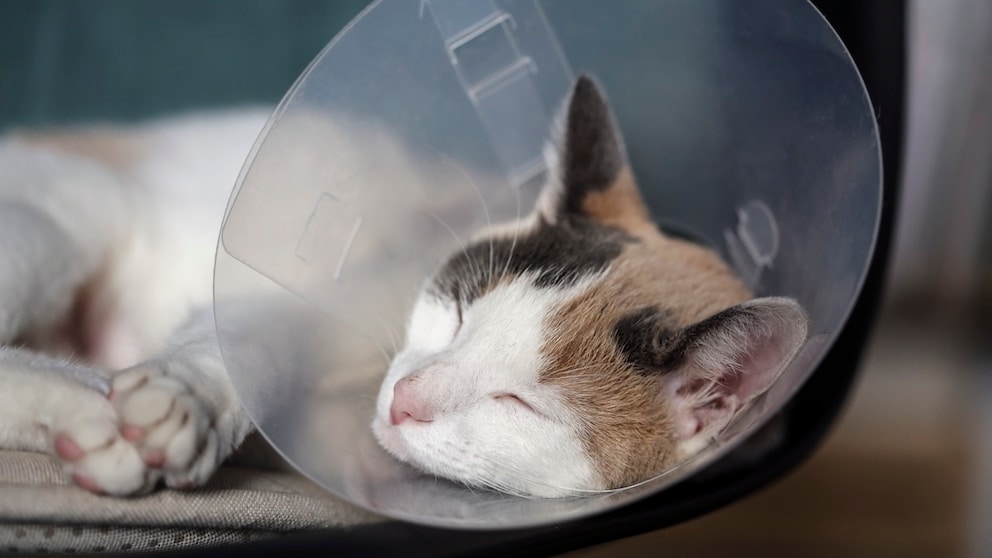
Female cats usually receive a collar or a type of protective suit to prevent them from licking their wounds. Cats are generally quite resilient and are often back to normal a few days after the surgery. However, you should closely monitor your cat to respond quickly to any possible complications, such as bleeding, and visit the veterinarian promptly.
About ten days after the procedure, a follow-up examination is conducted—the stitches are removed from the female cat, and the scars are checked.5
How Much Does Neutering Cost?
The cost of surgery varies depending on the gender and veterinarian. In 2024, the cost of neutering a cat ranged from about 60 to 170 euros, depending on the extent of the procedure. If the uterus is also removed, the price can rise to around 90 to 270 euros. Neutering a male cat is generally cheaper because the procedure is less complex—usually costing between 50 and 100 euros. Since the procedure for male cats is shorter and the aftercare is simpler, the overall costs are often lower. Additionally, owners should consider potential additional costs such as medications, painkillers, antibiotics, follow-up examinations, or a collar. To avoid unpleasant surprises, it is advisable to obtain a detailed cost estimate from the veterinary practice in advance.6

Pros and Cons of Neutering Rabbits

What is the difference between castration and sterilization?
Will My Cat Gain Weight After Neutering?
A common myth about neutering is the belief that cats gain significant weight and become lazier after their reproductive organs are removed. The observations themselves are often not incorrect, but the reasoning is. It’s not the neutering that’s to blame, but the reduced energy expenditure of the cat. At this point, owners should optimize the cat’s diet and adjust it to the new lifestyle and reduced activity.7
Can I Be Present During My Cat’s Neutering?
This depends entirely on the practice—the decision is up to the veterinarian. Some practices allow it, while others do not. The reasons are varied. On one hand, surgery on a cat is highly emotional for many owners—many understandably do not want to leave their cat alone. However, it is also a significant strain to see the beloved pet on the operating table—especially when it comes to open wounds. Some people underestimate the sight and may feel dizzy or faint in the operating room. Then veterinarians have to stop the procedure and attend to the owner instead of the cat.
It is therefore generally recommended to accompany the cat before and after the surgery and be there for it–but not during the operation.