

July 13, 2026, 3:14 pm | Read time: 3 minutes
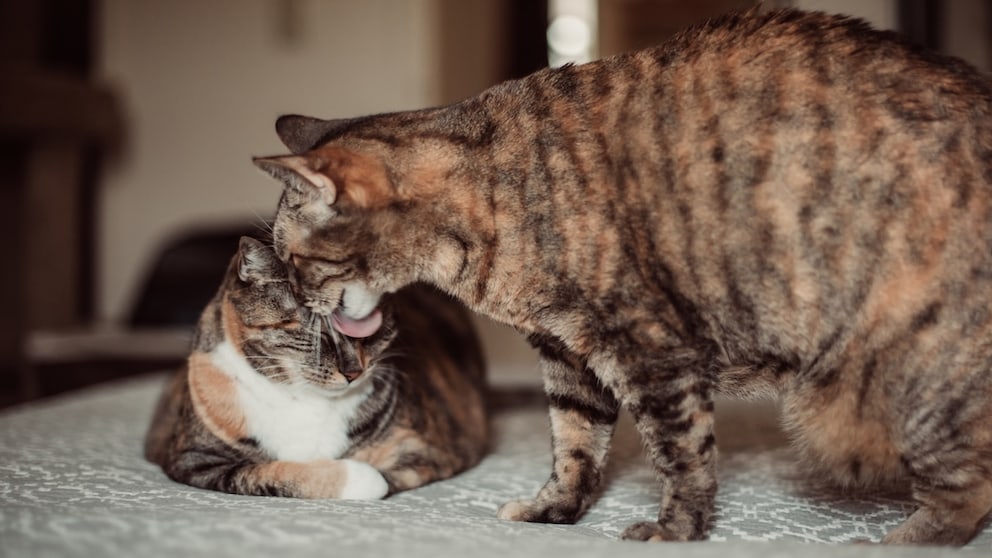
When two cats groom each other, many owners see it as a sign of a particularly close friendship. But this widespread belief is now being challenged. A new study shows that while mutual grooming can express affection, it can also be a sign of stress or an underlying conflict between the animals.
Mutual Grooming Has Two Faces
In a study, researchers from Ghent University and the University of Lincoln analyzed video recordings of 53 pairs of cats from multi-cat households. The scientists observed two completely different situations in which cats groomed each other:1
- On one hand, the behavior occurred in relaxed cats that sought close physical contact, lay next to each other, and synchronized their body postures. This was often followed by playful wrestling—a possible indication that grooming can indeed strengthen social bonds.
- On the other hand, the same behavior was also observed in cats showing signs of tension.
Stress Could Also Be Involved
In some situations, cats would turn their ears back, lick their lips conspicuously often, or shake their heads while grooming. Sometimes, paw swipes or bites preceded or quickly followed the grooming. According to the researchers, these behaviors could be displacement activities, indicating an internal conflict or stress between the animals.
However, this does not necessarily mean that the cats do not like each other. Rather, mutual grooming seems to serve different functions depending on the situation. It can both create closeness and help reduce tension between the animals.

Does Your Cat Groom Itself After Being Petted? Here’s What It Really Means

“If You Blink, I’ll Blink Back!” How Dogs React to Other Dogs
Not Every Grooming Cat Is Friends With the Other
The researchers also found it interesting that cats primarily licked each other’s heads and ears. These are areas they can hardly reach themselves, suggesting that mutual grooming might have a practical benefit beyond social aspects. However, whether fur care is the primary focus could not be determined by this study.
It was also surprising that related or co-raised cats did not groom each other more frequently than those without close familial ties. All groups exhibited the behavior. Therefore, a particularly close friendship between two cats cannot be identified solely based on this, the researchers noted.
The Overall Impression Is Key
The researchers’ conclusion is therefore much more nuanced: Mutual grooming is not automatically a sign of love. If both cats appear relaxed, voluntarily seek physical contact, and remain peacefully together afterward, it suggests a positive social relationship. However, if they show pinned-back ears, stress signals, or aggressive behavior, grooming can also be part of a conflict-ridden situation.