

September 18, 2026, 3:42 pm | Read time: 5 minutes
Social media is full of tips, training tricks, and supposed life hacks for cats. But do these recommendations really deliver what they promise? PETBOOK asked Helena Becker, a behavior therapist and trainer as well as a professional cat sitter, to weigh in on some popular trends.
Cat Chews on Leaves: Does Lemon Help?
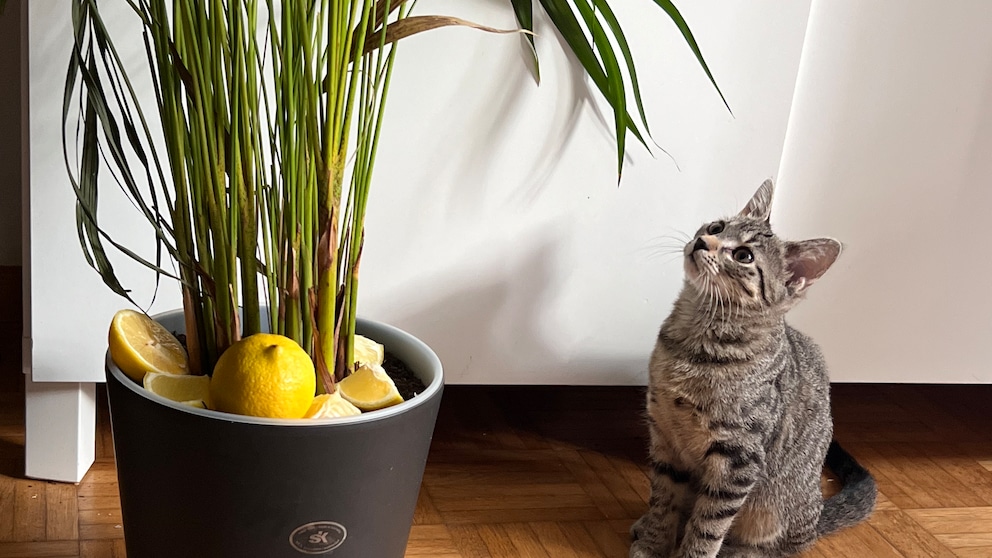
If a cat constantly nibbles on houseplants, many owners feel desperate. That’s why numerous training tricks circulate on social networks about how to keep cats away from leaves and flower pots. A common recommendation is to spray plants with lemon juice or place lemon slices in the soil. However, this can become a problem: Lemons and other citrus fruits are toxic to cats and can cause gastrointestinal issues, loss of appetite, and neurological symptoms.
Also interesting: These houseplants are safe for cats
Helena Becker, a behavior therapist and trainer as well as a professional cat sitter at “Stubentiger Berlin,” advises: “As always with such ‘tips,’ one must strongly question the expertise of the person.” In a Reel, a cat owner sprayed lemon juice on plant leaves. “She wants to make her life easier but does not consider the species-specific needs of cats when they exhibit certain behaviors,” Becker explains.
Of course, it’s understandable that owners want to protect their plants. However, the seemingly simple solution is problematic. Such methods are considered aversive measures, according to Becker. These include sprays and the use of lemon, which are intended to trigger avoidance behavior in cats.
Helena Becker explains: “The problem is that it causes stress, can shake the security in their core territory, and is not well thought out.” Living together on equal terms should not be based on punishment and deterrence, says the behavior expert.

Cat Digs in Potting Soil? Understand the Cause First
There are always tips circulating to cover flower pots with larger stones to prevent cats from digging in the soil or eating it. For Becker, such measures are not an option. “People think very one-dimensionally: Cat does something, it should stop. Instead of considering: Why is it doing that?” she says. Various needs could be behind the behavior, such as engagement, curiosity, play behavior, or the desire for a specific substrate.
If you want to change the behavior permanently, you should understand the cause and what need the cat has behind it, Becker explains. “And then see how to fulfill this in cohabitation while keeping your furniture and plants unharmed.”
Forbidding Scratching? Cats Mark for a Reason
Many owners resort to supposed training tricks for cats to protect their furniture from scratching. However, they often overlook why cats scratch in the first place.
“For example, scratching objects: Cats mark by scratching, they have scent glands in their pads that other cats can read,” Becker explains. At the same time, they leave visible signals. “They also mark visually by scratching particularly intensely or high. They communicate with other cats this way.”
The behavior serves multiple functions. According to the behavior expert, cats place such markers at strategically important places for themselves. Becker cites examples: to calm themselves or to show that their territory is regularly maintained. Therefore, Becker is not in favor of blanket bans or deterrence. “Everything cats do has a purpose, and it would benefit these creators to focus less on human problems and more on explaining why cats do or don’t do something. They simply lack the knowledge for that,” Becker criticizes such tips.

Everyone Thought Lilly Was Unclean–yet She Was Silently Pleading for Help

These Houseplants Are Safe for Cats
Water Guns, Ultrasound & Co.: Why Punishments Unsettle Cats
In addition to lemons, water guns, ultrasound devices, or other deterrent methods are also shown on social networks. Becker advises against these as well: “There are also devices that produce special sounds to keep cats away from something. Water guns are part of that. But also electric impulses, if we want to think even further.”
Such methods may temporarily stop cats from a certain behavior. However, the problem is usually not solved. Instead, Becker advocates for positive alternatives: “Cats should be redirected and given great alternatives, and boredom in everyday life should be reduced through exciting and positive stimuli.” Playing with a favorite toy is particularly suitable as a positive alternative.
Behavioral Problems Aren’t Solved with Online Tricks
For Becker, many viral training tips show one thing above all: The actual needs of the cat are often ignored. If you want to change behaviors permanently, you should focus on understanding rather than deterrence. “Training, handling, understanding–no aversive measures that can lead to severe insecurity, stress, fears, and behavioral problems in cats. Who really wants to risk that?” says the expert.
Her conclusion: “Living with cats on equal terms doesn’t work with a few tips, but with engaging with what they need.” If these needs are not met, cats will find other ways. “If you don’t deliver on one side, cats will find a way to express their needs for variety, suitable scratching opportunities, etc., in other ways.”