


April 9, 2026, 10:57 am | Read time: 5 minutes
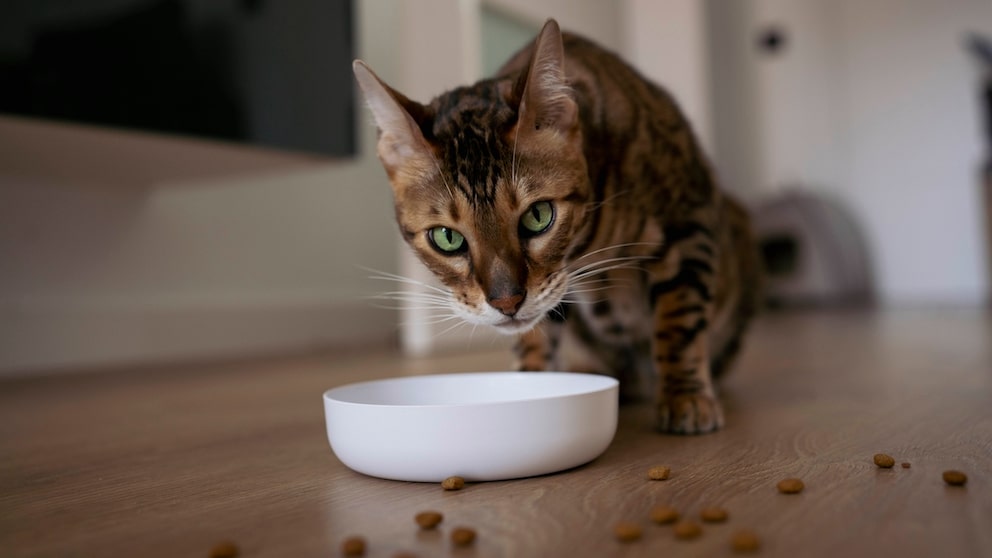
The bowl is still half full–and yet the cat just walks away. Many owners then wonder: Is she already full? Or does she not like it? A study may have found the answer to why the cat doesn’t finish her food.
When the Bowl Stays Half Full
Perhaps you’ve experienced this yourself: Your cat eats a few bites, then turns away–and as soon as you open a different type of food, the interest is suddenly back. Many believe it’s simply because the cat prefers the new type and will fuss until the desired food arrives. However, the behavior actually has a different reason, as a study has now been able to prove for the first time.
What Exactly Was Investigated?
A research team led by Takumi Takahashi from Iwate University in Japan wanted to better understand why cats often stop eating even though there’s still food in the bowl. To do this, the scientists observed twelve house cats under controlled conditions.
The animals were offered food multiple times in succession after a longer feeding break. Sometimes it was always the same type, sometimes it varied. Particularly interesting: In some trials, only the smell was changed, without the cats being able to eat the new food at all. This allowed for a targeted investigation of the influence of scent alone.1
Always the Same Food? Interest Drops Rapidly
The results were quite clear. When the cats were repeatedly given the same food, they ate less with each round. And this was despite having not eaten for a long time beforehand. Even particularly tasty food quickly lost its appeal if the smell remained the same.
This suggests that hunger alone does not determine how much a cat eats. Instead, the attractiveness of the food–and especially its smell–seems to play a central role.
A New Scent–and Suddenly It Continues
However, as soon as something new came into play, the behavior changed significantly. When a different food was offered, the cats immediately ate more. Particularly surprising: It was enough for the animals to simply perceive the scent of new food. Even if they weren’t allowed to eat it, their motivation to eat increased.
Conversely, the opposite effect was also observed. When cats were continuously exposed to the same scent, such as between feedings, they ate even less overall. The scent alone can apparently determine whether the cat has an appetite or not.
What Lies Behind Habituation and the “Reset Effect”
The researchers explain the cats’ behavior with a mechanism known from other areas. When a stimulus–in this case, the scent of food–is repeated, the brain becomes accustomed to it. The stimulus loses its effect, and interest decreases. Experts refer to this as “habituation.”
When a new scent comes into play, a sort of reset occurs. The cat reacts more strongly again, interest increases, and she continues to eat. This principle is called “dishabituation.” For cats, this means quite concretely: A new scent can “turn on” the appetite again.
Accordingly, cats quickly lose interest in food if its scent remains the same. So it’s not necessarily that the cat doesn’t finish her food because she’s full. Rather, the scent seems to become simply “boring” to her. On the other hand, when a new scent comes into play, the desire to eat can suddenly return. The cat often continues to eat, even though she had stopped shortly before.
Why This Perfectly Fits Cat Behavior
This fits remarkably well with the natural behavior of cats. As solitary hunters, they eat many small prey animals throughout the day in the wild. Each prey smells different, tastes different, and brings new stimuli.
That cats respond to variety and quickly lose interest with constant stimuli could be an evolutionary advantage. It ensures that they are repeatedly motivated to eat without consuming large amounts at once.
What the Study (Still) Can’t Answer
As exciting as the results are, they also have their limitations. Only twelve cats were studied, which also differed in age and living conditions. Additionally, the tests took place over a relatively short period, which does not fully reflect a cat’s daily life.
The exact processes in the body, such as in the brain or with hormones, were not directly measured. So it remains unclear how exactly the scent biologically triggers these effects. However, the observed connections are considered well-established.

Cat Sniffs Food but Doesn’t Eat? Here’s What’s Behind It

Cat Needs an Appetizer Before Eating! Possible Reasons
What Does This Mean for You and Your Cat?
For everyday life, the study provides a pretty clear explanation for a behavior that many cat owners know. If your cat seems picky or quickly loses interest in food, it can help to provide some variety.
This doesn’t mean constantly changing the entire food. Even small changes in scent can make a difference. Often, it helps to add some new food to the old or sprinkle something over the food.
At the same time, the study also explains why many cats prefer to eat several small meals throughout the day rather than one large portion at once. Nutrition and behavior experts for cats have long recommended feeding cats many small portions rather than just twice a day.
Conclusion: The Nose Decides Too
The study clearly shows that the scent of food plays a central role in why the cat doesn’t finish her food. When the scent becomes familiar, it loses its appeal. When something new is added, the appetite can immediately return.
Or put another way: If your cat leaves the bowl, it’s not necessarily because she’s full. The scent may simply not be exciting enough anymore. Because cats don’t just eat with their mouths–but especially with their noses.