

November 16, 2026, 12:50 pm | Read time: 3 minutes
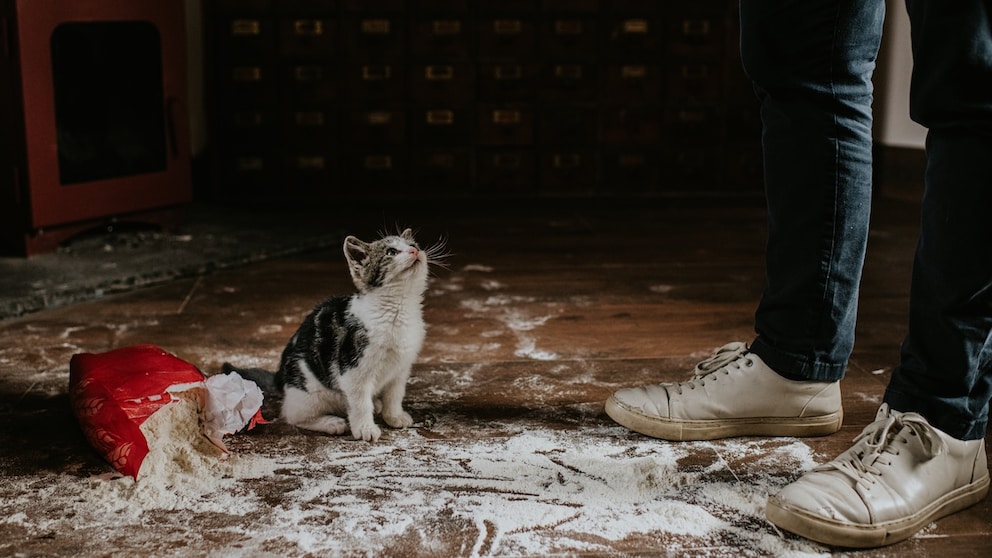
The chaos is set, the cat sits in the middle and looks up at its human with big eyes. For many owners, it’s immediately clear: She knows exactly what she did. But the seemingly guilty look actually means something entirely different.
Do Cats Feel Guilt?
A direct sensation of guilt or shame cannot be proven in cats. Veterinarian Sandra C. Mitchell writes on the PetMD portal that cats do not feel guilt or remorse like humans. Guilt requires evaluating one’s actions. A cat that knocks items off a shelf acts according to its instinct, not because it wants to do something “bad.”1,2
Why Does My Cat Look Guilty Then?
When a cat hides or keeps its distance after a mishap, it’s usually due to fear of the consequences, such as the owner’s reaction. Flattened ears or a crouched posture can quickly appear to humans as an admission of guilt. However, they are often misinterpreted.
Also interesting: How well do you understand your cat? One in four fails
What Does the Research Say?
We haven’t found a study on cats and guilt. However, the “guilty look” in dogs is well-researched. Psychologist Alexandra Horowitz found in 2009 that dogs showed typical guilt signals more often when scolded, regardless of whether they had done something forbidden. Notably, innocent but scolded dogs showed more of these signals than those actually guilty. The Tufts Collaborative for Shelter Dogs summarizes that this look alone does not mean the dog knows of a wrongdoing. It is a reaction to being scolded.3,4
Whether this can be directly applied to cats is not proven. However, it aligns with what experts say about cats: Their body language likely shows insecurity or fear rather than remorse. Additionally, research by Moriah Galvan and Jennifer Vonk indicates that cats respond only slightly to human emotional signals, most notably when shown by their own owner.5

Can Dogs Really Feel Shame? Here’s What a Biologist Says

Understanding Cats Better — Body Language and Behavior Explained
What About Purring and Head Bumping?
After a conflict, cats sometimes show reconciliation gestures like head bumping, purring, kneading, or slow blinking. According to PetMD, these are not apologies. They are meant to improve the mood.
What Should Owners Do?
Harsh punishment is ineffective. It can even increase the cat’s fear. Behaviors like scratching, urinating outside the litter box, bringing in live prey, or biting are normal for cats. To reduce them, PetMD suggests:
- first checking with a veterinarian if a medical issue is causing the litter box problems
- providing a scratching post
- having one more litter box than the number of cats in the household
- engaging the cat with interactive play