


August 13, 2026, 10:50 am | Read time: 4 minutes
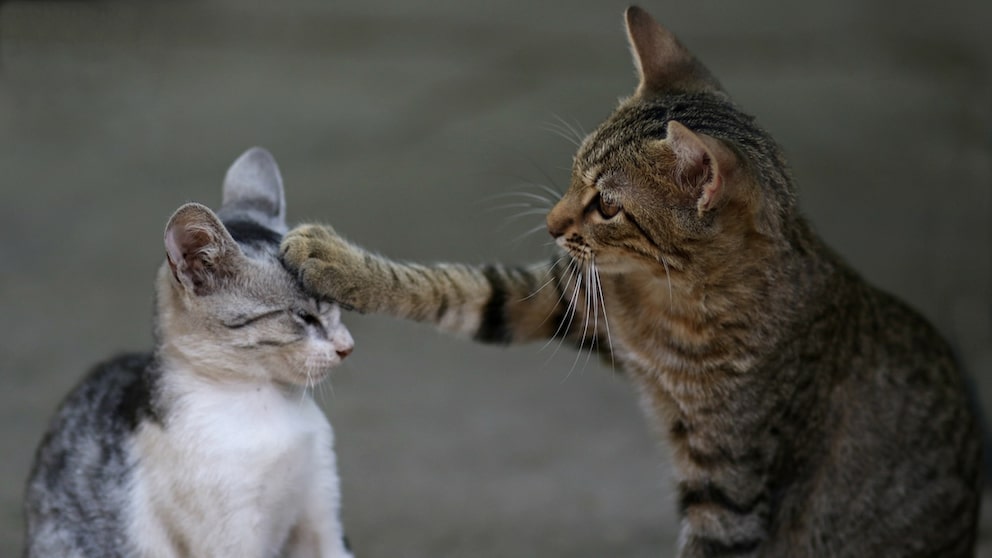
Anyone with multiple cats knows the situation: One always pushes to the bowl first, while the other prefers to hang back. It quickly seems like one cat is in charge. But is there really a hierarchy among cats? PETBOOK editor and cat behavior expert Saskia Schneider explains what’s behind this myth.
For Cats, Territory Matters–Not Rank
Observing cats living together might lead one to think there’s a “boss.” But unlike dogs or wolves, cats are not pack animals. Their social life revolves around territory, not an alpha animal.
Cats are territorial solitary hunters—each territory has a core area with food and sleeping spots, as well as a roaming area that often overlaps with other cats. When two cats meet in such an area, it’s not physical strength or “rank” that decides, but simply the question: Who is in the “right place at the right time”? Whoever claims the territory has priority—even if the other cat is stronger.
Living Together in Cat Groups
Where cats live in colonies in the wild—such as around farms, fish markets, or garbage dumps—surprisingly complex social structures emerge. Related females, in particular, form close communities: They raise their young together, share nests, groom each other, and defend the young. Friendly relationships between unrelated cats also occur and are reinforced by greeting rituals like nose contact, mutual rubbing (allorubbing), or sleeping together. 1
Group scent is important: Only those who “belong” smell the same. Intruders, on the other hand, are often driven away forcefully. In cats, position in the structure is not determined by rank but by bonds, personality, and situational advantages. Thus, cat groups are not rigid hierarchies but flexible networks—characterized by cooperation, but also by distance when necessary.
Why There Is Still a Hierarchy Among Cats
It’s not entirely without hierarchy. Especially in free-living colonies that form where food sources are plentiful, subtle hierarchies can be observed. These are based on age, gender, and experience. Older females often have priority access to resources. For males, it’s more combative: Unneutered males establish their social status through ritualized confrontations—usually loud, hissing, and impressive, but rarely bloody. 2
But these hierarchies among cats are flexible and situational. The one who gets the best spot today might voluntarily retreat tomorrow. Cats dynamically adjust their relationships—there is no rigid pecking order.
Hierarchy in Multi-Cat Households?
In households with multiple cats, the availability of resources plays the biggest role. If there are enough feeding stations, sleeping spots, and retreats, cats can live together peacefully–often even forming close bonds with mutual grooming or cuddling.
However, if resources are lacking, tensions arise: Some cats block access to bowls or litter boxes, while others withdraw or react aggressively. 3
It’s especially important to enable conflict avoidance: multiple feeding stations, enough litter boxes (rule of thumb: one per cat plus one extra), and escape options. This can prevent many “rank battles,” which are actually just competition for resources.

Is There a Hierarchy Among Dogs? Expert Explains

Is There Bullying Among Horses? Here’s What the Expert Says
The Myth of the “Alpha Cat”
The term “alpha cat” has become established—supposedly a dominant animal that calls the shots. But that’s a myth, derived from outdated ideas about wolf packs. Cats don’t have submission rituals like dogs. When a cat rolls onto its back, it’s not signaling “I give up,” but “I’m ready to fight—here are my claws.” Slow blinking or looking away are not gestures of submission, but polite de-escalation. 4
The label “alpha cat” is therefore misleading. It’s usually just a misunderstanding: A cat that meows demandingly, wakes its humans in the morning, or drives away other cats is not acting out of dominance, but motivation—hunger, playfulness, pain, or the need for attention.
Conclusion
Cats are not hierarchy animals in the classic sense. Their social behavior is more subtle, flexible, and primarily determined by territory. Hierarchies exist, but they are situational and not rigid. More important than a “boss cat” is the question: Are there enough resources to meet all needs?
Those who understand cats don’t see dominant “alphas,” but fascinating little strategists who shape their coexistence with looks, scents, gestures, and skillful retreat. And therein lies the magic: Cats live by their own rules—and we get to watch.
About the Author
Dr. Saskia Schneider is a biologist with a Ph.D. During her studies at the Free University of Berlin, she focused primarily on zoology and animal behavior. In addition to training as an editor, she completed training as a behavior consultant with a focus on cats.