

March 9, 2026, 4:11 pm | Read time: 6 minutes
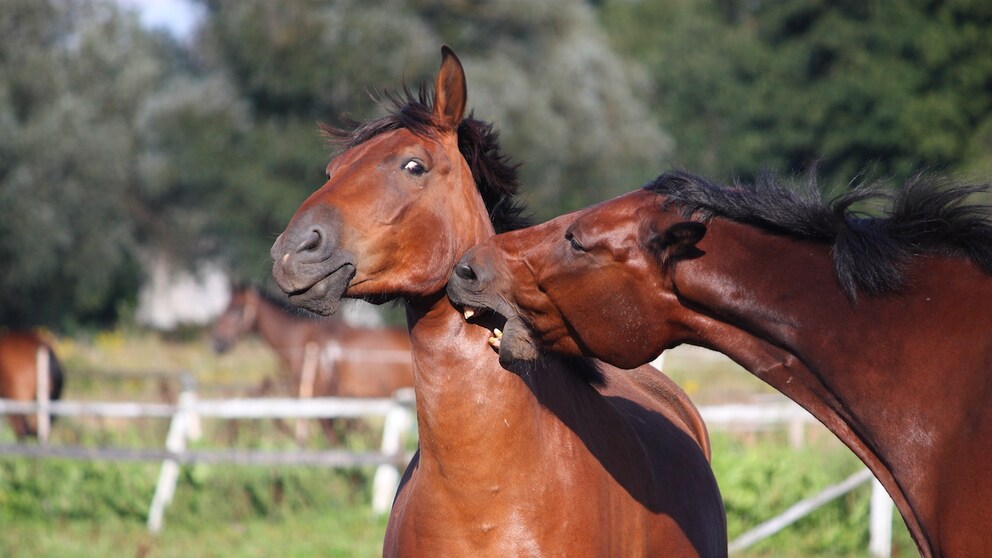
A new horse arrives at the stable–and a few days later, it has bite marks. In the paddock, it’s sent away, and at the hay, it stands on the edge. A word quickly circulates in the stable: “bullying.” But does bullying actually exist among horses? PETBOOK asked biologist and Ph.D. in equine science, Dr. Vivian Gabor.
How does a horse herd fundamentally function?
To determine if bullying really exists among horses, we first need to understand how a horse herd actually functions. For this, PETBOOK consulted biologist and Ph.D. in equine science, Dr. Vivian Gabor. She is the head of the Institute for Behavior and Communication (IVK), a training center for equine behavior trainers. Dr. Gabor explains: “Horses are highly social animals and naturally live in stable social groups. They show preferred social partners (such as grazing together, mutual grooming, proximity). These are often referred to in ethology as affiliative relationships–comparable to friendships.”
Many horse owners recognize this in their animals: No matter when you visit the paddock, you always find the horse with the usual suspects. This quickly gives the impression that horses can also have best friends. These social bonds are also important for safety, stress reduction, and coordinated behavior, such as resting or group movement, says Dr. Gabor. However, it remains true: “Conflicts occur but are usually ritualized through body language and threat gestures, so serious fights are rare.”
Another characteristic of a horse group is described by Gabor as follows: “Within the herd, individual animals also more frequently take on certain roles.” The expert further explains: “For example, in observing the surroundings or leading movements, which provides the group with overall protection and orientation.” This is especially true in the wild.
Is there such a thing as “bullying” among horses?
In some horse groups, tensions quickly become apparent. This behavior is often labeled as “bullying.” But is this term even accurate–and does bullying exist among horses? Dr. Gabor says: “The term ‘bullying’ comes from human psychology and describes deliberate, systematic exclusion with the intent to harm.” According to the expert, this concept can only be applied to horses in a very limited way.
What we interpret as exclusion usually follows clear rules within the herd. “Horses do not act out of strategic malice but respond situationally to resources like space, food, or safety. Conflicts usually serve a functional role in the social system and help clarify distance and responsibilities,” explains Dr. Gabor.
At the same time, the expert points out that ongoing tensions within a group should not be hastily individualized: “If individual animals are still consistently under pressure, the cause often lies less in the horses’ social behavior itself and more in unfavorable living conditions or an unsuitable group composition.”
Is there a fixed hierarchy–and how stable is it?
The idea of a clear, top-down hierarchy persists. However, the social structure of a horse herd is not that simple. Dr. Gabor describes the structure more like this: “Instead of a rigid ‘hierarchy,’ behavioral biology refers more to relationship networks.” Horses do have individual dominance relationships–that is, who yields to whom in certain situations–but these are context-dependent, the expert further explains.
The key is the specific context: resources, environment, and the animals involved play a role. The behavior expert describes: “A horse can be dominant at feeding but yield when it comes to access to water or resting areas. Additionally, the social structure changes with age, experience, health status, or new group members.”
No bullying–but when does it become critical?
Even if the term “bullying” is not technically applicable to horses, many owners are concerned about where the line between everyday social dynamics and a serious issue lies. When are tensions within the herd still part of normal interactions–and when is action needed? The expert says: “Threat gestures and brief altercations are normal and necessary to regulate distances. It becomes problematic when a horse consistently has no access to resources like food, water, or resting places or is constantly driven away.”
Only when such situations persist over time can noticeable consequences arise: “Then chronic stress can develop, which can also be physiologically measured, such as through changes in heart rate variability.” According to the expert, such situations usually indicate management problems rather than ‘malicious’ behavior by individual horses.
What typical misinterpretations do you observe among horse owners?
“A common mistake is anthropomorphizing horse behavior. People quickly interpret altercations as ‘bullying,’ ‘jealousy,’ or ‘malice.’ In reality, horses follow very clear, evolutionarily developed communication patterns.”
The expert further explains that threatening, pinning ears, or sending away are usually not aggression in the human sense but a clear and efficient form of conflict avoidance.
How strongly does the type of housing influence social behavior?
The expert clearly assesses the role different housing systems play in social dynamics: “The type of housing has a significant impact on social behavior. In spacious open or active stables with enough space and multiple feeding stations, horses can more easily avoid conflicts.”
But where space and resources are scarce, the social structure is more easily stressed. “In small groups or confined systems, tensions arise more frequently because there are no escape options,” the expert explains. Dr. Gabor further elaborates: “Situations are particularly critical when essential resources–such as hay or water–are not simultaneously accessible to all animals.”

Why Tapping a Horse’s Neck Is Often Not a Compliment

Are Mares in Heat Really More “Moody”?
How to avoid stress when integrating
When a new horse joins an existing group, it’s always a sensitive moment. How well the integration succeeds depends less on chance and more on preparation and conditions. Gabor advises: “The integration of new horses should be as gradual and well-prepared as possible. Ideally, there should first be visual and olfactory contact over fences before the animals have direct contact.” Additionally, sufficient space helps horses maintain distance.
Besides patience, practical organization also plays an important role: “It’s also important to offer multiple feeding places so that lower-ranking animals are not displaced. Careful group planning significantly reduces conflicts and promotes stable social relationships.”
Harmony is no accident
Whether close bonds, brief scuffles, or new group members–the social life of horses is complex. It often seems simpler than it is. Those who look closely and don’t anthropomorphize too quickly will recognize the connections.
Many conflicts are part of effective communication. The key question is not about “blame” but about the conditions. Sufficient space, good management, and an understanding of natural needs make the difference. Harmony in the herd is no accident–it’s the result of good conditions. Those who create them enable horses to have a social life that suits their nature.