

April 10, 2026, 8:16 am | Read time: 5 minutes
In cities, road traffic poses an underestimated danger for many animals—especially cats. More and more owners are opting against letting their cats roam freely and choosing indoor-only living. But can a cat truly live appropriately in a confined space? And what conditions must be met for them to feel comfortable? Moreover, does the animal protection law say anything about how much space cats really need?
How Much Space per Cat Is Sufficient?
The German Animal Protection Law (TierSchG) stipulates in Section 2 that every animal must be housed in a manner appropriate to its species and needs. It also prohibits restricting an animal’s ability to move in a way that causes pain, suffering, or harm. However, the law does not specify exact square footage—leaving the legal interpretation open.
The Veterinary Association for Animal Welfare (TVT) outlines minimum requirements for cat housing in its leaflet 189 in somewhat more concrete terms:
- For one to two cats, a minimum floor area of 20 square meters with at least two meters of room height is required.
- The rooms should be structured—with multiple levels, retreats, and climbing opportunities, allowing the animals to use the space three-dimensionally.
- Additionally, the rule of thumb is that the number of cats should correspond to the number of rooms that are constantly accessible.
To clarify the vague legal term “appropriate housing,” courts and professional organizations rely on recommendations like these.
Square Footage Not Decisive for a Cat-Friendly Household
Animal welfare advocates and shelters also have wishes for their charges. It is often stated that a cat should have at least 50 square meters of living space. For two animals, at least 60 square meters is considered a guideline. These figures are intended to ensure that cats have sufficient freedom of movement and opportunities for activity. This is especially important when roaming is not possible. However, this is the ideal case, which is not always possible in small city apartments.
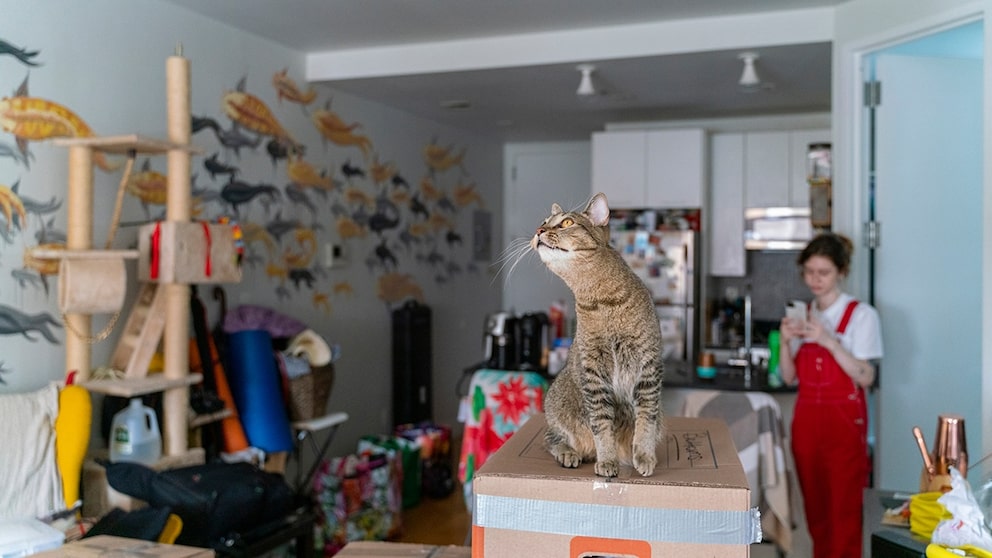
However, this does not have to be a criterion for excluding cat ownership. The key is not just the area but the design of the living space. A well-structured, varied apartment can be cat-friendly even in a smaller space—whereas a bare, sparsely furnished area may not be, even at 80 square meters.
Berlin Court Sets Minimum Standard
How closely animal welfare and housing rights can be intertwined is shown by a ruling of the Berlin Court of Appeals on June 3, 1991 (Case No.: 24 W 6272/90). A cat lover kept up to 14 cats in his 42-square-meter apartment. After massive odor nuisances in the hallway, a neighbor filed a complaint—and won. The court ruled that no more than four cats were allowed in an apartment of this size.
The ruling stated that keeping a larger number of animals in such a small apartment exceeded the scope of proper use of residential property (Section 14 No. 1 WEG). Even the justified concern of an odor nuisance was sufficient to justify a restriction. Thus, the Berlin Court set a clear boundary between animal love and reasonableness—also in terms of animal welfare and neighborly consideration.

Can You Keep Raccoons as Pets in Germany?

Can a Landlord Prohibit a Cat? What the Law Says
Cat-Friendly Apartment Design
An indoor cat needs exercise, stimuli, and retreats. Essential are:
- Cat litter box(es)—clean and quietly placed
- Scratching and climbing opportunities—scratching post, wall shelves, or windowsills
- Toys and interaction—for mental and physical engagement
- Retreats—caves, boxes, or elevated sleeping places
Especially for single cats, humans must compensate for the lack of social contact with other cats through attention and play. If a cat is permanently under-stimulated or confined, it can lead to behavioral issues such as nighttime meowing or uncleanliness. This is a warning sign of poor well-being.

Whether 42 or 72 Square Meters, It’s Not Decisive
“I still remember the pre-visit before I was allowed to adopt Remo the cat. Of course, I was nervous, but I had already thought about how I could make the space usable for the Spanish shelter cat. I had made an effort: a sturdy scratching post, a quiet corner for the litter box, a resting place on the windowsill. The apartment was small at 42 square meters, but it had enough structure.
My first cat, Minka, had even less space—but she chose it herself. Sixteen square meters in my youth room, and she was happy. She loved the bed, the windowsill, and the quiet hours when nothing happened except our togetherness. She only used the rest of the house on her way outside.
Since then, I am convinced: It’s not the square meters that count, but the care you share. An apartment can be small—as long as it is set up for cats and the relationship with the animal is right, it doesn’t matter so much. Remo now has significantly more space. In the new apartment, he has 72 square meters available, with many corners to romp, climb, and doze in the sun—and yet he prefers to stay on the same square meter as me.”
Conclusion: Indoor Cat–Yes, but with Responsibility
A cat can live appropriately indoors—if its needs are taken seriously. Key factors are sufficient space, a varied room structure, opportunities for activity, and human attention.
The animal protection law sets the ethical framework, the TVT recommendations specify the animal welfare minimum requirements, and the Berlin Court ruling shows where the legal limits lie. Those who consider these aspects create a home that allows a cat-friendly life even without roaming—for the well-being of the animal and in harmony with the neighbors.