

July 31, 2026, 6:22 am | Read time: 7 minutes
Cats often reappear at home after days, weeks, or even months. For many, this seems like a small miracle. Researchers suspect that the animals’ remarkable sense of direction is due to an innate instinct–though not all questions have been answered. My two cats could hardly be more different: While Minka always wanted to go outside, Remo hardly ever leaves the balcony voluntarily. PETBOOK explains why some cats seemingly never forget their way home.
Adventurer with an Inner Compass vs. Total Rejection of the Street
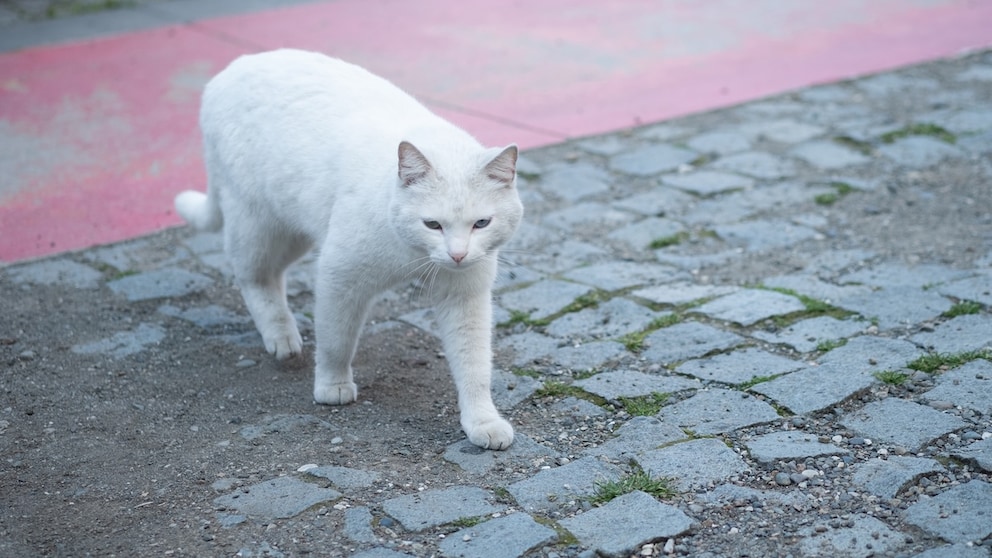
Let’s start with my personal example. My white cat Minka was rescued at seven months old from an inbreeding colony by a friend who is an animal rights activist. Once she arrived and settled in, it became clear: This animal needs freedom. Just a few days later, she stood at the door with perked-up ears and meowed as if to say, “I’d like to go out, but I’ll come back!” And she always did. Sometimes after one hour, sometimes after 72 anxious “Where is my cat?” hours, often with clumps of dirt on her fur and paws and sparkling eyes, as if she’d had the time of her life.
How did she find her way? Her senses seemed perfectly tuned: She knew the sounds of the area, the smells of the neighborhood, and most importantly, the exact timing of my return, including the sound of my footsteps on the path. I can recall many days when she was already there when I got home, or she would nonchalantly stroll around the corner, as if to say, “You were particularly slow biking today, I’ve been waiting.”
My current cat is completely different: Remo, orange and white, a Spanish street tough, whom I thought would never give up roaming. But it turned out quite differently. The first attempts to get Remo used to roaming were a complete failure. On the first try to let him into the yard, he backed away, crouched, and sought refuge in a hole in the ground.
His time in Spain left deep marks. On the street, he had to fight. In the shelter, he hadn’t lost his urge for brawling and would beat up other cats, which led to him sitting alone in his cage. Only at his foster home near Granada did he calm down and show his human-loving, affectionate side. Today, Remo seems to have no desire to go outside–perhaps because he associates it with “homelessness” or the loss of a home, which means security to him. For him, our living room is his universe, the balcony the only contact with the outside world he wants.
There Are Many Theories on Why Cats Always Find Their Way Home
Some cats reliably return from long excursions–others don’t dare step outside. Why this is, like much about our house cats, is not conclusively understood. However, there are several theories, some more plausible than others. Among them is astronavigation: Some researchers suspect that cats orient themselves by the position of the sun, as has been proven with migratory birds. Another speculative theory is the morphic field, which assumes an energetic connection between the animal and the place.
However, it is agreed that cats have an excellent sense of direction. This is based on a combination of highly specialized senses that complement each other. A cat’s sense of direction is not a single tool but a finely tuned interplay of many sensory inputs:
- Sense of Smell: With about 200 million scent receptors, cats are true sniffers. They can pick up scent trails over long distances. Even the smell of a distant flower bed or their home environment can serve as a guide.
- Hearing: Their highly sensitive hearing allows them not only to perceive a wide frequency spectrum but also to precisely locate sound sources. Scientists believe that certain soundscapes, like the rushing of a stream or the ringing of a bell, create “sound images” that cats memorize and later recognize.
- Seeing in Low Light: Thanks to their eyes optimized for twilight, cats keep track even in low light. Landmarks are easily recognizable even in the dark.
- Sense of Touch and Vibrissae: The sensitive whiskers on their snout and legs–called vibrissae–detect even the smallest air currents. This helps cats especially in estimating distances and navigating through narrow passages. With these senses, they explore their surroundings precisely.
- Magnetic Field Perception: There is now considerable evidence that cats–similar to birds or turtles–can perceive the Earth’s magnetic field. This ability could serve as an inner compass, especially in unfamiliar terrain.
What’s Behind the Magnetic Field Theory?
Scientists have already examined the theory of magnetic attraction in more detail. V. B. Pavlenko and A. M. Kulichenko from Tavrida National University in Simferopol, Ukraine, addressed the topic in 2004 and published their findings in the journal “Biophysics.”
The aim of the study was to find out how low-frequency (8 Hz) and high-frequency (51.47 GHz) electromagnetic fields (EMF) affect the behavior of cats. The focus was particularly on the neuronal activity in the so-called locus coeruleus (LC). This is a region in the brainstem that plays a central role in processing attention, emotions, and reactions.
In addition to analyzing neuronal activity, the behavior of the animals was also examined. It was found that under the influence of modulated electromagnetic frequencies, the activity of neurons increased significantly. Especially low-frequency fields can influence behavior and movement. The affected LC neurons play a central role in attention, motor control, and emotional response. Cats are therefore highly capable of sensing magnetic fields and respond strongly to them neuronally. 1
Not Every Cat Wants (or Can) Return
This would explain why Minka reliably found her way back after every outing: She had memorized her new home on all levels. Sounds, smells, lighting conditions–a cat apparently stores all this like we humans do a photo album.
However, the homing instinct is not equally strong in every cat. A cat that doesn’t know or want to roam won’t be able to orient itself in the same way as those that do. Cats that live only indoors and accidentally or incidentally get outside never stray far from home. They are more likely to seek refuge where they won’t be seen. My colleague Saskia Schneider shares her personal experience on this topic here: What You Should Do Immediately If Your Cat Runs Away.
Perhaps in cats like Remo, the fear of the unknown prevails. And this makes it clear: The emotional compass is just as important as the senses. Only those who truly feel at home somewhere want to return there–or stay there in the first place. Because alongside biological senses, the emotional bond to a familiar territory plays a central role. Scientists believe that this imprinting is a key factor in a cat’s desire to return home. This also explains why some cats eventually don’t come home, especially if there was no close bond to home and owner.

Why Does My Cat Follow Me to the Toilet?

Doing Yoga With Your Cat? Editor Offers Tips on Strengthening Your Bond
What You Can Do to Help Your Cat Get to Know Its Environment
For this reason, experts advise keeping newly arrived cats indoors for several weeks. During this time, the animal memorizes the environment–visually, olfactorily, and acoustically–and accepts it as a new retreat.
Cats rarely leave their home intentionally–they are often distracted by external stimuli or caught in unfamiliar situations. Common reasons for their disappearance include:
- Mating behavior in unneutered animals
- Territorial fights with other cats
- Hunting instinct: Prey or a place with many rodents can attract them
- Illness or injury: Some animals then seek shelter under porches or in barns
- Foraging: Feeding neighbors or garbage sites can be appealing
- Changes at home: New people, animals, or construction work can cause stress
Animal catchers or organizations like the animal shelter might have taken in the animal–a call is worthwhile.
How to Take Precautions
Whether an adventurer like Minka or a recluse like Remo, our job as owners is to meet the individual needs of our cats. Even though many cats find their way back, owners should not rely solely on this ability. Those who allow their cat to roam should have it chipped, neutered, and give it enough time to acclimate. These measures can prevent many dramas and increase the chances of a safe return.