

October 14, 2025, 12:00 pm | Read time: 6 minutes
Mouse collector, deity, messenger of Satan, or beloved family member. The history of the cat is long and marked by ups and downs. In ancient Egypt, the house cat was particularly polarizing. It was worshipped as a deity to the point of fanaticism, leading some later civilizations to mock it.
Cats and humans share a long, intertwined history full of ups and downs. But how did the cat come to us, and what relationship did ancient peoples have with one of the most popular pets? PETBOOK presents the history of the cat in ancient Egypt, when the cat was worshipped like a god, and the cult around the animals took on fanatical proportions.
The History of Cats in Ancient Egypt
It was long assumed that the cat as a pet originated in ancient Egypt, but domestication occurred differently, as you can read in the first part of the PETBOOK series “The History of the House Cat”: How Cats Were Domesticated.
Before the first Neolithic find, especially on Cyprus, it was long assumed that the history of the house cat began in antiquity. It is well known that people in ancient Egypt revered these animals and created deities in their image. Killing or injuring a cat was punishable by death in the late period of the great empire.1
The cult around cats in Egypt likely also arose because they kept mice and other small animals that fed on grain away from the supplies and caught them there. In the land along the Nile, a strict storage economy prevailed. The harvested grain had to last an entire year until the next Nile flood and harvest period. Because cats kept grain-eating animals away from the stores, the people in ancient Egypt were grateful and saw the animals as useful.2
Cats Had Their Own Goddess in Ancient Egypt
Indeed, there is even an Egyptian cat goddess who had her own temples and was worshipped. The goddess Bastet, sometimes depicted as a human with a cat’s head, sometimes entirely as a cat, represented love and music, as well as freedom and joy of life, but also motherhood. The ancient Egyptians associated these things with cats because they defended their young but also enjoyed their freedom and received love from humans. The first evidence of the worship of the animal goddess can be traced back to the 2nd Dynasty in the Old Kingdom, even before the pyramids were built.
By the end of the Old Kingdom and the 6th Dynasty, cats were firmly part of the Egyptian cult. In the burial site at Saqqara, which was used by kings and pharaohs for burials from the First Dynasty to the Roman period, the first evidence of cats can be found. Numerous pottery shards, animals wrapped in linen, and other depictions attest to the love for this animal in ancient civilization.
The rulers Pepi I and his (probable) son Pepi II built their pyramids in Saqqara and, according to archaeological findings, were also very fond of cats. Near the pyramid of Pepi II, who ascended the throne at just six years old and—according to some sources—ruled for over 90 years, more than 100 animals wrapped in linen from the Old Kingdom were discovered in 2018. In the late period of the empire, both rulers were worshipped as gods. With their deification, the veneration of cats also reached unprecedented proportions.
Cat Worship and Cultism
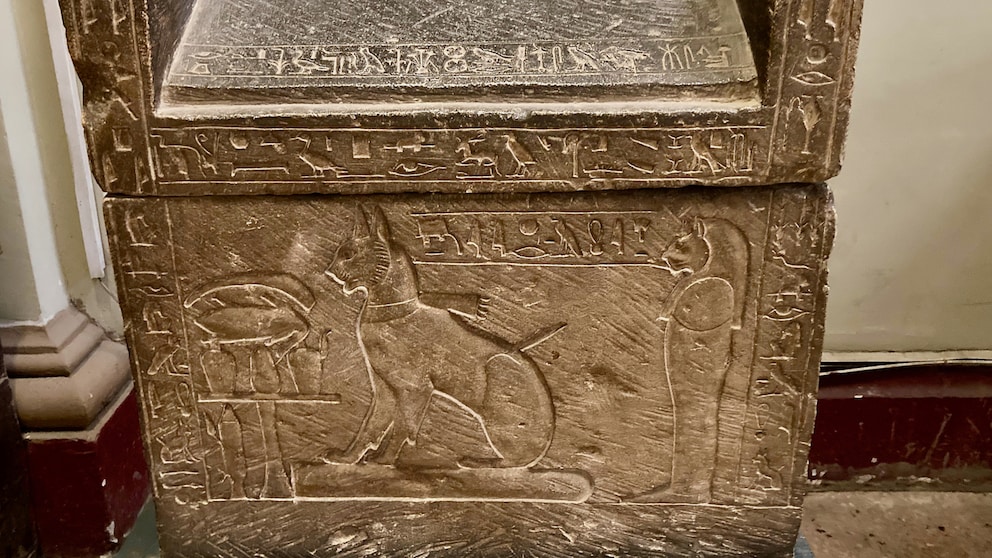
It is documented that the Egyptians later mummified their cats according to the principles of the death cult. According to their beliefs, they could take their animals with them to the Duat, the underworld, or the afterlife, after death. The young deceased Crown Prince Thutmose was buried in the 18th Dynasty with a cat sarcophagus containing his beloved house cat. This can be viewed today in the museum in Cairo.
The cat cult of the Egyptians reached another peak in the 22nd and 23rd Dynasties (circa 945 – 715 BCE). From this time, the first complete cat mummies have been preserved. They were treated with as much care as those of the Egyptian pharaohs. During this time, a pilgrimage site for cat lovers was also established in the city of Per-Bastet (“The House of Bastet”), later called Bubastis by the Greeks. This cult served the rejuvenation of the rulers and was financed by the priesthood and the royal house.3
Different Types of Cat Mummies
The famous Egyptologist and mummy expert Salima Ikram has extensively studied animal mummies and categorizes cat mummies into different types. These include animals buried with their owners. Sacred animals that were revered during their lifetime are also repeatedly found. Lastly, cat mummies were also votive offerings representing the gods and placed as offerings in temples.4
Indeed, cat worship took on fanatical proportions a few centuries later in the late phase of the ancient Egyptian empire. Scientists and archaeologists like Ikram believe that millions of animals were bred, killed in temples, and then sold as votive offerings by priests. An entire industry blossomed around the offerings with cat mummies. The fanatical cult lasted until the 4th century CE and beyond the collapse of the ancient Egyptian empire.4
However, many of these cat mummies were scanned with high-resolution X-ray devices, revealing that not every cat mummy sold as a ritual object actually contained an animal. Often, only parts or no feline anatomy were visible, meant to merely resemble the “ritual object” of the cat from the outside. Nevertheless, the cult around the animals, especially in the last phase of Egyptian high culture, represents a rather darker chapter in the history of the cat.1,3

How Much Pharaoh Cat Is in Your Pet? Study Aims to Find Out
How Cats Were Domesticated
Sources
- Jores, Nicola Lesley. On the Cultural History of the House Cat with Special Consideration of Its Diseases. Diss. 2004.
- Geigl, E. M., & Grange, T. (2019). Of Cats and Men: Ancient DNA Reveals How the Cat Conquered the Ancient World. Paleogenomics: Genome-Scale Analysis of Ancient DNA, 307-324.
- Johnston, R., Thomas, R., Jones, R. et al. Evidence of Diet, Deification, and Death Within Ancient Egyptian Mummified Animals. Sci Rep 10, 14113 (2020). https://doi.org/10.1038/s41598-020-69726-0
- Ikram, S., & Dodson, A. (1998). The Mummy in Ancient Egypt. Equipping the Dead for Eternity, London, 210–215. Book.
Other Sources
- “Npr.org”, “Archaeologists Discover Dozens Of Cat Mummies, 100 Cat Statues In Ancient Tomb” (accessed March 31, 2023)