

October 14, 2025, 10:10 am | Read time: 5 minutes
Mouse collector, deity, Satan’s messenger, or beloved family member? The history of the cat is long and marked by ups and downs. It all began with domestication tens of thousands of years ago, when our house cat originated.
Cats and humans share a long, intertwined history. In ancient Rome, the animals were called “mouse collectors,” revered as deities in ancient Egypt, and demonized in the medieval Christian West. But how did cats come to live with humans, and what was our relationship with one of today’s most popular pets back then? PETBOOK presents the history of the cat, starting from the very beginning with domestication in the Stone Age.
How Did Our House Cat Come to Be?
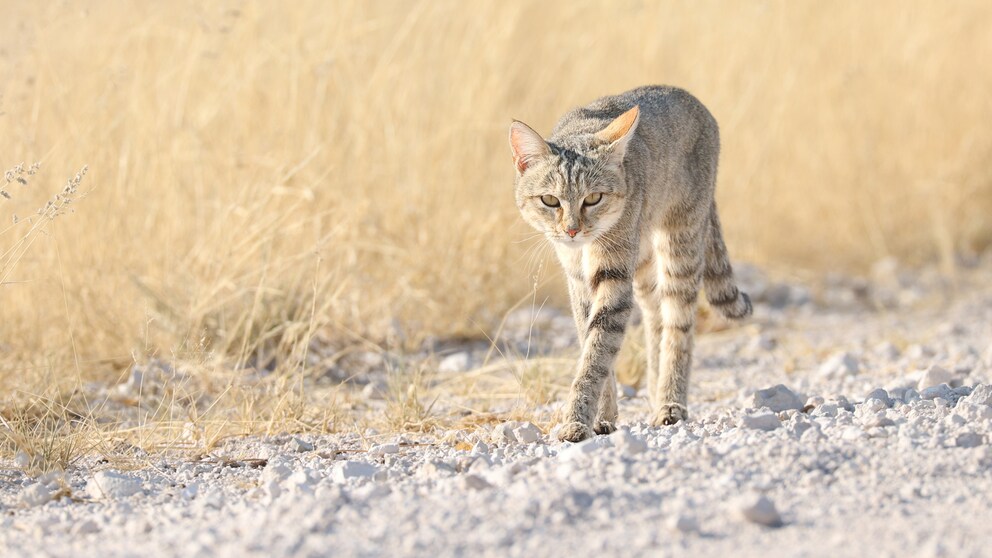
The modern house cat (Felis catus) descends from the African wildcat. It is primarily found in Africa and the Arabian Peninsula and is also known as the African wildcat. The African wildcat and our house cat still look very similar, and genetically, they are closely related. However, over the course of evolution, cats developed a so-called “gene for tameness,” which is absent in the African wildcat.1
It is likely that these clever animals first appeared alongside humans in the “Fertile Crescent”—a region where early ancient civilizations such as Mesopotamia, Babylonia, the Assyrian Empire, and ancient Egypt emerged. This area also revealed the earliest archaeological finds from the Neolithic period, showing that humans began practicing agriculture. In this fertile region, granaries were built, which became a popular food source for small rodents like mice and rats.
And where there are rodents, small predators like the African wildcat are usually not far behind. For these animals, this provided a new ecological niche that offered advantages. Humans likely appreciated the cats’ work nearby and rewarded them for cleaning up the granaries, leading the animals to become accustomed to humans in their environment.
When Did Cat Domestication Occur?
Determining when cats fully became pets is difficult. However, evidence suggests that cats accompanied humans to Cyprus between 13,000 and 11,000 years ago. Before the first settlement, the African wildcat was not native to the island and must have arrived on the boats of the first settlers.
The oldest cat known to have lived with humans was found in 2004 in a grave over 9,500 years old at the Shillourokambos excavation site, also in Cyprus. An approximately eight-month-old African wildcat was buried alongside a man. Archaeologists found no signs of violence on the animal, indicating it was not a sacrificial offering but died naturally. Both the deceased and the animal were found facing west, meaning they were traditionally buried. All this suggests a close relationship between humans and cats.2
There are also finds in China dating from between 5560 and 5280 B.C. These cats were outside the African wildcat’s range but were of comparable size. Excavations showed that the animals stayed near granaries and fed on grain-eating animals. A closer examination of the finds revealed the diet of the animals and humans. It turned out that the cats ate more millet than mice, a clear sign that they were fed by humans.3

Did Humans Eat Cats Before They Were Domesticated?

How Cats Were Revered in Ancient Egypt
Cat DNA Shows Two Major Waves of Domestication
For a long time, it was unclear which wildcat the modern house cat descended from, as several species, including the European wildcat, were theoretically possible. However, domestication only succeeded with Felis silvestris lybica, the African wildcat. This did not occur in just one location, as the examination of all archaeological cat finds from the last 15,000 years has shown.
Eva-Maria Geigl from Diderot University in Paris, along with colleagues, conducted a large-scale DNA sequencing of all cat finds and demonstrated that the cat’s journey into our homes began from two different locations. In southwestern Asia, the first cats were documented in the Neolithic period. From there, they spread further into Europe and Asia. Through this research, Geigl and her team showed that the first hunters and gatherers in Europe already brought cats with them, indicating that these animals have been our pets much longer than previously thought.4
A second cluster of cat domestication was evidenced by archaeological finds in Egypt. At the end of the Old Kingdom, likely under the reign of Pepi II, an Egyptian ruler of the 6th Dynasty, not only were the first cat finds discovered, but also the first pottery shards and depictions of the animals in the burial site at Saqqara. This was just the beginning of the Egyptian cat cult, which eventually led to the widespread distribution of cats.4
Sources
- Driscoll, C. A., Clutton-Brock, J., Kitchener, A. C., & O’Brien, S. J. (2009). The taming of the cat. Scientific American, 300 (6), 68.
- Vigne, J. D., Guilaine, J., Debue, K., Haye, L., & Gérard, P. (2004). Early taming of the cat in Cyprus. Science, 304(5668), 259-259.
- Hu, Y., Hu, S., Wang, W., Wu, X., Marshall, F. B., Chen, X., … & Wang, C. (2014). Earliest evidence for commensal processes of cat domestication. Proceedings of the National Academy of Sciences, 111(1), 116-120.
- Geigl, E. M., & Grange, T. (2019). Of cats and men: ancient DNA reveals how the cat conquered the ancient world. Paleogenomics: genome-scale analysis of ancient DNA, 307-324.