

December 10, 2025, 5:57 am | Read time: 8 minutes
When a cat’s behavior suddenly becomes a burden, many owners feel helpless. This is where Lucy Hoile comes in. The British cat behavior consultant has made it her mission to bring humans and cats closer together–with a lot of empathy, solid knowledge, and a trained eye for those subtle signals we easily overlook. In the PETBOOK interview, she reveals why cats aren’t “distant” but simply less obvious, why hissing isn’t aggressive behavior, and why it’s a huge compliment when a cat sleeps next to you instead of on you.
Lucy Hoile Dedicates a Chapter to Every Misunderstanding with Cats
For over a decade, Lucy Hoile has worked with cats whose behavior leaves their owners desperate. She listens, asks questions–even the uncomfortable ones–and helps to understand why a cat acts the way it does. Once this “why” becomes clear, solutions can be found.
The expert not only completed a specialized master’s degree in pet behavior but is also officially recognized as a clinical behavior therapist for cats. She is a member of several important professional associations that set strict quality standards in animal behavior counseling, including the Association of Pet Behaviour Counsellors and the International Feline Behaviourists.
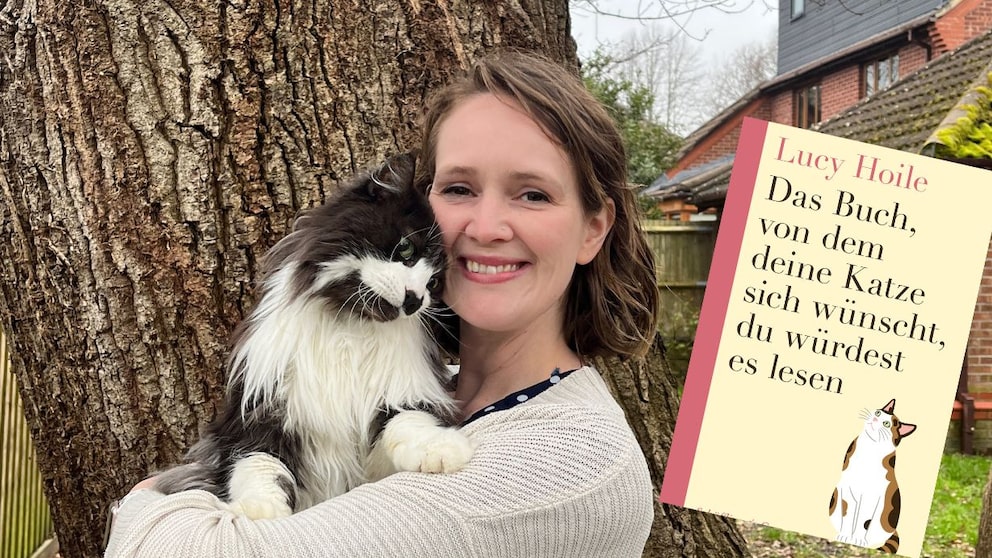
Despite all this expertise, Lucy Hoile remains approachable and understandable–and this is reflected in her book. Its title, “The Book Your Cat Wishes You Would Read,” is a real statement and the reason for our conversation: an invitation to finally read cats as they truly are.
“The Differences in Their Behavior Fascinated Me”
PETBOOK: How did you first become interested in cat behavior? Was there a particular cat or experience that inspired you to dedicate your career to understanding them?
Lucy Hoile: “As a child, I loved watching my cats because they were all so different. My cat Spooky was a sleek tabby and an enthusiastic hunter, while my other cat Lily was tiny and pure white and wouldn’t harm a fly. Both were very special cats, and I felt very bonded to them. The differences in their behavior fascinated me, and I learned everything I could about cats–and I’m still learning! I never thought I would one day make a career out of it!”
What do you find most rewarding about helping people better understand their cats?
“I love seeing people connect with their cats in a whole new way. It can make a big difference to help people understand the reasons behind their cat’s funny (and sometimes annoying!) behavior. I see people who were previously angry and frustrated with their cats develop empathy and understanding for them, leading to a much stronger relationship.”
Lucy Hoile: “We Must Read What They Don’t Say”
You chose a really meaningful title for your book. Can you really say that cats want you to read it?
“Absolutely! I feel that cats don’t usually actively want to communicate something to us. We have to tune in to them and read what they don’t say through their subtler body language and quirky behavior. If we do that, every cat will be happier, and that’s exactly the goal of my book.”
Was the short, “bite-sized” structure about things cats do intentionally chosen to reflect how cats communicate in small, subtle signals?
“Honestly, no, it was more about helping cat owners focus on the parts of the book that are relevant to them at the moment, rather than having to read it from front to back. House cats often live well into their teenage years, and during that time, our lifestyle can change significantly. My book is meant to support you through the changes we go through, but also through the changes in a cat’s life cycle.”
Hissing a Sign of Aggression? Quite the Opposite!
What were some of the most common misconceptions about cat behavior that you wanted to correct in your book?
“I find that many people believe their cat is aggressive when it hisses at its owners. That’s a big misconception because it’s actually trying to avoid any aggression. It may look scary, but it’s actually very positive behavior if you pay attention and give the cat some space.”
How did you decide which behaviors or topics to include, given the many misunderstandings between cats and humans?
“The inspiration for many topics in this book comes from my own experiences. I’ve had my cats Fig and Sparx for 16 years, and they’ve experienced new homes, new babies, and a puppy, so that part was easy. I’ve worked with so many cats and their owners that I’ve found the same issues keep coming up, so I got an idea of what to include. For example, everyone worries when they bring a new cat home and does everything to make it work.”
Cuddle Cat vs. “Hands Off”
Which part of the book was the hardest to write–emotionally or intellectually?
“The section ‘Finding the Right Cat’ was the hardest for me. There are so many different ‘types’ of cats–strays, purebreds, rescue animals, confident, shy, playful, or territorial cats. It’s hard to know what a person is looking for and whether they can provide the right environment. Also, you often don’t know what a cat needs from its human. Some people want a cuddle cat, but some cats prefer a more ‘hands-off’ approach.”
How long did the research and writing process take, and what was that journey like?
“It took about nine months to research and write the book. The research and preparation phase was the hardest because I had to organize my thoughts. But when it came to writing, everything seemed to flow from my head onto the page–I really enjoyed that part!”
Many people still believe cats are “distant” or “untrainable.” What do you say to that based on your experience?
“I think cats have that reputation because their body language is quite subtle. People look for obvious signs of affection, like you would expect from a friendly dog. But a sneaky slow blink, approaching with a raised tail, and soft purring are also positive signs that we miss if we don’t know what to look for.”

Dog Trainer Tracks Stray Dogs: “Puppy Books Need to Be Rewritten!”

Expert: ‘Orcas purposely sink sailing yacht!’
Nature vs. Nurture–What Is Learned, What Is Innate?
How much of cat behavior do you think is instinctive, and how much is learned through interaction with their human environment?
“That’s an excellent question because I believe both aspects play an equal role. Much of their behavior is instinctive, like their predatory nature and primal need to protect themselves. Yet we see them adapt to our lifestyle and change their behavior to make it work. They start to fit into our routines and learn to communicate what they need. They know they have to sit by the back door for you to eventually open it. Or that they have to meow near the food shelf for you to pity them and feed them. They learn really quickly.”
Do you observe cultural differences–for example, in how cat owners in different countries interpret their cats’ behavior?
“Yes, definitely, and it fascinates me. I would love to learn more about cats around the world. I met a man in India who told me that people in the surrounding villages love cats because they help keep rodents away from their food. I found it very interesting that they are appreciated for their natural instinct, while in other parts of the world, they are kept indoors for the same reason.”
Lucy Hoile: “Every Cat Is an Individual”
If someone could take away just one insight from your book, what should it be?
“That every cat is an individual. We all need to take the time to learn what they need from us and what unique nuances they have to truly connect with them.”
What everyday behavior do cats show that almost everyone misinterprets?
“Sleeping near you but not on you. I think people feel rejected by their cats if they aren’t particularly affectionate. But sleeping next to a person and being completely relaxed is such a big sign of trust and contentment that it’s a huge compliment we often misinterpret.”
What is the most surprising thing you’ve learned about cats since working with them?
“For me, it was learning that even very aggressive cats aren’t ‘bad’ cats. They are shaped by their experiences and are trying to cope with a difficult situation. Every cat needs empathy and understanding to improve its behavior–even the really challenging ones.”
Are there myths about the human-cat relationship that you wish would finally disappear?
“That every cat would be happy living with other cats. While they are no longer a solitary species, they have very specific social needs, and some cats are happier in single-cat households. I find it really hard to see some cats living very unhappy lives in large cat groups.”