


April 28, 2026, 3:10 pm | Read time: 5 minutes
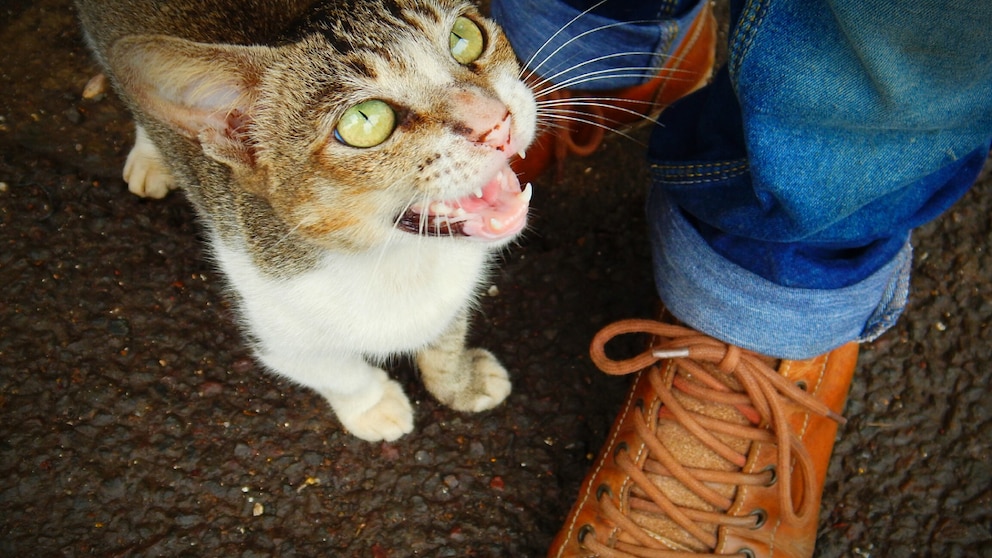
Cats have various ways of greeting their humans when they come home. Until now, there has been little research on this behavior. A new study has taken a closer look, and it did so in the animals’ familiar environment: their own home. Particularly intriguing: Not only do cats show different behavior patterns upon reunion, but they also meow more frequently when a man enters the door. What lies behind this unique dynamic between humans and animals?
Little Research on How Cats Greet Humans
Greeting behavior serves important social functions in animals: It signals peaceful intentions, reduces tensions, and strengthens social bonds. Cats were originally considered loners. Today, we know they can form stable social relationships with fellow cats—and with humans as well. Studies show that cats respond not only to eye contact or body posture but also to the language, voice, and tone of their humans.
Nevertheless, research findings on greeting behavior remain incomplete. Often, they rely on surveys, whose significance is limited by subjective perception. This study aims to change that: It is based on systematic video analyses of real encounters between cats and owners after a separation, such as after returning from work.
Researchers Studied Real-Life Situations
A Turkish research team led by Yasemin S. Duman from Boğaziçi University in Istanbul sought to fill these gaps and examined how house cats greet their owners. They wanted to find out which factors influence this behavior.
The study was conducted from 2022 to 2024 and published in November 2025 in the journal “Ethology.” It focused on the natural behavior of 31 house cats, recorded in real-life situations—without artificial tests or questionnaires. The researchers aimed to better understand how complex and multifaceted the social communication between cats and humans truly is.1
Analysis Included 22 Clearly Defined Behaviors
The study analyzed the greeting behavior of 31 house cats in their familiar environment. Five-minute videos were recorded immediately after the owner returned home. However, only the first 100 seconds of each video were evaluated.
The analysis included 22 clearly defined behaviors—from body postures (such as “tail upright”) to vocalizations and approaches or retreats. Both the frequency and duration of each behavior were recorded. The goal was to uncover connections between specific behavior patterns and correlate them with demographic factors like the owner’s gender or the cat’s age.
In households with multiple cats, only the behavior of the first greeted animal was analyzed. The evaluation was conducted using BORIS software by an experienced behavioral researcher. Participation required a minimum relationship of six months between human and cat, and ethical approval from the university was obtained.
Cats Meowed Significantly More When a Man Entered
The analysis revealed two notable behavior clusters:
- Social Approach (e.g., tail upright, approaching, rubbing against humans) often occurred together, indicating coherent, friendly greeting behavior.
- Additionally, so-called “displacement activities,” such as yawning, body shaking, or self-grooming, typically occur in situations of internal conflict or tension.
These two clusters—friendly-social versus self-soothing—were clearly distinct from each other. Food-related activities like seeking the food bowl showed no connection to the other patterns.
Surprisingly, the only demographic factor with influence was the gender of the human. Cats meowed significantly more when a man entered the door—regardless of the cat’s gender or age, breed, or the number of cats in the household. All other factors studied—such as the cat’s age or pedigree status—had no measurable impact on greeting behavior.
Do Cats Demand Attention from Men by Meowing?
These results confirm that cats’ greeting behavior is not one-dimensional but consists of different behavioral components. The combination of approaching, rubbing, and upright tail reflects familiar, social behavior—likely an expression of a positive human-animal relationship.
In contrast, self-directed behaviors suggest possible internal tension, which does not necessarily have to be negative: They could serve self-regulation or be a means to subtly direct human attention. The fact that food behavior shows no connection to greeting signals suggests that reunions are indeed about social interaction—not food acquisition.
That cats vocalize more toward male caregivers could indicate differences in human-animal communication. Men may interact less verbally with cats, leading the animals to call for attention more actively. Cultural aspects could also play a role, as all study participants were from Turkey.

Birds Flee Sooner From Women Than Men

Why Male Mammals Often Die Earlier
Small Sample Size and Influence of Cultural Characteristics
The study provides valuable insights but is limited in its significance. The sample size (31 cats) is relatively small, which restricts generalizability. Certain factors—such as the duration of the human’s absence or the cat’s feeding condition—were not standardized. Additionally, all participants came from a single country, so cultural characteristics may have influenced behavior. The fact that almost all cats were adopted and not purchased also limits transferability.
However, the natural environment of observation—the animals’ home—and the objective behavior analysis based on established criteria are positive highlights. The methodology avoids subjective assessments by owners, increasing the significance of the actual behavior of the animals. Future studies with larger and culturally diverse samples could help further understand the role of gender, culture, and human-animal interaction.
Conclusion: Greeting Is Socially Motivated in Cats
Cats exhibit complex, finely tuned behavior patterns when reuniting with their humans—from friendly approaches to potential stress signals. The study confirms that this is socially motivated behavior that cannot be explained solely by food expectations.
Particularly noteworthy: Cats meow more often when men come home. This could indicate gender-specific differences in human-animal communication. For pet owners, this means paying attention to subtle signals is worthwhile—they help better understand the behavior of their own cat. The results provide a solid foundation for further research and highlight the importance of direct observation in a natural environment.