

November 14, 2025, 3:46 pm | Read time: 9 minutes
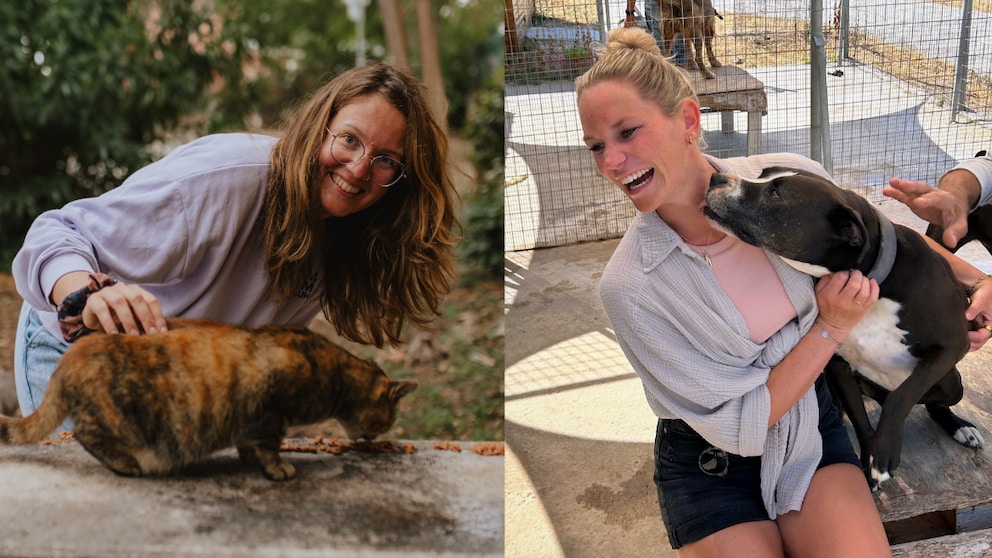
What began as a vacation experience in the Seychelles became the birth of a brand: When Madeline encountered a heavily pregnant stray cat, she suddenly became aware of the plight of homeless animals. Back in Germany, she shared her experience with her friends–and together they decided to take action. This encounter led to the creation of Strayz: a social pet food brand that sells high-quality organic food and helps stray animals worldwide. In an interview with PETBOOK, founders Madeline Metzsch and Saskia te Kaat discuss how compassion turned into a business, why they make no compromises on meat, and how they balance animal welfare, sustainability, and economic action.
The Idea Behind Strayz and Their Commitment to Stray Animals
PETBOOK: Let’s start with the founding and your motivation to start this brand. How did it come about, and how did the idea for Strayz originate?
Madeline: “In 2019, I was in the Seychelles, staying at a small, cozy guesthouse. On the first day, I saw Mushki–a small, round cat.
The owners wanted her gone because some guests allegedly found her bothersome. For them, that was reason enough not to keep the cat on the premises. I said, ‘You do realize she’s heavily pregnant and more cats will soon be here?’–’No, no, she’s just fat,’ they said. But Mushki was indeed pregnant. I immediately researched whether there were any animal welfare organizations nearby that could take care of her.
Even the dream beaches–like those in advertisements–were full of stray dogs. That’s when I realized: There’s not just a problem with stray cats here, but also with dogs. During this vacation, I became truly aware of the suffering of these animals for the first time. I had previously just photographed them because I found them cute. Meanwhile, I was getting photos of my cat from home almost every hour–my mom was taking care of her ‘grandchild’ and spoiling her thoroughly.
That hurt: A beloved pet safe at home, while around 680 million strays worldwide struggle to survive. In Germany alone, an estimated two million stray cats live–you hardly see them in Berlin, but in rural areas, on farms or industrial sites, it’s a big problem because they often aren’t neutered.”
“So the ‘Souvenir’ Became an Idea Instead”
“The deeper I delved into the topic, the clearer it became: Something needs to happen here. Of course, I would have loved to take Mushki as a souvenir–but bringing a pregnant cat into the EU is difficult. So the ‘souvenir’ became an idea instead.
Back in Germany, I told my former colleagues Sassi and Stefi about it–and we decided: We have to do something. Piece by piece, the idea for Strayz emerged. Initially, there was just this desire to help. Then we thought about how we could implement it–and came up with the ‘Buy one, give one’ principle.
I feed my cat high-quality food–so why not one that not only looks good and is healthy but also helps strays? When we started five years ago, pet food on the shelves was still pretty boring.
Thus, Strayz became a social pet food brand that offers good food, educates, creates transparency–and does it all in a modern, appealing format. A brand that not only reaches animal lovers but also inspires people to engage with strays.”
Saskia: “And that’s how this triangle of Strayz came about, simply consisting of these three points.”
“We Are Not an NGO–We Have to Operate Economically”
PETBOOK: What was your biggest drive? We’ve already talked about the love for animals–but you also focus on organic quality and sustainability. At the same time, you’re a business. How do you balance that?
Madeline: “I believe one doesn’t work without the other. We are not an NGO–we have to operate economically to even enable donations. Therefore, everything must always be thought of together.
The topic of meat was a big issue for us from the start–and honestly, a difficult one. The entire team is essentially vegetarian, many even vegan. Starting a meat brand was therefore a real challenge for us.
That’s why it was clear to us: If we’re going to do this, then only with organic quality. We know that at least the living conditions are better. We also know exactly where our raw materials come from because we work with a great supplier from southern Germany. He also sources regional meat for Austria and has close relationships with local farmers.
We really researched long and hard to find these partners–and to be able to say: Yes, we’re now founding a brand that produces meat products, but with a good feeling about it.”
Why No Animals Are Slaughtered Specifically for Strayz Food
Saskia: “Exactly. It was always important to us that no animals are slaughtered specifically for our food. I find it almost reprehensible when brands advertise with ‘food quality.’ For one, that’s actually not allowed–you can’t use that term because pet food must be produced in special facilities where no food is processed.
And regardless of that: We live in times when many people have to count every penny to feed themselves. We can’t justify slaughtering animals just to feed other animals.
In the meat industry, a lot of good material is left over anyway. There are numerous high-quality leftovers that would otherwise just go to waste. For example, in turkey slaughter, usually only the breast is used–that’s about 50 percent of the animal. The rest often ends up in the trash. Yet many of these parts can be wonderfully utilized: like the legs or meat scraps on the skeleton. You know exactly what you’re using. Organs like the heart and liver have high nutritional value and are therefore valuable components for pet food.
All This Care Comes at a Price
It’s quite different with conventional supermarket food: When it says ‘meat meal’ or ‘animal by-products’ on the package, you often don’t know what animal it comes from or what’s actually in it. This makes it difficult to determine what a pet is reacting to in case of intolerances.
You can see–the topic is incredibly complex. We donate regularly, we focus on high quality, and through organic certification, we ensure that sustainability is truly considered. Of course, packaging is also a major issue.
All of this, however, comes at a price. Our margin is extremely small as a result. While other companies have large budgets for advertising, we can hardly afford it. This makes everyday life quite tough sometimes–especially when it comes to making decisions and growing organically, that is, on our own strength.”
“Many Big Brands Keep Their Information Deliberately Vague”
PETBOOK: I hadn’t actually considered this aspect. I know the reaction of many consumers who say, ‘Animal by-products–I don’t want my cat eating that.’ Yet it’s on many pet foods.
Madeline: “Exactly. That’s the advantage for many big brands: They keep their information deliberately vague and remain extremely flexible about what they put in the food. But if you say what’s really in it, you have to stick to it–and that makes things significantly more complicated.
Anyone who wants to declare as transparently as possible quickly hits limits. You have to specify every single ingredient, every percentage exactly. Even with ingredients like broth, it’s often difficult to openly state what’s exactly in it–depending on legal regulations, sometimes even varying by state.
We constantly delve into the details to keep track. Transparency is extremely important to us–in everything we do: in donations, in the food itself, and in the composition.
I think you should simply have the right to know what’s in your pet’s food. It’s actually a farce that this is so often not the case. There are two types of declaration: open and closed.
With open declaration, it’s clear down to the last percentage point what’s included. With closed declaration, often only about ten percent of the components are truly transparently specified–the rest is a kind of opaque mix of various ingredients.”

Who Is Actually Behind the Pet Food Brand Strayz?
Strayz Founders on Their Poor Performance in “Stiftung Warentest”
Finding the Right Formula with Natural Ingredients
PETBOOK: Something else comes to mind: There are various additives, such as taurine or vitamin A, that must be added to pet food. I’ve read that vitamin A levels can sometimes exceed the recommended value by up to 40,000 times when added. How do you handle that? What guidelines do you follow?
Madeline: “We follow the so-called FEDIAF values (Editor’s note: FEDIAF stands for ‘Fédération Européenne de l’Industrie des Aliments pour Animaux Familiers,’ the European Pet Food Industry Federation)–they specify exactly which nutrients should be present in what minimum and maximum amounts.
Our approach is to work with natural ingredients as much as possible. Our manufacturer has years of experience and test data from raw material suppliers who regularly analyze the individual ingredients. This way, we know exactly what’s naturally present in the meat, for example.
However, you have to consider: The food is preserved, meaning it’s heated–many vitamins are lost in the process. We then have to specifically add them back. It’s quite a calculation effort, a kind of ‘recipe mathematics,’ to find the optimal balance–so that the values are neither too high nor too low.”
Strayz: “A Feed Mash Based on Meat Meal Is Always Composed the Same Way”
“The whole thing becomes even more complex when working with unprocessed, natural raw materials. A feed mash based on meat meal is always composed the same way–you can simply add standardized vitamin mixes, similar to a tablet. With natural recipes, it doesn’t work that easily.
That’s why we regularly conduct lab analyses to check whether the calculated values are actually present in the final product. Of course, there are slight fluctuations–this is hardly avoidable with natural ingredients. But it balances out over time: No chicken is exactly the same as the next, and no batch is identical. The animals regularly get new food anyway, and over the various batches, the nutrient balance evens out well.”
PETBOOK: That brings me to a point we need to discuss: Your performance in “Stiftung Warentest.” Why did you receive a 5 ‘poor’ rating?
The answer to this intriguing question and more about the animal welfare and growth plans of the Strayz founders will be revealed in the second part of the interview, coming soon on PETBOOK.