

April 22, 2023, 6:19 am | Read time: 6 minutes
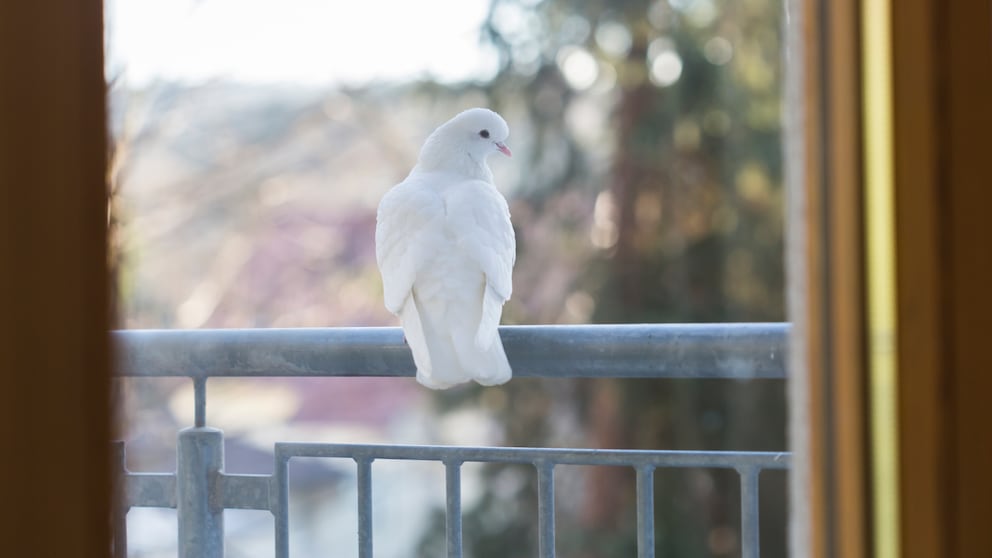
A dull thud against the window, and it’s happened. A bird has flown full force into the glass pane and now lies motionless on the ground or windowsill. But why do such accidents keep happening? PETBOOK explains why birds fly into windows and how this can be prevented with simple measures.
Wild birds can fall victim to many man-made obstacles while flying: Sometimes entire flocks get caught in airplane turbines or wind turbines. However, according to NABU, the most common fatal accidents occur when birds collide with windows and glass facades. The Nature Conservation Association estimates, based on counts, that approximately 100 million birds die each year. The state labor protection associations of bird protection stations (LAG VSW) suspect the number is even higher, as sometimes the animals do not die immediately at the accident site but move with internal injuries or severe traumatic brain injury to a bush, where they then perish. Generally, significantly more birds die at large office buildings than at the windows of private homes. Nevertheless, it’s worth making windows bird-safe at home as well. How to do this is explained in the following article.
Overview
Why do birds fly into windows?
Birds–especially birds of prey–actually have excellent vision. From miles away, a kite can spot a grasshopper in the meadow or a mouse in the field. A blackbird also has excellent spatial vision. However, because their eyes are positioned on the sides, their forward-directed vision is limited. Additionally, glass surfaces have optical properties that prevent birds from recognizing them as obstacles.
Reflection
The reflection of the surrounding nature and sky in the glass panes creates the illusion of an endless landscape for the bird. It only sees the reflection and continues flying, aiming to land in the next tree, for example. If the building is surrounded by lush vegetation where many birds reside, the risk of bird collisions is even greater.
Transparency
There are also buildings constructed at angles or with particularly clean glazing that become a hazard for birds. These include conservatories, swimming halls, noise barriers, bus stops, or stairwells. Here, the bird sees the open sky or the group of trees on the other side, which it targets, only to be abruptly stopped by the glass facade.
Lighting
Especially in the evening or at night, buildings lit from the inside and their glass panes can pose a danger to migratory birds. These birds navigate their migration routes by the moon and stars, as well as the Earth’s magnetic field, which they can likely see with a receptor in their eyes. On their flight, they are drawn to the light beams of cities, lose their orientation, and collide with the large glass facades of office buildings. However, due to energy savings, these artificial light sources will become less common in the future.
Also interesting: What do birds actually do when it rains?
Why you so rarely see dead birds
Why Wasps and Bees Buzz Up and Down at the Window
What should I do if a bird has flown into a window?
After a collision with a window, you should check whether the bird is dead from the impact or unconscious due to a traumatic brain injury.
First aid measures for a bird collision:
Check vital signs:
- Does the bird still have a pulse and is it breathing?
- Can you hear or see the heartbeat?
- Shine a flashlight into the eyes. If the pupils contract, the bird is alive.
- The bird can now be secured: A small box with a lid, with enough air holes cut into it, is best. For a young bird, you can place a not-too-hot hot water bottle inside. The temperature should be 86 degrees Fahrenheit. An adult bird does not need a heat source. Then, carefully place the injured bird on a towel inside.
If no severe external injuries are apparent, leave the bird alone for a while and place the box in a quiet, shady corner.
Warning: Do not give it water! If it has suffered a concussion, it could vomit and choke.
If it has not suffered serious injuries, the bird should recover after one to two hours, and you can take the box outside and release it. If it still appears unchanged after about two hours, please consult a veterinarian or a wild bird rescue service.
How can I prevent birds from flying into windows?
“With the right markings on the outside of the glass, the number of bird deaths can be significantly reduced,” says ornithologist Christa Glauser from Birdlife Switzerland. In her experience, traditional bird of prey silhouettes are not very effective. However, there are effective bird protection markings you can apply to your windows:
- Vertical lines and patterns are best perceived by birds
- Place the stripes or dots about a hand’s width apart. This way, the bird will not try to fly through a perceived gap.
- The markings must cover the entire surface of the window.
- The markings must always be applied from the outside.
- The color orange is particularly well perceived by bird eyes.
- NABU recommends cost-effective solutions from the outside: fly screens, string curtains made of cords, window paints, and frosted adhesive strips.
- Inside, you can use light curtains, blinds, shades, or similar items.
Conclusion: Flying into windows is one of the most common causes of death for birds. Therefore, it’s worth ensuring that windows are bird-safe in private living areas. Vertical lines and patterns are best perceived by birds. While this may seem unsightly to humans, it reliably prevents the animals from dying in accidents. Otherwise, curtains or blinds also help reduce the risk of a bird flying into the window.
Sources
- Nabu.de, “Klimaschutz nicht auf Kosten von Arten und Lebensräumen” (accessed April 20, 2023)
- Vogelglas.vogelwarte.ch, “Zu viele Vögel kollidieren mit Glas” (accessed April 20, 2023)
- Lbv.de, “Wie gehe ich mit verletzten Vögeln um?” (accessed April 20, 2023)
- Srf.ch, “Wie der Tod von Millionen von Vögeln verhindert werden kann” (accessed April 20, 2023)