

March 27, 2023, 3:58 am | Read time: 3 minutes
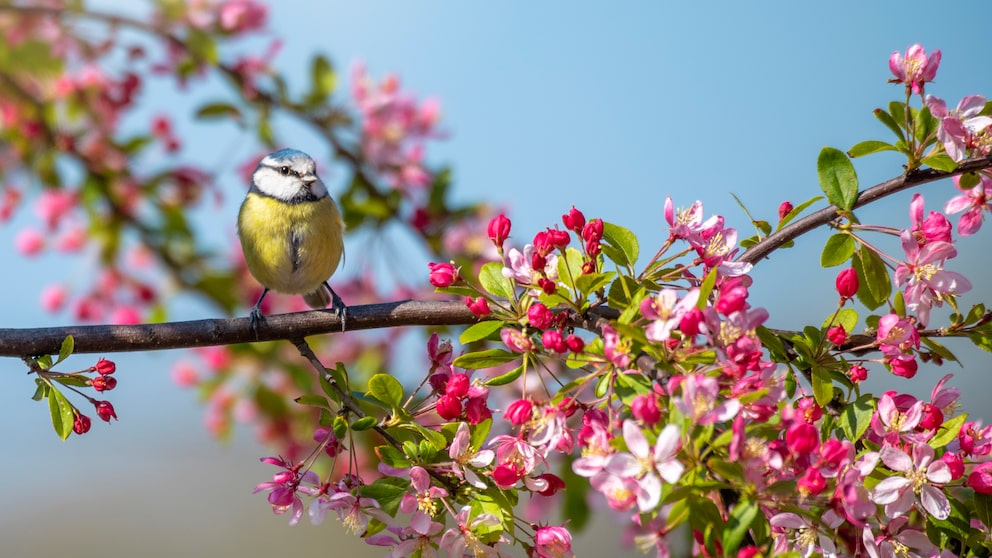
With the coming spring, birds like blackbirds and great tits, which stay with us all year, become more active again. With their songs, they aim to attract females and assert their territorial claims. PETBOOK reveals which birds are now singing more and how to recognize bird calls.
Cheerful bird chirping is simply part of spring and makes the hearts of many bird lovers beat faster. But when the birds sing at the top of their lungs, it can get quite loud outside the window. If the bird concert starts at 5 a.m. outside the bedroom, even the most devoted animal lover might wonder sleepily or grumpily: Who’s singing out there? Read here to learn how to recognize and distinguish bird calls.
How can I recognize bird calls?
Some bird species have names that mimic the sound of their calls, making them particularly easy to identify. For example, the cuckoo actually calls “cu-coo,” with an emphasis on the first syllable. Its calls can be heard from afar because it perches high up when calling. The chiffchaff, a small songbird, is also named after its song, which sounds like “chiff-chaff-chiff-chaff,” with varying pitch.
A particularly talented singer is the blackbird. Its flute-like song includes various melodic stanzas that the bird repeatedly varies and recombines. Less creative are the field and house sparrows, which are still easily recognizable by their monotonous “chirp” or “cheep.” Great tits like to chirp a cheerful “zizibeh” or simply “dee dah, dee dah, dee dah.”
Also interesting: What do birds actually do when it rains?
Which bird is singing now?
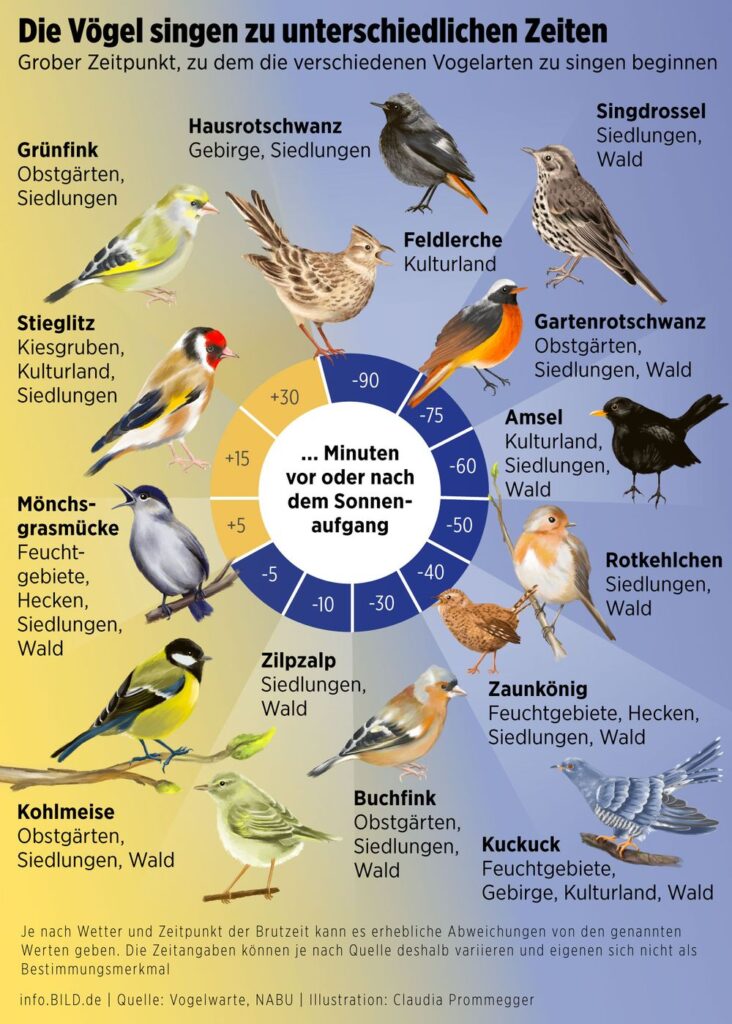
To associate a bird song with a specific species, checking the time can be helpful. Not all birds sing at the same time. The early risers among the birds are the common redstart and the black redstart: They start singing 80 and 70 minutes before sunrise, respectively. About an hour before sunrise, the song thrush and the barn swallow join in. The blue tit, with its high “zizizi,” can be heard about 30 minutes before sunrise. The starling and the chaffinch, considered late risers, begin chirping only 15 to 10 minutes before sunrise.
The bird concert reaches its peak in May. By then, almost all migratory birds have returned, and the breeding season is in full swing. Toward the end of summer, the chirping decreases. The young birds gradually become fledglings, and the first long-distance migrants start their journey south. Nevertheless, bird songs can still be heard in the fall–though not as loud and varied. For example, young male birds practice their chirping, and some species are already marking their territory musically for the next spring.
Interesting Facts About Chickadees That You Didn’t Know Yet
Why Woodpeckers Don’t Get Concussions When Pecking
Recognizing bird calls: Apps for call identification
Various apps can help recognize and identify bird calls. The Nature and Biodiversity Conservation Union (NABU) offers the free “Vogelwelt” app for iOS and Android. It contains information on over 300 native bird species, with details on appearance, song, behavior, and frequency.
Particularly practical, though not free, is the “Zwitschomat – Vogelstimmen ID” app. It allows users to record bird calls: The app then analyzes the sound and suggests possible species.
Sources
- Nabu Baden-Württemberg, “From loud and shrill to soft and pearly: Spring feelings among songbirds” (accessed March 24, 2023)
- lbv.de, “Recognizing birds by their calls” (accessed March 24, 2023)
- Nabu.de, “Experience a concert in the morning: Set your alarm by the birds!” (accessed March 24, 2023)