

April 23, 2023, 6:47 am | Read time: 4 minutes
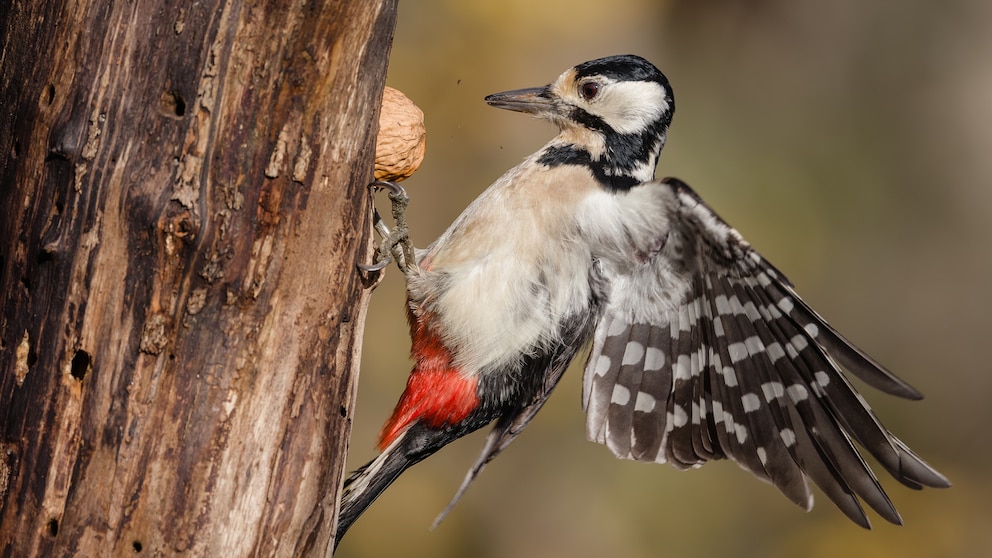
Woodpeckers hammer into trees at speeds of up to 15 miles per hour, with their beaks striking the wood up to 20 times per second. A human would at least get a severe headache from such activity. Why don’t woodpeckers get concussions?
If you hear frantic and loud tapping in the forest or on the outskirts of town, it’s likely a woodpecker. These birds work on the bark and wood of our trees to find and eat insects and their larvae underneath. They also carve out tree cavities that serve as sleeping and nesting places for woodpeckers and many other animal species. If a woodpecker’s beak hammers, taps, or drums with full force on the wood, other animal species would likely get a headache quickly. However, woodpeckers have developed several mechanisms to mitigate or absorb the impact force, preventing them from getting concussions while tapping.
Overview
Why Woodpeckers Don’t Get Concussions
In the various woodpecker species known for their hammering and tapping, the birds’ unique anatomy and the interplay of muscles and bones work together. The following features make the woodpecker’s body a true shock absorber, preventing concussions while tapping:
- The cervical spine and skull bones in woodpeckers are reinforced.
- Additionally, the birds have particularly strong neck muscles that make rapid and powerful hammering possible and can absorb the forces exerted when the beak strikes the wood. Just before the beak hits the tree, the bird unconsciously tenses its muscles, absorbing most of the energy.
- In the woodpecker’s skull, there are small, flexible bones at the beak and between the eyes that can cushion blows.
- Unlike humans and some animal species, woodpeckers have almost no cerebrospinal fluid, and their skulls are filled without gaps by the brain. In a concussion, the brain is jolted against the skull bones due to its loose position in the skull during a strong fall or rapid back-and-forth movements. This is less likely to happen in woodpeckers due to their special anatomy.
- When examining the skull’s structure closely, you can see in profile that the beak is positioned below the brain. The forces generated when the beak strikes the tree do not act directly on the brain but on the bones and tissue beneath it.
Also interesting: What to do if a bird flies into a window
Not All Woodpecker Species Peck on Wood
For many woodpecker species, working with their beaks on trees serves various purposes. Light drumming is comparable to the singing of songbirds. It serves communication and, for example, attracts females ready to mate. In contrast, stronger pecking and hammering aim to expose insects under the bark and form cavities in the wood.
Since pecking is easy for woodpeckers, they may build a second or third cavity if the first one doesn’t please the female. Other animal species benefit from this. For instance, squirrels often take over woodpecker cavities as nesting sites to raise their young. Tits also seek out tree cavities as sleeping or nesting places.
Finally, there is a woodpecker species, the wryneck, that cannot drum, peck, or hammer itself and therefore prefers to use the abandoned homes of its woodpecker colleagues. These do not necessarily have to be carved into trees. Woodpeckers sometimes work on house walls and expand the insulation layer beneath into a cavity. However, this is rarely a cause for joy among homeowners, as it can also lead to moisture damage. Those who provide enough trees for woodpeckers in their garden are less likely to encounter this problem.
.
The Nuthatch — European Native Wild Bird and Climbing Artist

How high can birds actually fly?
Native Woodpecker Species in Germany
The following woodpecker species can usually be observed or, more often, heard in the trees here:
- Great Spotted Woodpecker
- Middle Spotted Woodpecker
- Three-toed Woodpecker
- Green Woodpecker
- Grey-headed Woodpecker
- Lesser Spotted Woodpecker
- Middle Spotted Woodpecker
- Wryneck
- Black Woodpecker
- White-backed Woodpecker
Sources
- br.de, “The Woodpecker – Hammering Without Headaches” (accessed on 04/21/2023)
- NABU Baden-Württemberg, “Why Don’t Woodpeckers Get Headaches?” (accessed on 04/21/2023)
- naturschutzgebiete.org, “Woodpeckers in Germany” (accessed on 04/21/2023)