

September 25, 2026, 11:16 am | Read time: 7 minutes
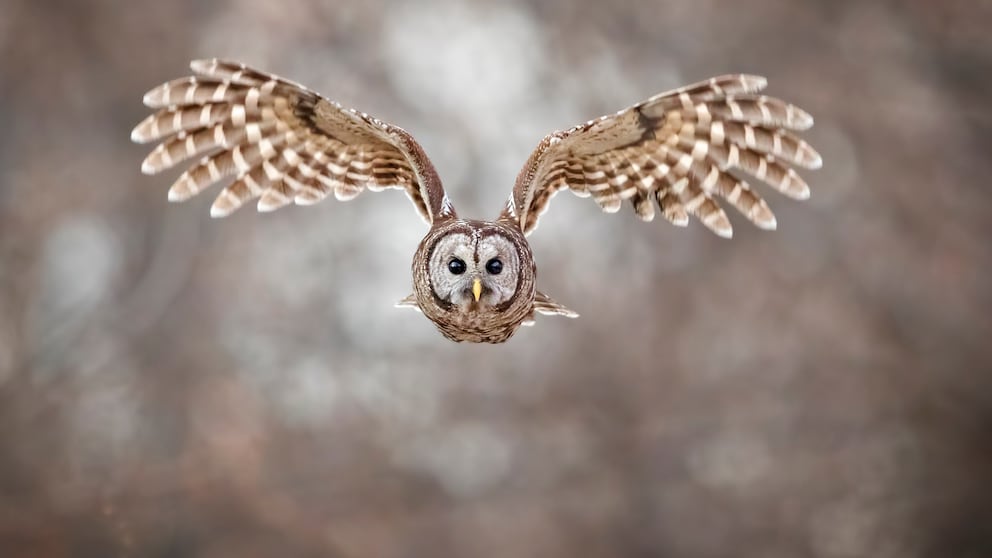
“Owl Capone” made headlines in 2016 in the U.S. city of Salem: The barred owl repeatedly attacked joggers, eventually forcing authorities to put up warning signs. The idea that owls can attack humans even played a role in the famous criminal case involving Kathleen Peterson (“The Staircase”). PETBOOK asked owl expert Stefan Brücher from the Society for the Preservation of Owls (EGE) what lies behind such attacks and how common they really are.
When an Owl Becomes “Owl Capone”
The owl struck multiple times in Bush’s Pasture Park in Salem, usually from the darkness and without warning. Victims reported scratches on their heads and the shock of being suddenly hit by something invisible while jogging by. One of the victims, Dwight French, described to local media how he was hit on the head from behind while jogging in the evening, sustaining small cuts. Only afterward did he realize that an owl was responsible for the attack.
In Portland, about 50 miles away, there have been recurring reports for years of barred owls attacking people in parks, such as in Marquam Nature Park. Due to repeated attacks, warning signs had to be put up there as well.1,2

Stefan Brücher, owl expert at the Society for the Preservation of Owls (EGE), is skeptical about a key point of the story: the timeframe. “‘Over months’ seems a bit suspicious to me,” he tells PETBOOK. Most young owls can fly at eight weeks and have a significantly larger range by about ten weeks. At that point, the parents would no longer defend them as intensely.
However, owl chicks often leave their nests before they can fly. They may sit on the ground or low in trees, increasing the likelihood that parent birds will see such situations as worthy of defense.
Why Do Owls Attack Humans?
Owls are among the birds of prey that very consistently defend their territory and especially their offspring. An attack on a human is usually not unprovoked aggression but a defensive reaction.
Those who unknowingly approach a nest or newly fledged birds are perceived as a threat and attacked. According to Brücher, barred owls are particularly known for similar aggressive behavior.
This may also be because their nesting sites are often very close to humans. Stefan Brücher explains: “Breeding in parks is common, and especially there, joggers or cyclists are often around during twilight hours.” The speed of people acts as a threat amplifier to the owls, intensifying their defensive behavior.
Also interesting: What is the difference between an eagle owl, a tawny owl, and an owl?
Does This Happen in Germany Too?
Even in Germany, owls are by no means defenseless or shy. The EGE has particularly specialized in the eagle owl, the largest native owl species. Their experiences mentioned below specifically refer to this one species, not to owls in general.
In the EGE’s own work, according to Brücher, there are almost no real attacks. Since 1980, the society has documented the population development of the eagle owl in the Eifel and has visited over 2,500 eagle owl nests for scientific banding of the chicks. There have been isolated cases, about 10 to 20 times, of mock attacks.
This means that parent birds flew close and warned loudly without actually touching the people. In two cases, female eagle owls additionally threatened with wing flapping, hissing, and beak snapping. According to Brücher, there was never any real physical contact during these visits because they always took place in broad daylight.
When Is the Risk Greatest?
According to him, the breeding season plays “the decisive role” in the aggression potential toward humans. During this phase, parent birds are particularly vigilant and more quickly perceive even harmless passersby as threats. Since owls are mostly nocturnal, most incidents occur at dusk or night. This makes the attacks additionally unpredictable because victims usually only notice the animals after the attack.
Special Circumstances Increase the Risk
It is different under special circumstances: At dusk or in darkness, eagle owls are significantly bolder toward humans. “Some animals also physically attack humans to protect their offspring,” says Brücher. They fly from behind and rake their talons into the scalp as they pass by. According to the EGE, such real attacks have been reported about five times in 47 years of work, mostly in situations where people unintentionally got very close to young eagle owls.
For other native owl species like the barred owl, which is also involved in the Oregon case, the EGE has no specific attack data. However, the defense patterns described above generally apply similarly, according to Brücher.
The Harry Potter Effect: When Owls Are Imprinted on Humans
Brücher also mentions another, less known reason for attacks on humans: owls raised by humans. If such animals grow up without conspecifics, they often do not develop natural behavior and instead become imprinted on humans. For this reason, they later see humans as potential mating partners. If such animals are released into the wild, it can lead to actual “landing attempts” on the head, where the birds try to hold on with their talons.
This behavior closely resembles the defensive attacks described above and is easily confused with them. Such behaviorally disturbed owls emerged several times in Europe, especially during the Harry Potter boom, when owls became popular as pets in cages.
Also interesting: Why this woman keeps an owl–even though it’s actually forbidden
How Should You React if an Owl Attacks?
Brücher’s most important advice is to avoid making quick movements near nests, especially at dusk or in darkness. If you notice signs of an owl nest in a forest area or hear repeated, agitated calls, it is advisable to leave the area quickly. In the event of an actual attack, it helps to protect your head with your arms or a cap rather than fighting back. A counterattack would only further provoke the animal.
Buzzard Attacks People–Expert Explains the Behavior

Why Birds Suddenly Shred Crocuses
The Mysterious Case “The Staircase”
How seriously owl attacks can theoretically be taken is shown by a much older and far more dramatic case from the U.S., known as “The Staircase.” In December 2001, American Kathleen Peterson was found dead at the foot of a staircase in her home in Durham, North Carolina. She had severe head injuries. Her husband, Michael Peterson, was convicted of murder in 2003, and the case later became world-famous through a well-known documentary series and a fictionalized TV adaptation.
Years later, a family friend and lawyer developed an unusual counter-theory known as the “Owl Theory.” It suggested that Kathleen Peterson might have been attacked by a barred owl outside. She returned home bleeding, where she eventually fell down the stairs and bled to death. As possible evidence, he cited small, feather-like fibers that were reportedly found in Kathleen Peterson’s hair.3
The court never officially examined this theory, but in 2017 there was an out-of-court settlement in which Michael Peterson agreed to an Alford plea. This means the defendant acknowledges that the prosecution’s evidence would likely be sufficient for a conviction, but he does not admit guilt. Peterson maintains his innocence to this day. There was never a new trial in which the “Owl Theory” might have been substantively examined.
The “Owl Theory” is not proven, and it should be considered with caution. However, the fact that such a theory was even seriously discussed shows how real the injury potential of owl attacks on the human head is apparently assessed. A fatal outcome, as the theory suggests, would be an absolute exception.
Also interesting: Buzzard attacks humans–expert explains the behavior
Should You Be Worried?
Despite the headlines from Oregon and the speculations surrounding the mysterious case of Kathleen Peterson, owl attacks on humans remain a rare occurrence. This is also shown by the EGE’s experiences after nearly five decades of fieldwork. Only a handful of real attacks stand against thousands of uneventful encounters. A case like “Owl Capone” makes international headlines mainly because it was so unusually persistent, not because aggressive owls are the norm.