


April 13, 2026, 10:44 am | Read time: 5 minutes
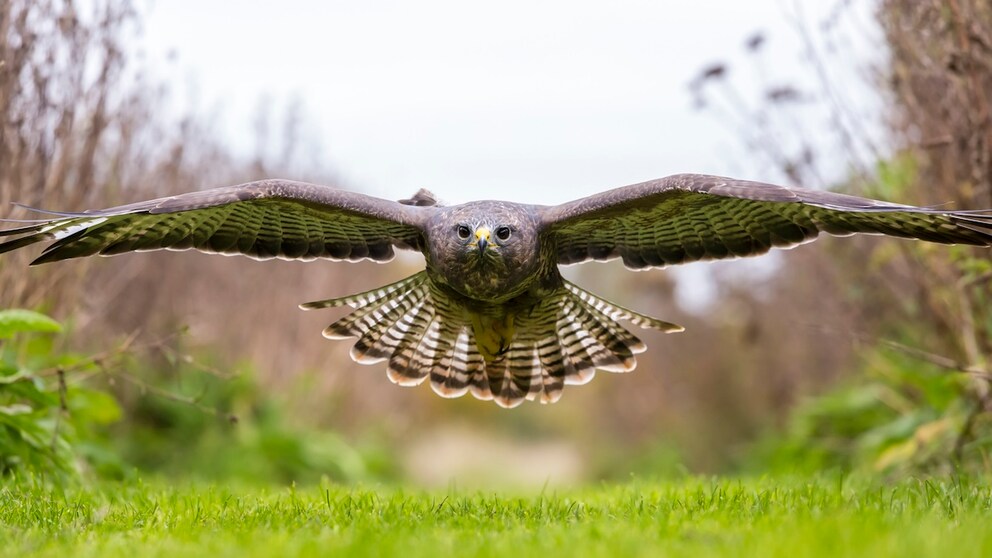
An aggressive buzzard is currently causing a stir in Belgium: The bird of prey is said to have attacked more than 25 people already—authorities even advise taking an umbrella for protection.1 Such incidents seem dramatic but are rare. PETBOOK spoke with NABU bird expert Martin Rümmler, who explains why buzzards attack people, when the risk is particularly high, and how to behave in an emergency.
Why Do Buzzards Attack People?
Even though such incidents sound spectacular, NABU wild bird expert Martin Rümmler clearly assesses the situation: “This behavior is comparatively very rare when considering the frequency and wide distribution of buzzards.”
According to Rümmler, aggressive encounters with birds of prey almost always have a clear trigger: the breeding season. “It mainly has to do with the reproductive period, during which territory and brood are defended,” the expert explains.
At this time, two interests collide: protecting offspring and personal risk. “For parent animals, it’s always a balance between investment costs and risks, as well as the potential success of a behavior,” says Rümmler. In plain terms: A buzzard decides situationally whether an attack is worthwhile–even if it potentially puts itself in danger.
It’s well known that birds of prey can be quite bold. Buzzards defend their territory not only against humans but also against significantly larger species. “It’s known that they confront other larger birds of prey like sea eagles,” says Rümmler.
Not Every Buzzard Is Equally Aggressive
However, not all animals exhibit this behavior. “Even among birds, there are different personality traits,” explains Rümmler. Some individuals are simply braver and less shy than others.
Possible hormonal influences also play a role. In other bird species, it has been observed that males attack more frequently—possibly due to increased testosterone levels. Additionally, aggressive behaviors often occur particularly frequently just before the young birds leave the nest.
Why Such Attacks Often Occur in Cities
In Germany, buzzard attacks happen from time to time. Last May, a cyclist was attacked in Metzingen, as reported by “SWR.” Around the same time, several attacks on walkers and joggers occurred in the Barsen community in Hamm-Bockum-Hövel, as informed by the online portal of the “Westfälischer Anzeiger.”
Many of the cases occur in or near populated areas. “Risk areas are usually parks or wooded areas directly in settlements,” says Rümmler. There, the habitats of humans and animals overlap particularly strongly.
Moreover, cities increasingly attract birds of prey. “There is more food, more protection, and more potential breeding sites,” the expert explains. Food scraps, fewer predators, and suitable nesting sites make urban areas attractive—but simultaneously increase the potential for conflict.
Umbrella as Protection–Sensible or Overblown?
The unusual advice from authorities to take an umbrella actually has a professional basis: “An open umbrella certainly offers protection from physical contact during mock attacks,” confirms Rümmler. At the same time, the unfamiliar shape of the umbrella can have a deterrent effect. Even closed and held over the head, it can help: Attacks would then likely target the umbrella rather than the head.
That’s precisely where the birds aim. “Since the head is usually targeted as the highest point, wearing a hat can reduce the possibility of injuries,” adds the expert.
How to Behave During Attacks
Above all, it’s important to stay calm and keep your distance. “If such cases are known, you should avoid the affected area for some time,” advises Rümmler. Warning signs could help sensitize walkers in advance.
Many attacks are so-called mock attacks. “Often, there is no direct contact,” says the expert. Nevertheless, they can be frightening—and in rare cases, lead to minor injuries.
Actively confronting the animal is not a good idea. “I would not recommend trying to fend off the animal or even pursuing it,” emphasizes Rümmler. This is not only risky but also legally problematic.

After an eagle attack on a toddler: Expert explains the behavior

The reason why buzzards attack people who are jogging
Habituation to Humans Can Intensify Behavior
Another factor: the so-called habituation, or getting used to humans.
If birds repeatedly have no negative experiences with humans, they lose their shyness. “This can theoretically lead to the animals not perceiving humans as a dangerous opponent, exposing them to a higher risk of injury,” explains Rümmler.
In the current case, this could play a role: The buzzard is said to have been fed by humans before–a circumstance that can encourage problematic behavior, as Rümmler also confirms: “It’s possible that the buzzard in question lost its fear of humans due to human feeding and the resulting habituation effect. As a result, it is not only more approachable than usual but possibly also bolder toward humans in terms of defensive behaviors.”
Do We Need to Worry?
Despite the dramatic headlines, the expert gives reassurance: “There is no reason to assume that such behaviors are increasing.” While increasing urbanization may lead to more instances of human-animal contact, he does not see serious dangers for the population.
His conclusion is clear: “With great probability, no one needs to worry about our future safety in parks and urban forests.”
The “Dinant buzzard” thus remains a spectacular isolated case, which mainly shows one thing: Even seemingly familiar wild animals follow their own rules, especially when it comes to protecting their offspring.