

August 14, 2025, 4:06 am | Read time: 6 minutes
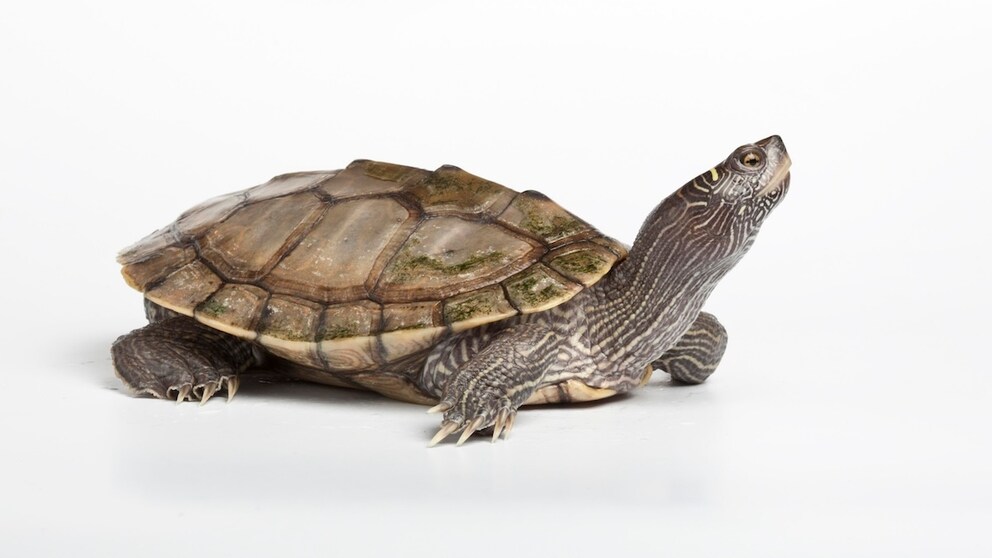
With its distinctively patterned shell, the map turtle (Graptemys geographica) resembles a small work of art by nature. However, those interested in keeping this North American aquatic turtle must consider more than just its extraordinary appearance. This species demands high standards for habitat, water quality, and technical equipment. Only by precisely replicating its natural conditions can one ensure a healthy and long life for the turtle in an aquaterrarium.
Origin
The map turtle, also known as the map slider turtle, is found in eastern North America, inhabiting large rivers and lakes with slow-flowing water. In Canada, it is found in the southern parts of Ontario and Quebec—regions characterized by structured waters, soft shorelines, and good water quality. This habitat offers numerous basking spots, clear water with high oxygen content, and a diverse underwater landscape—all aspects that must be considered in home care.
According to the IUCN Red List, the species is not endangered. Therefore, there are no regulatory requirements for keeping them. However, map turtles should only be obtained from reputable breeders to avoid wild-caught specimens. While no formal expertise is required, a sound knowledge of turtle care is essential for a healthy turtle life.
Appearance
The most striking feature of this species is the olive-green to brown shell with fine yellow lines that resemble contour lines on a map—hence the German name. The dorsal line is slightly keeled, and the rear edge of the shell is serrated. The plastron is usually a solid yellowish color, with young turtles showing dark lines along the plastron seam.
The head and neck region is marked with yellowish stripes, and there is a light spot behind each eye. A pronounced sexual dimorphism is typical for the species: females can reach up to 27 cm in shell length and are significantly bulkier, while males grow to a maximum of 16 cm, have a slimmer head shape, and longer claws.
Behavior
Map turtles are highly alert, shy, and diurnal. In an aquaterrarium, they are sensitive to movements outside the tank, diving immediately when disturbed and are difficult to acclimate to humans, making them more suitable for observation only. They exhibit a clear activity pattern with alternating phases of basking and swimming. In a well-structured environment, they are active, curious, and generally peaceful with conspecifics—provided there is enough space. Typical is the communal “basking,” where several turtles gather under heat lamps or on sun islands.
As a highly active aquatic turtle, Graptemys geographica requires a generously sized aquaterrarium with varied design. The turtles use both deeper swimming areas and shallower zones with calm water. A sufficiently large and dry basking spot equipped with a UVB lamp reaching temperatures of up to 35°C is particularly important.
The map turtle has a high spatial requirement. Females need tanks with a volume of at least 600 liters, especially when kept in groups. Engagement is provided through a richly structured design with climbing roots, hiding places, and enrichment feeding. Live food such as snails or crayfish also promotes natural hunting behavior.
Proper Care & Maintenance
Keeping this species requires a minimum technical and spatial standard. Crucial is stable water quality with temperatures between 22 and 26°C, clear, well-filtered water, and adequate oxygen supply.
A powerful filtration system, regular partial water changes, and precise temperature control are essential. The turtles need at least one completely dry land area that serves as a basking spot and is equipped with a UVB lamp. In addition to light and heat, a time-controlled lighting system is important to simulate the turtles’ natural rhythm.
Structural materials such as stones, branches, roots, and plants serve not only as visual barriers but also for territory formation and movement promotion. Outdoor housing in summer is generally possible and even recommended under controlled conditions and secure fencing. In their natural habitat, map turtles undergo a multi-month winter dormancy, which lasts from November to April, depending on the distribution area. They spend this time at the bottom of rivers or lakes, hiding among roots, under deadwood, or in bottom sediments. A very good oxygen supply in the water is crucial, as this species does not breathe at the surface during winter but absorbs oxygen through the skin, mucous membranes, and throat.
In home care, a winter dormancy should also be an integral part of the annual cycle. It helps stabilize metabolism, prevents obesity, supports a strong immune system, and is important for successful reproduction. Preparation begins in late summer with a gradual lowering of water temperature and reduction of feeding. During winter dormancy, the optimal water temperature for Graptemys geographica is between 4 and 8°C. The tank or winter quarters must be well-ventilated to prevent oxygen deficiency.
Diet
In the wild, map turtles feed almost exclusively on animal matter. The robustly built females specialize in hard prey such as mussels and snails, while males and juveniles prefer smaller insect larvae and crustaceans. In an aquaterrarium, a varied, protein-rich diet should be offered that closely resembles the natural composition. This includes amphipods, aquatic insects, mussel meat, shrimp, and high-quality commercial turtle food.
Additionally, cuttlebone or calcium supplements should be provided to prevent shell problems. Occasional supplementation with plant-based food, such as aquatic plants or dandelion leaves, is possible but not a main component. The age-appropriate amount of food is important: juveniles eat daily, while adult turtles typically eat two to three times a week.
Keeping and Caring for the Black-Knobbed Map Turtle in an Aquaterrarium
Why This Turtle Smells–Yet Makes a Great Pet
Susceptibility to Certain Diseases
Like many turtle species, Graptemys geographica is sensitive to husbandry deficiencies. Common problems include shell softening due to UV deficiency, respiratory diseases from low temperatures or drafts, and digestive issues from unsuitable food. Poor water quality can also lead to skin and eye infections.
Stress from too small tanks, lack of retreats, or aggressive tank mates can cause behavioral disorders. Female turtles, in particular, tend to become obese with lack of exercise and overfeeding, which can also lead to egg-binding. A veterinary check-up at least once a year and after any husbandry changes is recommended.
Careful health monitoring before winter dormancy is also important, as only healthy turtles should undergo this phase. An uncontrolled attempt can lead to respiratory problems or even death. Overwintering in an outdoor pond is only possible if it is frost-proof, deep, and protected from predators. Alternatively, a cooled indoor setup or a special refrigerator with a large water container is used, where temperature, oxygen content, and water quality are continuously monitored.
The Map Turtle at a Glance
- Origin: Eastern North America (primarily Canada, USA)
- Size: Females up to 27 cm, males up to 16 cm
- Behavior: Diurnal, shy, active
- Care: Only in large, well-filtered aquaterrariums with basking spot
- Special Features: Significantly larger female proportion, demanding in care and technology
- Diet: Meat-oriented (mussels, insect larvae, shrimp, snails)
- Suitable for: Experienced keepers with knowledge in technology and water biology