

July 31, 2025, 1:49 pm | Read time: 5 minutes
The black-knobbed map turtle is one of the most fascinating representatives of North American aquatic turtles—and for good reason. With its compact size, distinctive shell, and peaceful nature, it is popular among aquarists. However, its attractive appearance is deceiving: Proper care requires much more than just a beautiful tank. What reptile enthusiasts should know about the care, diet, and lifestyle of this unique Graptemys.
Origin
The black-knobbed map turtle (Graptemys nigrinoda nigrinoda) belongs to the genus of map turtles (Graptemys) and originates from the southeastern United States. Its range includes the river systems of Alabama and Mississippi, particularly the Alabama River, Tombigbee, Black Warrior, Coosa, Tallapoosa, and Cahaba River. While the nominal form Graptemys nigrinoda nigrinoda is found throughout the range, the subspecies Graptemys nigrinoda delticola is limited to the southern river branches in Mobile Bay.
The species was scientifically described in 1954 and owes its name to the characteristic dark knobs on its shell. The genus name “Graptemys” is derived from Greek and roughly means “painted turtle.” They are often found under the name “map turtles” in the trade.
In total, 14 species of this genus are known, many with additional subspecies. The black-knobbed map turtle is one of the smaller members of this group and is therefore increasingly popular in aquaristics.
Appearance
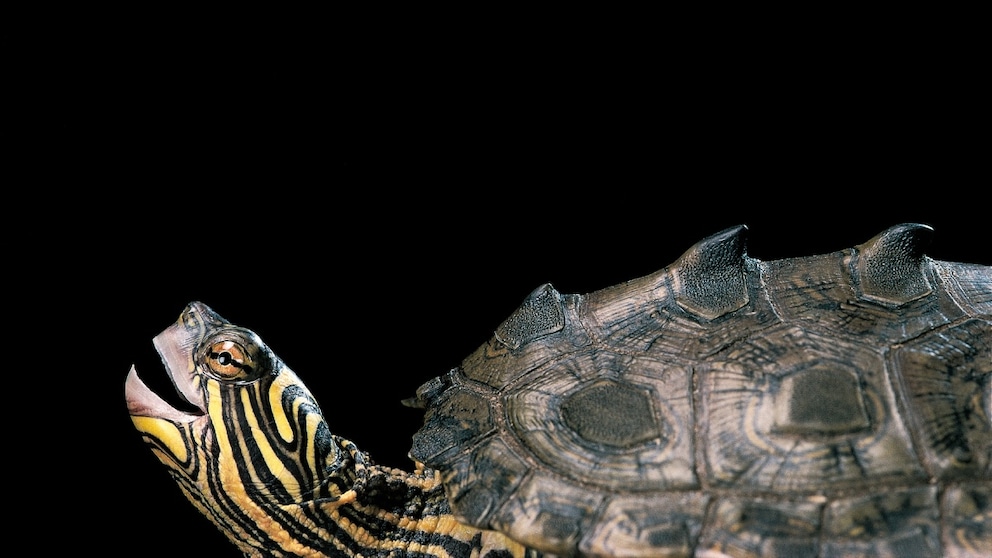
The black-knobbed map turtle is characterized by its distinctly structured shell (carapace), which bears small black knobs on the central vertebral scutes. These are particularly pronounced in males on the second and third vertebral scutes. The carapace is green to olive-brown and patterned with striking yellow rings or semicircles.
The plastron varies greatly in its pattern: While Graptemys nigrinoda nigrinoda usually has a pale or yellowish plastron with fine markings, the rare subspecies Graptemys nigrinoda delticola has a darker and nearly uniformly pigmented plastron.
The head is narrow, with two to four yellow lines extending to the eyes. Males have elongated front claws—a feature that plays a role in courtship behavior. Overall, the species appears very decorative due to its compactness and contrasting coloration.
Behavior
Black-knobbed map turtles are considered shy and reserved animals that quickly flee into the water when disturbed. Nevertheless, well-acclimated turtles can be observed basking or swimming. They show pronounced activity during the day but also spend a lot of time floating at the water surface to soak up warmth.
The species is generally peaceful and has low aggression potential—especially in males. While solitary housing is recommended, same-sex groups are possible under certain conditions with an appropriate tank structure.
Black-knobbed map turtles benefit from variety in their daily routine. A sandy substrate particularly encourages foraging, activating natural search behavior. Swimming space is essential—the turtles like to cover longer distances in the tank. Swimming obstacles, current simulations, or movable plant islands provide additional stimuli. Changing feeding locations also promotes mental engagement.
Proper Care & Maintenance
A spacious aquaterrarium is essential for housing. Male turtles can manage with tanks at least 100 cm long, while females require at least 120 cm. A high water level—at least three times the shell length—is crucial, with 30 cm or more being optimal.
The substrate should ideally be fine sand to support foraging. A simple tank setup with securely fixed stones or roots is recommended. Plants are usually eaten or uprooted—only robust species like Anubias occasionally persist.
A dry land area with UV lighting is mandatory, as a suitable sunbathing spot is necessary to prevent shell diseases. HQI lamps with UV-A/UV-B components provide the necessary lighting and temperature (up to 40 °C). The water temperature should be adjusted throughout the year, as should the light duration, since the black-knobbed map turtle undergoes a pronounced cycle.
The winter months from December to February are marked by complete winter dormancy, during which neither lighting nor heating is used—the water temperature remains at a consistently cool 10 to 15 °C. Starting in March, both light duration and temperature gradually increase: From 6 hours of light and about 17–20 °C in March, the intensity rises to up to 13 hours of lighting at a maximum of 28 °C in July and August.
In the fall, the values should gradually decrease again: Starting in September, the lighting duration is continuously shortened, and water temperatures drop until they are prepared for winter dormancy again in November with partially staggered light duration (5, 3, 1, 0 hours). This staggered annual profile is crucial for a natural and healthy care of the species.
Diet
The black-knobbed map turtle is an opportunistic omnivore. Reports indicate that the diet of males consists of about 60 percent animal matter, while for females, this proportion is about 70 percent. Preferred foods include insects, worms, crustaceans, and sponges. Bryozoans and snails are also accepted. Plant components such as algae, duckweed, or hornwort complement the diet.
In the aquarium, live food (worms, grasshoppers), frozen food (Mysis, Tubifex), and dried food and flakes (Gammarus, shrimp) are suitable. High-quality pellets are also possible. A varied diet promotes vitality and growth. Cuttlefish bones or eggshells should be available at all times to meet calcium needs.
Map Turtle – Origin, Characteristics and Lifestyle
Proper Care for the Painted Turtle Chrysemys picta and Its Four Subspecies
Susceptibility to Certain Diseases
Like many aquatic turtles, black-knobbed map turtles are prone to shell diseases—especially with insufficient UV lighting and high humidity. Moist or inadequate land areas promote bacterial infections and shell necrosis. Therefore, a completely dry sunbathing spot is important.
Poor water quality can also lead to skin or eye infections. Regular water changes and a powerful external filter are therefore indispensable. For females, a suitable egg-laying site is necessary—even without males, as unfertilized eggs must be laid. Otherwise, life-threatening egg retention can occur.
The Black-Knobbed Map Turtle at a Glance
- Size: Males 7.5–12 cm, females up to 22.1 cm
- Distribution: Alabama and Mississippi, USA
- Character: Shy, calm, sun-loving, low aggression
- Diet: Omnivore with high animal content
- Shell: Green-brown with yellow patterns, black knobs on the back
- Care: Aquaterrarium with high water level and a sunbathing spot
- Winter Dormancy: 3 months necessary