

September 26, 2026, 10:09 am | Read time: 5 minutes
Do fish actually sleep? And if so, how, when they can’t close their eyes? The answer is fascinating: Fish need rest just like other animals, but they’ve developed their own unique strategies. PETBOOK explains how to recognize sleeping fish and which species might even dream.
Overview
How long do fish sleep?
Fish need sleep too. However, they don’t spend several hours at a stretch in bed like we do; instead, they usually rest in shorter sleep phases. Many species sleep about five to eight hours a day. To get enough rest, they rely on a regular cycle of light and darkness. In aquariums, this is often simulated with a timer that automatically turns the light on and off.
Also interesting: Do fish actually need to drink water?
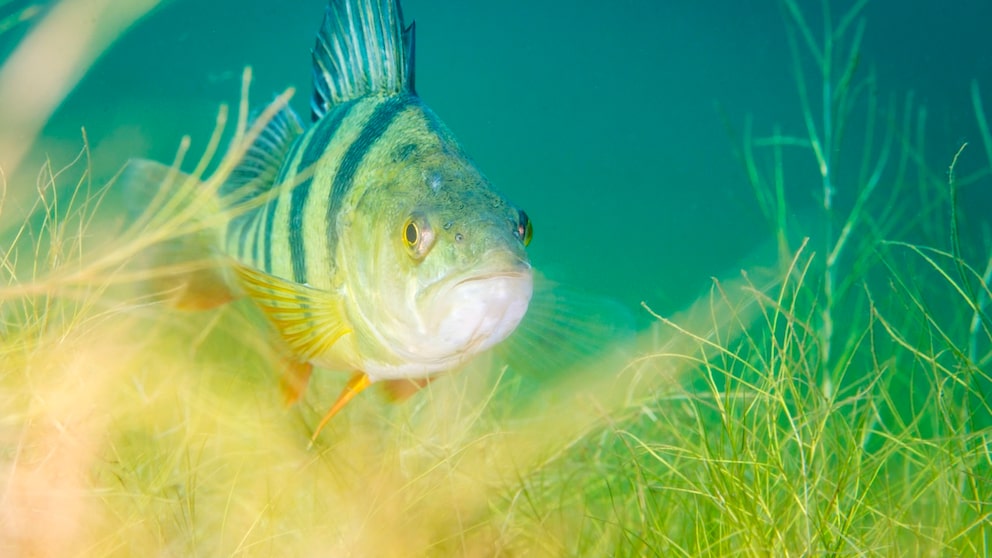
The importance of lighting for fish sleep is demonstrated by a study by scientists from the Leibniz Institute of Freshwater Ecology and Inland Fisheries in Berlin. They found that river perch produce less melatonin in bright conditions. The hormone regulates the day-night rhythm. Artificial light sources could therefore cause fish in urban waters to sleep poorly.
Conclusion: Fish usually sleep in short intervals. While some species rest for only a few seconds, others can sleep for several hours. Most fish only become truly tired at nightfall–even if their eyes remain open.
When do fish sleep?
Like many other animal groups, there are diurnal and nocturnal fish. Fish that are more active during the day and sleep at night when it’s dark include the colorful fish living in coral reefs. At night, they often take on a subdued coloration that provides excellent camouflage. The parrotfish in the Indo-Pacific Ocean, for example, envelops its body in a protective mucus layer every evening, which suppresses its scent and protects it from predators like moray eels.
Nocturnal fish such as moray eels, eels, mackerel, zander, or groupers hunt at dusk, so they sleep during the day. However, there are also diurnal fish species that take naps during the day.
In what positions do fish sleep?
Some marine animals like dolphins or toothed whales shut down one hemisphere of their brain and close the corresponding eye. The eye on the side of the active brain hemisphere remains open. This is known as “unihemispheric sleep.”
Some marine creatures hide in dark caves or among plants to sleep undisturbed. This is not possible for the giant sperm whale. It simply stands vertically and sleeps deeply in the water. Due to its size, it doesn’t need to worry about predators. However, it can collide with ships because it sleeps so soundly that it often doesn’t hear them approaching.
However, dolphins and whales are mammals that evolved from land back to marine life. But what about fish?
Open-ocean sharks, like the great white shark, cannot sleep on the bottom or in caves due to their oxygen needs. They must constantly move to ensure oxygen-rich water flows through their gills. They don’t seem to truly sleep. However, they have rest phases where they swim more slowly. Sleep research on sharks is still very rudimentary.1
Schooling fish, like tetras, doze in the safety of the group. Researchers suspect that each group has sentinels that warn the other sleeping fish of danger.

Why Cats Suddenly Twitch in Their Sleep

How Long Do Cats Really Sleep?
How can you tell if a fish is sleeping?
When dogs and cats have their eyes closed, we know they’re sleeping. Like us, as land animals, they protect their eyes from drying out by closing their eyelids during sleep. Most fish, however, don’t have eyelids because they don’t need them in water. Since fish sleep with their eyes open, you must look for changes in vital and bodily functions to determine if they’re sleeping. This includes, for example:
- Is the gill breathing slowed?
- Does the fish respond to external stimuli in its environment?
- Is it “hovering” motionless in one spot in the water or in the middle or lower part of the aquarium? (The fins may still move slightly)
- Is it perhaps lying on the bottom under a rock, a tree stump, or a decorative piece in the aquarium?
Warning: If the fish is lying on its side on the bottom and eventually floats belly up, it is likely dead.2
How do fish and human sleep phases differ?
Our sleep is roughly divided into the non-REM phase and the REM phase, with the non-REM phase further divided into different stages. During these, muscle tension, heart rate, and breathing decrease until a person falls into deep sleep. This entire phase lasts about 20 minutes.3
This is followed by the REM (“Rapid Eye Movement”) phase, during which rapid eye movements occur, and we begin to dream. This phase is particularly important for psychological regeneration. Fish also significantly lower their metabolism, but they never fall into deep sleep.
Scientists believe that most fish species remain in a sort of twilight mode so they can flee from predators at any time. However, the zebrafish contradicts this theory. Sleep researchers at the Stanford University School of Medicine in California found in a study that zebrafish experience deep sleep and dream sleep. This was evident from their heart rate and muscle tone. However, they did not exhibit the strong eye movements typical of the REM phase.