

September 8, 2026, 6:53 am | Read time: 5 minutes
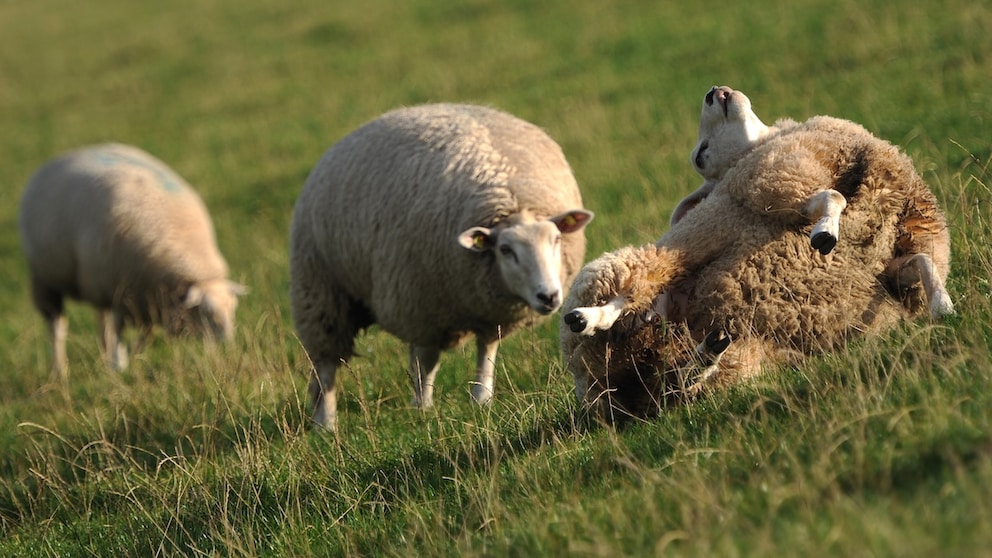
What initially sounds bizarre is actually a well-known issue in sheep farming: Time and again, walkers discover sheep lying helplessly on their backs, unable to get up on their own. Often, a determined push is what saves the animals’ lives. PETBOOK explains why sheep end up in this predicament and why quick action can be crucial.
When Their Own Fleece Becomes a Danger
What initially sounds like a quirky coastal custom has a serious background. Despite their robust appearance, sheep often find themselves in life-threatening situations: Some sheep—especially pregnant ones or breeds with short legs—roll onto their backs and can’t right themselves. In such cases, every minute counts. That’s why the Lower Saxony Farmers’ Association repeatedly calls for help: “Pushing sheep” is explicitly encouraged.1
Especially in the warmer months, many sheep carry particularly dense, heavy fleece. This strong hair growth is the result of selective breeding—with serious consequences for the animals. When it becomes damp or warm, the skin under the wool quickly starts to itch. To scratch themselves, sheep roll on the ground. However, not all animals can get back on their feet afterward.
This results in sheep with particularly pronounced body structures often remaining helplessly on their backs. In this position, they face a quick death: Gases accumulate in the digestive system—specifically in the rumen—which can cause the animal to die painfully within a short time if no help arrives.
Also interesting: The Amount of Animal Suffering in Cashmere Wool
Torturous Breeding Instead of Nature—The Problem Is Man-Made
Many modern sheep breeds are the result of extreme breeding measures. To obtain as much wool and meat as possible, the natural molting process was bred out of the once wild-living mouflon. The fleece continues to grow endlessly—a process no longer compatible with the animal’s natural anatomy.
The so-called wool sheep can no longer shed their fleece on their own. Especially in the summer months, the heavy wool leads to severe itching, causing some animals to roll onto their backs to scratch themselves.
In addition to the fleece, other physical characteristics hinder mobility. Particularly in breeds kept for their meat, a broader torso was deliberately bred. The broad body structure combined with short legs makes it extremely difficult to stand up. Sheep lying on their backs are therefore completely dependent on human help—in the form of a strong push.

Did You Know That Lanolin is Derived From Sheep?
When the Tail Ensures Survival–The Curious Story of Fat-Tailed Sheep
How to Push Sheep Safely and Without Stress
With the right technique, any walker can help quickly and without stress. It’s important to proceed calmly and securely, so as not to further panic the animal. First, observe it briefly from a distance, then approach the animal at a calm pace—ideally from the side. This is the least threatening for the animal. Sheep are flight animals with a wide field of vision, mainly to the side and rear. Approaching directly from the front or back can surprise the helpless animals, as they cannot see it directly.
Then, gently grasp the sheep by the fleece—do not pull on the legs or head! The most effective way to help is to give the sheep a firm but controlled push on the hindquarters. This sets the body in motion, allowing the animal to roll into a side position. Support the movement calmly with some force through your hands, helping the sheep roll until it is back on its feet.
Once the sheep is standing or runs away, keep your distance. Petting or following would again cause stress for the animal. Give it time to calm down. If the animal does not behave normally after being upright or continues to lie down, contact the responsible shepherds or the nearest animal protection agency. Contact information is often posted on pasture fences or information boards.
Animal Welfare, but Not Species Protection
The call to push sheep is sensible and correct from an animal welfare perspective. However, as emphasized in the owners’ press release, it has nothing to do with “species protection.” Unlike wild animals such as wild bees or meadow birds, livestock breeds are not at risk of extinction—they will continue to be bred as long as humans derive meat, wool, or milk from them.
Due to the constant fleece production, sheep are necessarily dependent on regular shearing. But this also carries risks: If sheared too early, a sudden cold snap can lead to death from hypothermia. If the fleece remains too long, life-threatening heat strokes can occur in summer heat. Additionally, shearing is extremely stressful for the flight animal sheep—a situation with no real escape for the animals.
The idyllic image of peacefully grazing sheep on the dike should not be misleading: These animals have been deliberately bred to benefit humans. Helping a sheep back on its feet aids the individual animal—but does not change the underlying conditions. The rescued animal remains part of a system that envisions its utilization.
Those who wish to help sheep sustainably can only break the system of overbreeding by consistently avoiding products derived from them. Even beyond meat and milk, there are now numerous alternatives to sheep wool—all without animal suffering. Many of these products are not only high-quality but also comfortable to wear—and don’t even itch. 2