

December 10, 2025, 4:32 pm | Read time: 6 minutes
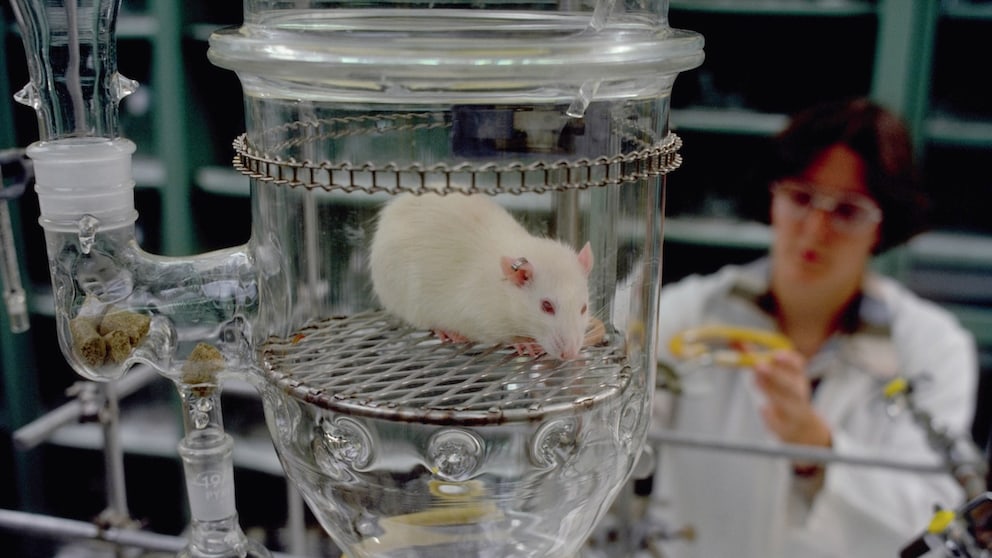
Every December, the Federal Institute for Risk Assessment (BfR) publishes the number of animals used or killed for scientific purposes in Germany. For the reporting year 2024, it shows: The number of laboratory animals has decreased for the fifth consecutive year—yet despite the renewed decline, millions of animals still die for research.
3.06 Million Laboratory Animals in 2024—Including Organ Donors and “Surplus Animals”
In total, 3,063,569 animals were used or killed for scientific purposes in Germany in 2024. This number comprises:
- 1,327,931 animals actually used in experiments,
- 626,538 animals killed solely for organ or tissue extraction,
- and 1,109,100 animals bred for scientific purposes but ultimately not used, and still killed.
The BfR also distinguishes between animals used in an experiment for the first time and those reused. In 2024, 1,302,190 animals were reported for the first time, while 25,741 animals were used multiple times.
The number of animals killed not in experiments but for organ or tissue extraction was 626,538 in 2024—nearly seven percent less than the previous year (671,958). Adding these animals to those used in experiments results in a total of 1,954,469 scientific uses for 2024. In 2023, it was around 2.13 million, about eight percent more.
Thus, 2024 saw the fewest laboratory animals used in years—the numbers have decreased for the fifth consecutive time. Nevertheless, the statistics still mean that millions of animals are used or killed for research and science.
Over 1.1 Million “Unused” and Killed Animals
Since 2021, Germany has also counted animals bred for scientific purposes but never used and still killed. These can include offspring of genetically modified lines that do not carry the desired mutation, animals “of the wrong sex,” or animals too old for the planned experiment.
In 2023, there were 1,373,173 so-called “unused, killed” animals. This number has decreased by about 19 percent in just one year—since the start of recording in 2021, it has more than halved overall. Nevertheless, the scale remains enormous: Over a million animals die without ever being used in an experiment.
Which Animal Species Were Most Affected in 2024?
Despite the decline, the fundamental picture changes little: As in previous years, small mammals and fish are primarily used.
Of the 1,327,931 animals in experiments:
- Mice: 956,636 animals (72.0%)
- Rats: 83,369 animals (6.3%)
- Fish (zebrafish and other species): 176,778 animals (13.3%)
- Rabbits: 57,966 animals (4.4%)
- Birds (domestic chickens and other bird species): 16,304 animals (1.2%)
- Other species (including dogs, cats, monkeys, other mammals, reptiles, amphibians, cephalopods): 36,878 animals (2.8%)
Thus, mice and rats together account for almost 80 percent of all laboratory animals. Fish form the second-largest group but remain below the peak levels of previous years.
Monkeys, Dogs, Cats—Small Groups, Big Debate
Although they are far behind mice and fish in numbers, monkeys, dogs, and cats are particularly in the public spotlight. The number of uses of monkeys and prosimians reached a new low in 2024: 1,088 uses—about 35 percent less than the previous year.
Because around 19 percent of these animals are reused, the number of first-registered individuals is significantly lower at 876 animals. Monkeys are predominantly used for regulatory purposes, such as in the approval of new human medicines. Great apes (primates) have not been used for scientific purposes in Germany since 1991.
Dogs and cats are used, among other things, in applied research and for legally required tests:
- Dogs: 2,220 animals in experiments (2023: 2,550; a decrease of about 13 percent)
- Cats: 698 animals in experiments (2023: 544; the number increased significantly)
The high proportion of reused animals is notable: About 64 percent for dogs and around 51 percent for cats. Therefore, only 806 dogs and 340 cats were included in the statistics of first-recorded animals in 2024.
How Much Did the Laboratory Animals Suffer in 2024?
The BfR classifies the burden on animals into four categories: no restoration of life function, mild, moderate, or severe.
For 2024:
- 63 percent of the animals were mildly burdened—similar to the previous year (63.8 percent).
- 28.4 percent were subjected to moderate burdens.
- 3.6 percent of the animals were used in severely burdensome experiments, keeping the proportion at the low level of 2023.
- About 5 percent of the uses occurred under full anesthesia, from which the animals did not awaken.
In absolute numbers, this means that tens of thousands of animals still suffer in experiments associated with massive pain, suffering, or permanent damage.
What Are the Animals Used For?
Despite many alternative methods—from cell cultures to organoids to computer-based models—animal testing still plays a central role in some areas of research.
The distribution of laboratory animals in 2024:
- Basic research: about 57 percent of the animals
- particularly common in the areas of the immune system (22%) and nervous system (20%), as well as oncology, metabolism, and developmental biology
- Translational and applied research: about 15 percent
- focus: human cancers (43.4 percent of the animals in this area), as well as nervous and mental disorders, infections, and cardiovascular diseases
- Production and quality control of medical products / toxicological safety tests: about 17 percent
- Maintenance of genetically modified colonies: about 7 percent
- Other purposes (conservation, environment, education, training): together about 4 percent
Thus, basic research remains the area where most animals are used, often without a direct benefit for humans.
Are Woolly Mice the First Step on the Way to Reviving the Mammoth?

EU Fur Industry Costs Us 446 Million Annually
Genetically Modified Animals
A large portion of laboratory animals is genetically modified:
- 2023: 738,066 genetically modified animals (50.6 percent)
- 2024: 658,559 genetically modified animals (49.6 percent)
For the first time since 2021, slightly more non-genetically modified animals than genetically modified ones were used. At the same time, the proportion of genetically modified animals whose modification demonstrably impairs well-being increased from about 23 to around 25 percent. Mice and zebrafish are particularly often genetically modified.
Since 2020, the first reporting year published by the BfR, the numbers have been trending downward. At that time, the COVID-19 pandemic had already led to a noticeable drop in animal testing. Since then, both the number of animals in experiments and the number of killed animals have decreased—and since 2021, also the number of unused, killed animals. This trend continues in 2024, yet the overall picture remains troubling.
Politics Praises Decline—PETA Calls for System Change
The renewed decline in laboratory animal numbers elicits different reactions. Silvia Breher, the federal government’s commissioner for animal welfare, sees the development as a clear sign that alternative methods are gaining importance. “The fact that the number of laboratory animals in science and research has fallen to a record low again is really good news.”
At the same time, Breher makes it clear that many animals are still used in the laboratory animal sector. The trend must therefore “be an incentive to further reduce the number of laboratory animals.” The assessment from the perspective of the animal rights organization PETA is different. “We call on the federal government to seize the momentum and finally advocate for an end to these cruel and unnecessary methods,” says specialist Sabrina Engel.
The total number shows “the lowest level in years,” but also that animal testing is an outdated model and not as indispensable as often claimed. “Instead of poisoning mice with chemicals or drilling into monkeys’ skulls, science must fully focus on research and testing methods without animal suffering.”
While Breher interprets the numbers as a success and evidence of progress in animal welfare, PETA sees it as an argument for a complete system change. The handling of laboratory animals thus remains a politically and ethically contested issue—despite declining numbers.