

October 7, 2025, 11:42 am | Read time: 4 minutes
The pressure on valuable deep-sea resources is growing—but the consequences for many marine species could be catastrophic. An international study warns: 30 species of sharks, rays, and chimeras are acutely threatened by deep-sea mining. Many of them are already on the Red List of Threatened Species. Particularly alarming: Even the smallest changes in the depth of the so-called wastewater plumes could determine whether species survive—or disappear.
Norway’s Deep-Sea Initiative
As the first country in the world to do so, Norway planned to allow industrial mining of rare earths and metals in the deep sea starting in early 2024. The proposed areas, located between Svalbard and East Greenland, cover about 281,000 square kilometers and contain valuable deposits of cerium, copper, and zinc—resources needed for batteries, chips, and electric vehicles.
However, the decision sparked an outcry: Scientists, conservationists, and environmental organizations such as WWF warned that the plans could destroy unique, largely unexplored ecosystems. Deep-sea mining was subsequently not included in Norway’s 2025 state budget—a first success for the critics. WWF Norway even sued the state to set a precedent.
“For 99 percent of the affected area, there is no environmental data,” explains Kaja Loenne Fjaertoft, a marine biologist at WWF Norway. PETBOOK also spoke with Till Seidensticker, a marine expert at Greenpeace, about the massive risks of the planned deep-sea mining.
“What Is Destroyed There Is Irretrievably Lost”
“There can fundamentally be no deep-sea mining that spares the deep sea and its ecosystems,” Seidensticker previously said in an interview with PETBOOK. “The areas now being targeted in Norway are full of unique habitats—such as active and inactive black smokers, where hot water emerges from the seabed. Species live there that are found nowhere else. These ecosystems are self-contained—if you destroy them, they are irretrievably lost.”
Moreover, the consequences of such interventions are felt for millennia: “The machines grind down the surface of seamounts, destroying corals and habitats that develop extremely slowly. Life in the deep sea is sluggish because there is little light, food, or movement. Any disturbance acts like an earthquake there—only nature does not recover.”
Study Confirms: Sharks and Rays Particularly at Risk from Deep-Sea Mining
How severe the consequences could actually be is shown by a recent study by Aaron B. Judah and an international research team from the universities of Hawai’i, Dalhousie, Simon Fraser, Washington, NIWA New Zealand, and Tasmania. The results will appear in the November 2025 issue of the renowned journal “Current Biology.”
For the first time, the study comprehensively examined the specific risks deep-sea mining poses to 30 selected species of cartilaginous fish—namely sharks, rays, and chimeras. The researchers analyzed how much the habitats of these species overlap with planned mining areas for polymetallic nodules, sulfides, and cobalt-rich crusts.
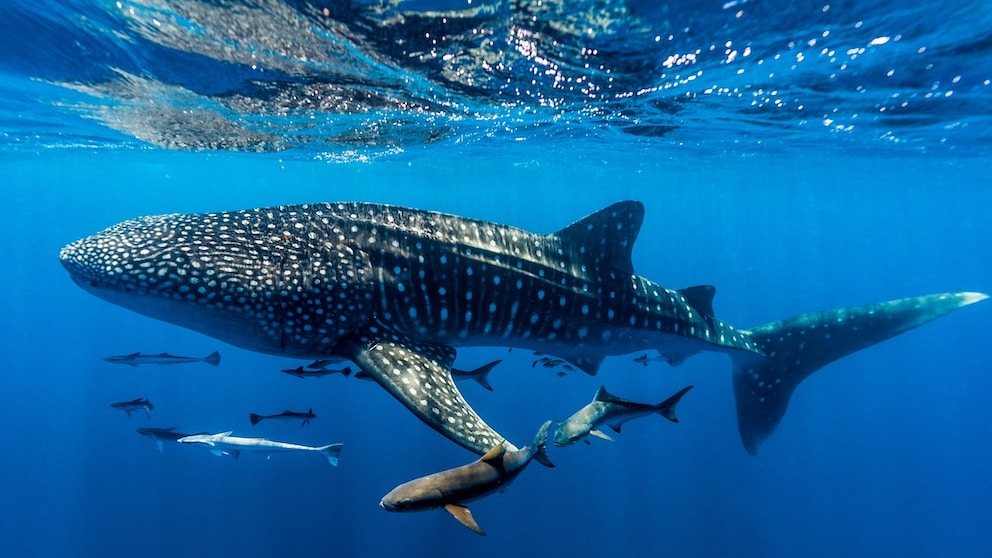
The result: 30 species overlap spatially and vertically with future mining zones, including 20 sharks, eight rays, and two chimeras. Species with limited mobility or bottom-dwelling lifestyles are particularly affected. A full 83 percent of the species studied show critical overlap with mining areas, 87 percent with polymetallic sulfides. Many are already considered threatened, such as the chocolate skate (Rajella bigelowi) or the whale shark (Rhincodon typus). Overall, 18 of the 30 affected species are already listed as threatened according to the IUCN Red List—60 percent. Extrapolated to some of the less-researched species, where no statements about their threat level can yet be made, the proportion is likely over 64 percent. 1
70 Shark and Ray Species Receive Global Protection
Sharks on Drugs! Cocaine, Caffeine, and Acetaminophen Found in Animals’ Blood
Noise, Sediments, and Unclear CO₂ Losses
The study shows that not only the machines on the seabed but also the wastewater plumes—sediment clouds from the mining operations—pose a massive threat. Pelagic filter feeders like whale sharks or devil rays could be severely affected by murky, nutrient-poor layers.
In addition to the direct destruction of the seabed, deep-sea mining also carries indirect risks: The noise from underwater excavators can severely disturb whales and dolphins, which rely on acoustic orientation. “Whales need their hearing to survive. If it is damaged, it can be fatal,” Seidensticker previously warned in the PETBOOK interview.
Moreover, it is still barely researched what role the deep sea plays in carbon storage. If its ecosystems are destroyed, bound CO₂ amounts could be released—with potential feedback effects on the climate.
Conclusion: Precaution Instead of Risk
The study demonstrates that deep-sea mining poses a massively underestimated risk to marine life—especially for threatened, bottom-dwelling, or filter-feeding species. It also shows that targeted measures such as deeper wastewater discharges, protected areas, and stricter environmental impact assessments could help avoid the worst damage.
But as long as the research gaps remain so large, experts warn against an experiment with unforeseeable consequences. “A green label has no place in the debate on deep-sea mining,” emphasized Seidensticker. “Anyone who takes sustainability seriously must preserve—not exploit—the last untouched ecosystems of our planet.”