

January 2, 2026, 10:39 am | Read time: 4 minutes
Fingerprints are considered a reliable means of identification in humans–no two are alike, even in identical twins. But is this individuality truly exclusive to humans? In fact, there are remarkable parallels in the animal kingdom–and a surprise among marsupials.
Unlocking phones, opening doors, catching criminals: Much is possible thanks to human fingerprints. Technically, our fingerprint is an impression of the papillary ridges, the curved lines on the underside of the fingertips. These form a complex pattern of arches, loops, whorls, and branches. But what about the animal kingdom: Do animals have fingerprints too?
How many people have the same fingerprint?
We humans like to emphasize what sets us apart from our animal counterparts–such as the development of detailed communication and acting according to ethical and moral principles. Yet scientific studies repeatedly show that we are more similar to our closest relatives in the animal kingdom, the great apes, than we might think. What about fingerprints: Do animals, especially primates like chimpanzees, have this feature? And if so, does it reveal as much about animals as it does about us? 1
Because the human fingerprint is unique. According to scientists, the probability that two people have the same fingerprint is 1 in 64 billion. So far, no cases of people with identical fingerprints have been reported. Even in identical twins, the fine ridges on the fingertips show slight differences–despite their otherwise striking resemblance.
The reason lies in the development of fingerprints in the womb. They form between the eighth and twelfth weeks of pregnancy, when the fingers are developing. While the basic structures of fingerprints are inherited, random factors such as the movements of the embryo create individual variations on the ridged skin surface. But does this also apply to animals? 2, 3
Also of interest: Why the term “Big Five” for African wildlife is problematic
Do apes have fingerprints?
Besides humans, great apes like gorillas and chimpanzees also have distinctive fingerprints. The skin on their fingertips and the soles of their feet is also individually ridged. The papillary ridges developed over the course of evolution when our ancestors lost the hair on their hands and feet and developed firm pads there.
The purpose: The fine lines on the epidermis increase friction when gripping a smooth surface, allowing for a secure grip. Incidentally, fingerprints remain the same for humans and apes throughout their lives, unless altered by a scar or similar.

Why Wombats Have Such Hairy Snouts
Animals also mourn the loss of their own kind
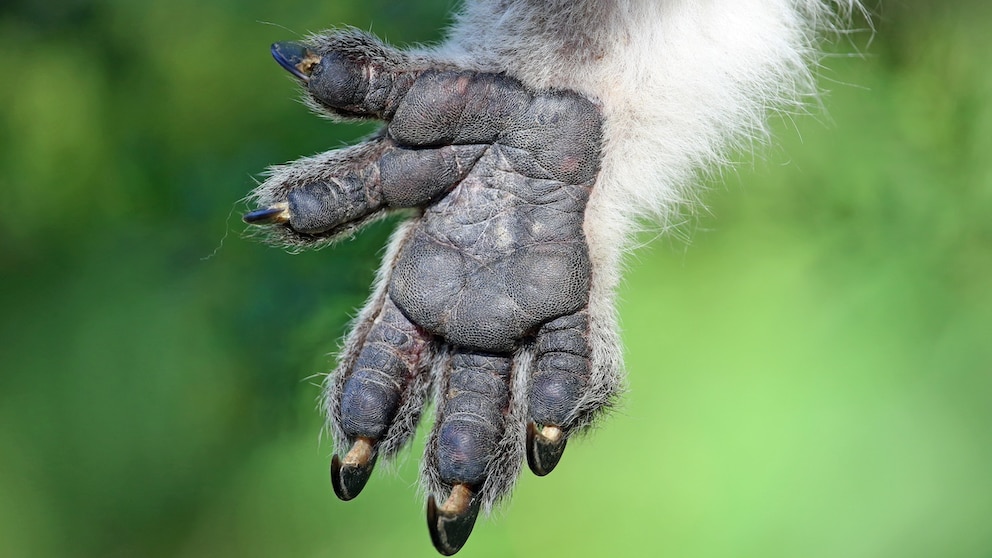
Koala fingerprints resemble human ones
But there is another animal with a unique fingerprint: the koala. It also has papillary ridges–fine lines on the skin of the fingertips–that form an individual pattern. Particularly astonishing: Koala fingerprints are so similar to human ones that they are almost indistinguishable under a microscope.
A study by the University of Edinburgh shows that such patterns in humans arise from specific signals in the skin. These signals ensure that more skin cells grow in certain areas, where the ridges then form. These patterns develop from within, without the need for external influences. Researchers suspect that a very similar mechanism occurs in koalas. Thus, despite significant differences, very similar fingerprints could develop in both humans and animals.4
Nose prints in dogs
Dogs don’t have fingers and therefore no fingerprints. However, our pets can also be uniquely identified by a distinctive feature–their nose print. A dog’s nose has a variety of different lines and patterns that form a unique nose print.
A Korean start-up is taking advantage of this fact. With the “Petnow” app, dog owners can register their pets using their nose prints. Here’s how it works: You scan the dog’s nose with a smartphone camera. The biometric data is then stored along with the owner’s contact information. If the dog ever runs away, it can be identified and returned to its owner based on the stored information. The creators promise a success rate of 98.97 percent.5