

August 10, 2026, 4:19 am | Read time: 6 minutes
A single poison dart frog carries enough toxin to kill several humans. Yet, despite the deadly substance coursing through its body, the animal remains completely unharmed. But how do these creatures manage not to poison themselves? PETBOOK investigates this question.
Why don’t poisonous animals poison themselves?
A poison dart frog can carry enough toxin to kill several humans. Some birds also store potent toxins in their skin, feathers, and muscles. For predators, an encounter with them can be dangerous, but the animals themselves seem unaffected by their chemical weapon.
This is precisely the puzzle: Why don’t poisonous animals poison themselves? For a long time, researchers assumed they were simply immune to their own toxins. However, it now appears that the answer is more complicated. Some species may neutralize their toxins within their bodies using special proteins, a kind of natural “toxin sponge.”
The poison dart frog is one of the most poisonous animals in the world
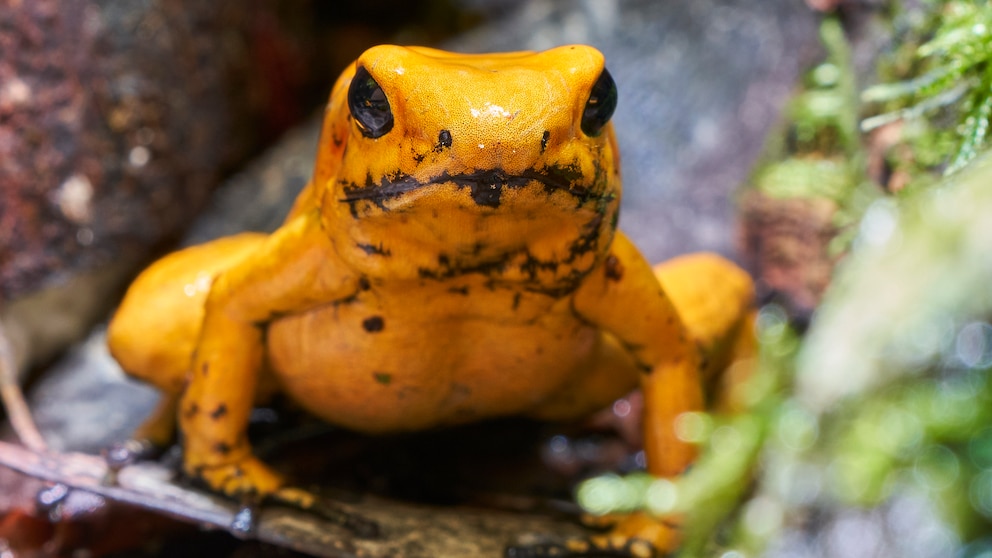
Poison dart frogs, also known as tree frogs, live in the rainforests of Central and South America. Their bright colors signal to predators that they are not to be trifled with. Due to a neurotoxin they secrete through their skin, they are among the most poisonous animals in the world. Their toxin is 200 times more potent than morphine. If it enters the bloodstream of animals–and humans–it can be fatal, paralyzing muscles and respiration within minutes. A single golden poison dart frog can kill ten adult humans with its toxin.
Their name, poison dart frogs, is well-earned. Indigenous people in Colombia and Panama use the toxic skin secretions as poison for blowgun darts. Some of the colorful frogs secrete particularly large amounts of toxin through their skin glands. Simply rubbing a dart across the back of a living frog is enough to turn it into a deadly weapon.
However, the frogs are not born as toxin-producing amphibians. When kept in a terrarium, they even lose their deadly properties. Captive-bred frogs are completely toxin-free unless their diet is re-enriched with toxins. In the wild, poison dart frogs absorb toxic chemicals from insects and other arthropods, such as ants, mites, and millipedes, and store them.
Also interesting: Why small scorpions are often more poisonous than large ones
Rainforest bird with poisonous skin, muscles, and feathers
The skin, muscles, and feathers of the hooded pitohui, a bird living in the rainforests of Papua New Guinea, contain the same toxin as the secretion from the poison dart frog. This trait of the small bird with bright orange-black plumage was discovered only about 33 years ago. Even minor injuries to human skin can cause numbness and burning pain upon contact with the feathers. The bird, also known as the hooded pitohui, uses its toxin to protect itself from predators. A dangerous poisoning for humans can only occur if large amounts of bird meat are consumed.
Similar to poison dart frogs, the hooded pitohui acquires its defensive toxin through its diet. The bird specifically eats a certain type of toxic beetle. The more of these beetles the rainforest bird consumes, the more toxic its feathers, muscles, and skin become. Another positive side effect is the protection of its plumage from parasites–a benefit the toxic skin secretion of the poison dart frog is also believed to provide for the amphibian. The toxins from beetles, millipedes, or ants are primarily meant to protect against predators. Just like with the frog and bird, the toxins seem to have no effect on them. How is it that these poisonous animals do not poison themselves when consuming their prey?
Strategies of poisonous animals to avoid self-poisoning
Scientists have long puzzled over why poisonous animals that ingest their own “chemical weapon” do not poison themselves. The term used in scientific circles for “self-poisoning” is autointoxication. In the animal kingdom, there are various strategies to prevent such a process. The most common is described as a genetic mutation. In this case, the shape of the target protein of the toxin in the organism changes slightly, preventing it from binding to this protein.
A study published in 2017 shows that the resistance of the blue poison dart frog, a subspecies, to its own toxin is due to this protective mechanism. Another strategy that poisonous animals use to protect themselves from self-poisoning is the removal of the toxin from their own bodies. This adaptation is mainly used by predators that eat poisonous animals.
Have you heard of the world’s most poisonous bird?

The Most Poisonous Animals in the World
Researchers suspect “toxin sponge” as a protective mechanism in frogs and birds
The third strategy involves intercepting the toxins within the organism. Animals use a kind of “protein sponge,” also referred to as a “toxin sponge.” The production of a protein to which the toxin binds prevents it from attaching to other, vital proteins. These sponge proteins neutralize the toxin present in the organism.
In a 2021 study, scientists proposed that both the poison dart frog and the hooded pitohui use the strategy of a toxin or protein sponge. The scientific term for this is sequestration. Tests conducted on the frogs showed that the animals were not immune to their own toxin. Therefore, they must neutralize the toxin.
Venomous snakes can neutralize their own venom
Although it is not immunity in the case of poison dart frogs and hooded pitohuis, this is the case for other animals, including venomous snakes. The reptiles are exposed to their own venom in only one situation, which occurs multiple times daily: when they eat their prey. At this point, the prey is either dead or paralyzed–in any case, poisoned. The reason snakes do not die when they consume prey with high venom content is due to their immunity and another secret weapon.
Also interesting: The snake with the longest venomous fangs is …
The proteins of a certain type, which primarily make up snake venom, cannot withstand the stomach acid of the reptiles. When acid encounters them, they change shape and become ineffective. While snakes are immune to the venom of their own species, this protective mechanism helps them with venom from other species. This allows them to consume prey killed by other venomous snakes. Other poisonous animals also cannot poison themselves. This includes scorpions, which are largely immune to their own venom. A sting lethal to them would have to contain enough venom to kill 100 to 200 guinea pigs.
Source
- Abderemane-Ali, F., Rossen, N. D., Kobiela, M. E., Craig, R. A., Garrison, C. E., Zhou, C., Colleran, C. M., O’Connell, L. A., Du Bois, J., Dumbacher, J. P. & Minor, D. L. (2021). Evidence that toxin resistance in poison birds and frogs is not rooted in sodium channel mutations and may rely on “toxin sponge” proteins. The Journal of General Physiology, 153(9).
- Dumbacher, J. P., Menon, G. K. & Daly, J. W. (2009). Skin as a toxin storage organ in the endemic New Guinean GenusPitohui. The Auk, 126(3), 520–530.
- Tarvin, R. D., Borghese, C. M., Sachs, W., Santos, J. C., Lu, Y., O’Connell, L. A., Cannatella, D. C., Harris, R. A. & Zakon, H. H. (2017). Interacting amino acid replacements allow poison frogs to evolve epibatidine resistance. Science, 357(6357), 1261–1266.
- a-z-animals.com, „Are snakes immune to their own venom?“ (accessed on 08/07/2026)
- scinexx.de, „Mit Schere und Stachel“ (accessed on 08/07/2026)