

July 9, 2026, 3:01 pm | Read time: 3 minutes
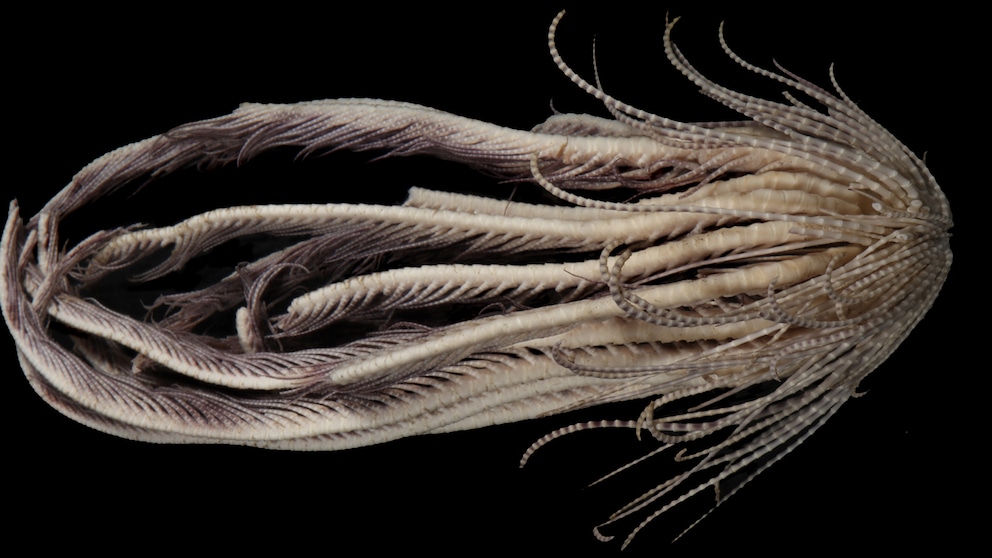
In the depths of the Southern Ocean lives an unusual creature with 20 “arms” and tiny claws: the Antarctic strawberry feather star. Scientists first described the new species in detail in 2023. However, it did not receive its name because of its color or numerous arms. Only a closer look at the underside of the animal reveals what it has in common with a strawberry.
Why the Deep-Sea Creature Is Called “Strawberry Feather Star”
The new species was discovered in the Southern Ocean at depths of 65 to 1,170 meters when scientists dragged a net through the water. The 20 “arms” of the deep-sea creature, which can be up to eight centimeters long, differ from each other—some have a rough surface, while others appear feather-like. These long, tentacle-like parts are typically spread out and help the marine animal move. Tiny claws at the tips allow it to anchor itself to the ocean floor.
The marine animal was named the Antarctic strawberry feather star by the scientists. This fruity naming might seem odd at first, as the deep-sea creature does not initially resemble a strawberry.
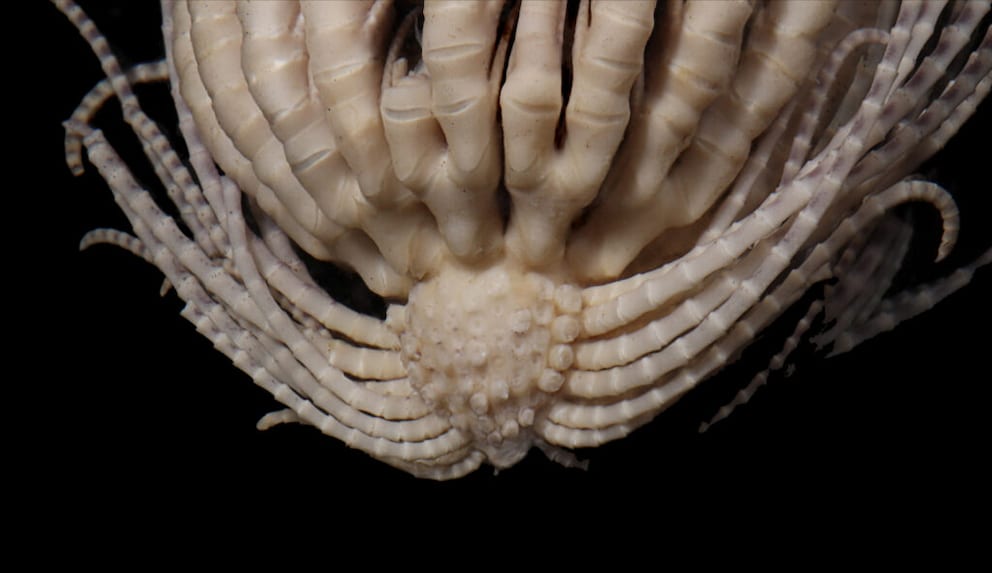
A closer look at the animal solves the mystery. The reason for the name is the attachment points of the so-called cirri—plural for cirrus, a zoological term for body appendages of various animals, meaning lock or fringe.
These attachment points are located at the base of the animal. “We removed some of the cirri so you can see the parts where they are attached, and it looks like a strawberry,” explains Greg Rouse, professor of marine biology at the University of California, San Diego, to Business Insider. The attachment points that remain are circular bumps on the body of the feather star.
Also of interest: These are the 7 creepiest deep-sea fish
Researchers Make Another Discovery
Before the discovery in the Southern Ocean, only one species in the group of Arctic feather stars was known to science. The research team discovered not just one new species on their expedition, but a total of four. All of these species could belong to the group of Antarctic feather stars. However, none of the known species surpasses the length of the “arms” of the Antarctic strawberry feather star. Marine biologist Greg Rouse explains to Business Insider that the majority of feather stars have ten arms.
Although the researchers discovered only four additional species, they added a total of eight new species to the category of Antarctic feather stars. Previously discovered animals, originally thought to be a separate species, could thus be reassigned. According to Rouse, the researchers identified not just one species with 20 “arms,” but eight species—six of them with 20, and two with 10 tentacle-like “arms.”