


May 30, 2026, 4:21 am | Read time: 4 minutes
They kill silently, precisely, and without poison: Many snake species overpower their prey using only muscle strength. Instead of poisoning, they skillfully coil around their victims, causing their circulatory system to collapse. PETBOOK editor and biologist Saskia Schneider explains why this hunting strategy is evolutionarily successful, which species use it, and why non-venomous snakes are by no means “less dangerous.”
How Snakes Hunt–With and Without Venom
Snakes are among the most successful hunters in Earth’s history. For over 100 million years, they have developed various strategies to overpower prey. Two methods are particularly well-known: Some species rely on venom, others on sheer muscle power.
Venomous snakes use a highly complex secretion produced in specialized glands and delivered through teeth–known as fangs–into their prey. The venom can paralyze the nervous system, destroy blood and tissue, or combine multiple effects. The key point is: This venom primarily serves to procure food, not to defend against humans.1
Other snake species manage entirely without effective venom. They grab their prey with their teeth, quickly coil around it with their bodies, and kill it through what is known as constriction–an equally effective and impressive hunting method. But which came first–venomous or constrictor snakes?
These Snakes Have No Venom
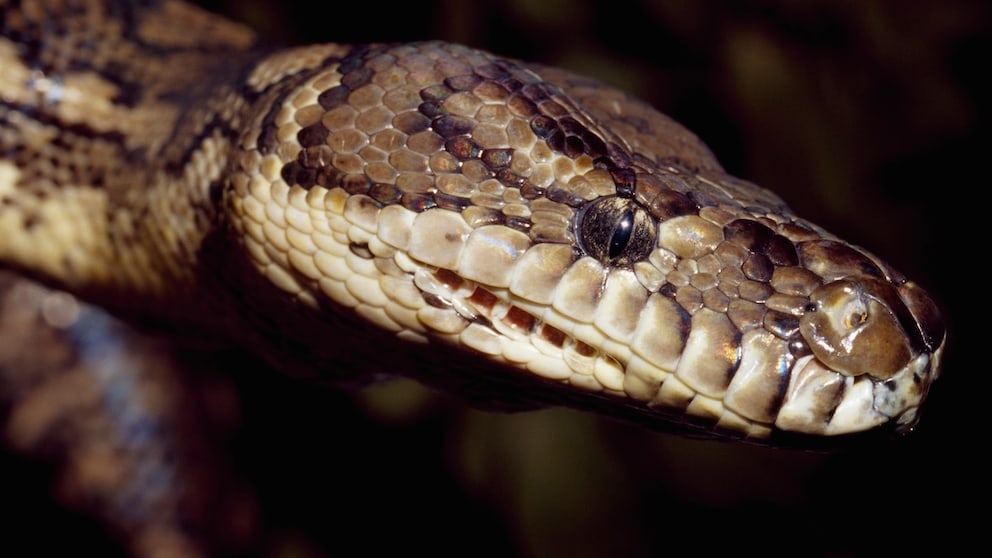
The term “constrictor snake” does not describe a distinct biological relationship but a common hunting strategy. The large representatives are particularly well-known:
- Pythons (Pythonidae), such as the ball python or the green tree python, which primarily live in Africa, Asia, and Australia.
- Boas and anacondas (Boidae), including the green anaconda or the boa constrictor from Central and South America.
However, many smaller colubrids–including species that live in our regions or in terrariums–kill their prey by coiling, especially when it is small. Some snakes are so specialized that they pose no threat to humans: Egg-eaters, for example, have highly reduced teeth and feed exclusively on bird eggs, which they break open inside their bodies.2
Why Some Snakes Constrict Their Prey Instead of Poisoning It
For a long time, it was believed that constrictor snakes suffocate their victims. Today we know: That’s not true. When constricting, the snake primarily prevents the return flow of blood to the heart. Blood pressure collapses, vital organs are no longer supplied–the prey dies from rapid cardiovascular failure.
From an evolutionary perspective, this method is older than snake venom. The earliest snakes did not yet have venom and relied on muscle power. For many species, this strategy is still sensible today: It is reliable, requires no energy-intensive venom production, and works on prey that can hardly defend itself.
Moreover, constriction and venom have developed independently multiple times. This shows that in evolution, there is no “one right way”–but many successful solutions to the same problem.3

These are the 6 biggest snakes in the world

Scientists Solve Mystery of How Burmese Pythons Digest Entire Skeletons
Are Venomous Snakes More Dangerous?
To humans, venomous snakes often seem more threatening–and objectively, they are in certain regions. But biologically, they are not more “aggressive” or “belligerent” than non-venomous species. Snakes do not hunt humans, and their venom was not developed for us.
Interestingly, studies show that many snake venoms initially cause only mild pain when bitten. If the venom were primarily for defense, it would need to be extremely painful immediately. Instead, it often takes effect with a delay–a clear indication that it is tailored to prey.4
From the snake’s perspective, venom is one tool, constriction another. Both strategies are highly specialized and perfectly adapted to habitat, prey, and energy balance.
Conclusion: Pure Muscle Power Is as Effective as Venom
Whether constriction or venom: Snakes are masters of adaptation. The fact that some species kill their prey with muscle power while others rely on chemical precision is not a sign of backwardness or danger–but of evolutionary diversity. Constrictor snakes demonstrate impressively how effective pure muscle power can be. They remind us that strength in nature doesn’t always have to be loud or spectacular.
About the Author
Dr. Saskia Schneider is a biologist with a Ph.D. During her studies at the Free University of Berlin, she focused primarily on zoology and animal behavior.