

June 5, 2026, 3:07 pm | Read time: 4 minutes
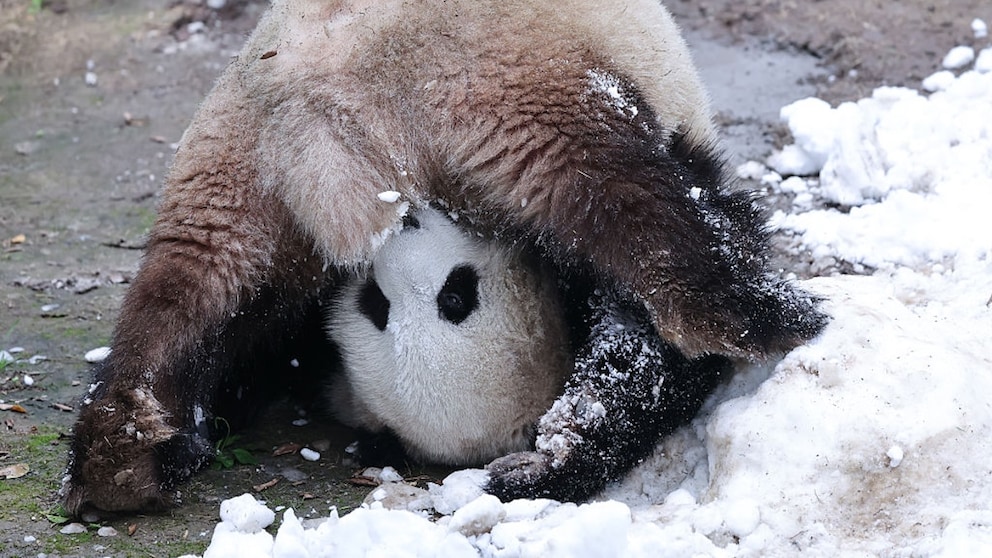
Anyone who thinks pandas are just laid-back bamboo eaters hasn’t seen one of their most remarkable traits: Male giant pandas actually do a handstand when they urinate. It looks like a quirky circus act, but it serves a very specific purpose. Researchers even suspect that the unusual pose sends important messages to other pandas.
Pandas Send Important Messages with Urine
Pandas are rather solitary animals. In the mountain forests of China, they rarely encounter each other. This makes it all the more important for them to leave information about their location, gender, or readiness to mate.
They use scent marks for this. In addition to secretions from special scent glands, pandas also use urine. Other animals can glean numerous pieces of information about the originator from this. However, the black-and-white bears do not distribute their scent messages randomly.
Pandas Choose Their “Toilet” Carefully
Researchers observed wild giant pandas in China’s Qinling Mountains and found that the animals prefer certain trees. Broad trunks with rough bark are particularly popular.1
The reason is simple: The indentations in the bark retain scent substances longer. Additionally, the scent marks are more easily perceived by passing conspecifics. The animals seem to want to place their scent marks as efficiently as possible. And this is where the unusual handstand comes into play.
Why the Animals Hang Upside Down on Trees for This
By pushing itself up a tree and urinating upside down, a male panda can place its scent mark significantly higher than in a normal position. For a long time, researchers believed that the elevated position primarily served to make the scent detectable over a greater distance. However, there are now indications that there is more to this behavior.


Scientists Solve Mystery of How Burmese Pythons Digest Entire Skeletons

Why Dogs Are So Interested in Discarded Christmas Trees
High Scent Marks Could Signal Strength
In another study, scientists examined how pandas react to scent marks at different heights. It turned out that the animals were significantly more interested in high-placed scent traces than those near the ground. Younger males, in particular, tended to avoid areas where high-placed urine traces of adult males were found.2
Researchers, therefore, suspect that the height of a scent mark reveals more than just a panda’s location. It may also signal the animal’s size, strength, or competitiveness. For rivals, a high-placed scent mark could send the message: a dominant male lives here. The handstand while urinating would then be much more than a curious habit—it would be part of a sophisticated communication system.
Not the Only Quirky Urination Behavior in the Animal Kingdom
However, pandas are by no means the only animals with unusual toilet habits.
Male Amazon river dolphins, for example, turn on their backs and spray their urine in an arc through the air. Scientists suspect that chemical information is also conveyed to other dolphins in this way.3
Siberian chipmunks also use urine in surprisingly creative ways. At least with snake urine. When the rodents encounter it, they rub the snake’s urine into their fur and even spread it on branches or tree stumps. Researchers suspect that the animals might be warning their conspecifics of possible snakes in the area.4
It gets even more curious with reptiles. Unlike mammals, many snakes, lizards, and birds do not excrete liquid urine. Instead, they produce so-called urates—a solid or paste-like excretion of uric acid. Researchers discovered in 2025 that these consist of tiny crystal spheres that help the animals remove nitrogen waste and salts from their bodies.5
The unusual form has a crucial advantage: It conserves water and is likely to have evolved particularly for life in arid environments. Some scientists even speculate that the sophisticated mechanisms of reptiles could one day help better understand diseases like gout or certain kidney stones in humans.