


April 7, 2026, 11:06 am | Read time: 3 minutes
Many are familiar with the term “Rabenmutter” (German for “raven mother”)—often used as a reproach for supposedly bad or unloving parents. Yet few know: The expression is based on a centuries-old misconception about the behavior of ravens. PETBOOK editor and biologist Saskia Schneider explains the true origin of the term and why it doesn’t do justice to the fascinating family structures of these intelligent birds.
Where Does the German Term “Rabenmutter” Come From?
The term “Rabenmutter” is one of those expressions that persistently endures—despite being based on a misconception. It was used as early as the Middle Ages to criticize women as supposedly bad or unloving mothers.
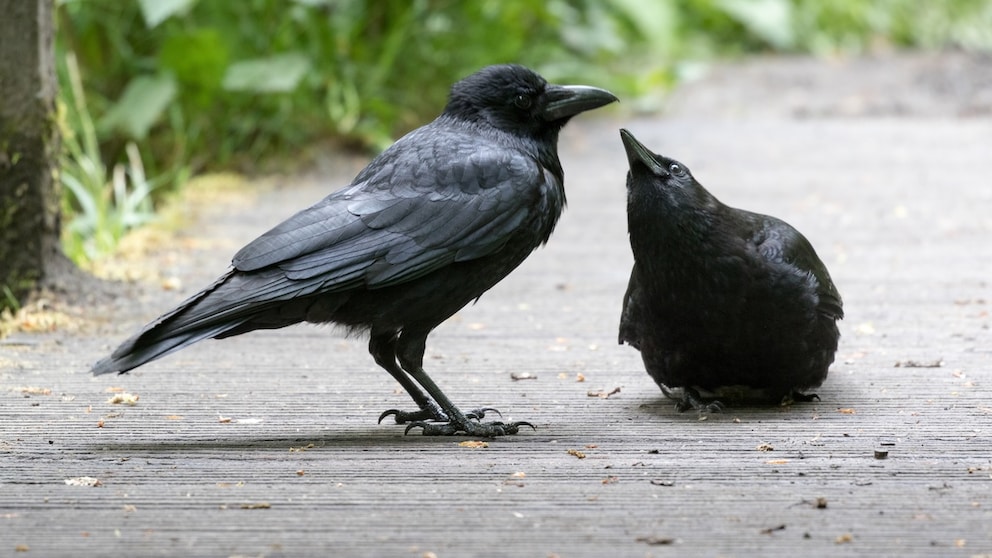
Its origin likely lies in an observation that many people misinterpreted: Young ravens leave the nest before they can properly fly. They then appear helpless on the ground or on low branches—seeming as if they have been abandoned by their parents.1
This is precisely where the misunderstanding lies. Those who observe the animals longer quickly realize: The parents remain nearby, feeding and protecting their offspring. Nevertheless, the notion that ravens are bad parents persisted for centuries—and the term “Rabenmutter” was born.2
Religious and literary interpretations also contributed to solidifying this image. Today, however, we know: It has little to do with reality.
Are Ravens and Crows Really Bad Parents?
In short: no. Quite the opposite.
Ravens are among the most caring parents among birds. Their young are born completely helpless—naked, blind, and dependent on intensive care. Both parents tend to them, provide food, and defend them against predators.
This care does not end after leaving the nest. The young birds continue to be fed, accompanied, and cared for for weeks. Leaving the nest early is not a sign of neglect but part of their natural development.
The bad reputation of ravens doesn’t match what science shows. Many prejudices—such as that they “breed uncontrollably” or wipe out other bird species—have long been debunked. Yet they persist surprisingly stubbornly to this day.3
7 Exciting Facts About Corvids
Raven or Crow? How to Recognize the Difference
Family Bonds–How Social Are Ravens and Crows?
Those who observe ravens more closely quickly notice: It’s not just about survival, but genuine social relationships. Ravens and crows often live in stable pair bonds and complex family groups. The offspring often stay with their parents for a long time—sometimes for years. During this time, the young birds learn everything they need for life: finding food, assessing dangers, and social rules.4
Particularly fascinating: In some species, older siblings even help raise new young. They bring food, defend the territory, or participate in nest building. Such “helpers at the nest” are more commonly known from mammals—among birds, it’s a real rarity.5,6
Their intelligence is also evident in their social behavior. Crows recognize each other as individuals, remember faces—even those of humans—and have an astonishingly nuanced communication system with many different sounds.
And something else continues to fascinate researchers: their behavior toward dead conspecifics. Crows gather at such sites, become silent, and remain for a while. Some interpret this as a form of mourning behavior—what is certain is that the bonds between these animals are stronger than we long thought.
Conclusion
The term “Rabenmutter” ultimately says more about us humans than about the animals themselves.
It is based on a misunderstanding—and persists to this day, even though we know better. Ravens and crows are not bad parents, but caring, social, and highly intelligent animals with close family structures.
Perhaps it’s time to reconsider the expression. Because those who take a closer look realize: These birds are anything but “ravenously” bad parents.