

October 5, 2026, 3:52 pm | Read time: 3 minutes
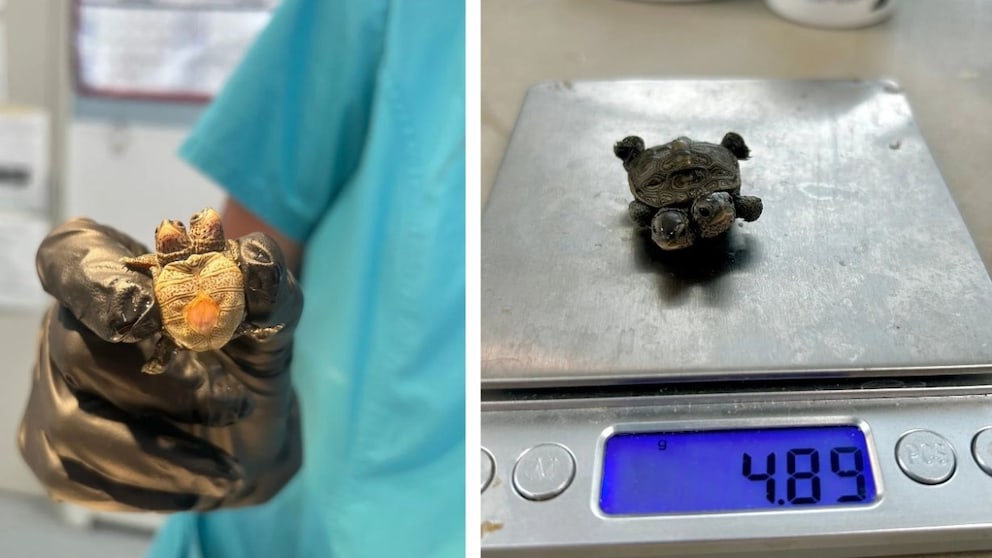
With two heads and weighing just 5.2 grams, this young diamondback terrapin is a true rarity. The unusual hatchling was discovered in the U.S. and continues to puzzle researchers. PETBOOK explains the phenomenon behind this rare occurrence.
Rare Two-Headed Diamondback Terrapin Causes a Stir
The young diamondback terrapin (Malaclemys terrapin) was discovered at a protected nesting site on Cape Cod, a peninsula in southeastern Massachusetts. Shortly after its discovery, it was taken to the New England Wildlife Center, where it is now being monitored around the clock.
Particularly noteworthy: The animal currently weighs only 5.2 grams. In contrast, adult diamondback terrapins weigh several hundred grams to about one kilogram, depending on their sex. However, veterinarians have not yet determined whether the hatchling is male or female.1
Despite its unusual anatomy, the hatchling seems to have had a good start in life so far. According to the caretakers, the turtle eats and swims normally. Its behavior is also not significantly different from that of other young turtles. Only a small character difference is already noticeable: The left head is apparently considered a bit more assertive by the caretakers.2

Why Some Animals Are Born with Two Heads
The phenomenon of animals having two heads even has a name: bicephaly. Zak Mertz, executive director of the New England Wildlife Center, explains that it occurs when an embryo begins to split like identical twins, but the process is not fully completed. The extent to which the two heads and the underlying body structures are connected can vary from case to case.
The newly discovered hatchling is also not the first of its kind. According to the wildlife center, it is already the third two-headed diamondback terrapin to be cared for there in six years.

Giant Squid Filmed Alive for the First Time — and It’s Tiny!

How Can You Tell if a Hedgehog Is Underweight?
Much About the Turtle Remains a Mystery
Whether it is male or female, the veterinarians cannot yet say. The hatchling is still too young for that. It seems to be developing well at the moment. However, it remains unclear how its anatomy is precisely structured, whether both heads control the body together, and what future awaits the unusual turtle. For researchers, this is what makes the case so exciting.
Veterinarians cannot yet look under the shell. The turtle is still too small for X-rays or CT scans. For now, the focus is on closely monitoring its development.
“We make sure that both heads are alert and active, perceive their surroundings, and try to eat,” Mertz explained to the science magazine “Popular Science.” This is how the team assesses the animal’s well-being. So far, there is good news: Both heads react, look around, and show interest in food.
Two-Headed Turtles Are Rare but Not Unique
A well-known example is the Greek tortoise Janus from the Natural History Museum in Geneva. The animal was born with two heads in 1997 and became a minor celebrity. In 2022, Janus celebrated his 25th birthday, as PETBOOK reported. This was made possible mainly through intensive care at the museum. In the wild, an animal with such anatomy would likely have much poorer survival chances.
Whether the tiny turtle from Cape Cod will also have such a long life, no one can say yet. For now, the caretakers are focusing on the essentials: eating, growing, and staying healthy. For a hatchling that weighs barely more than five grams, that’s challenge enough.