


May 20, 2026, 3:11 pm | Read time: 4 minutes
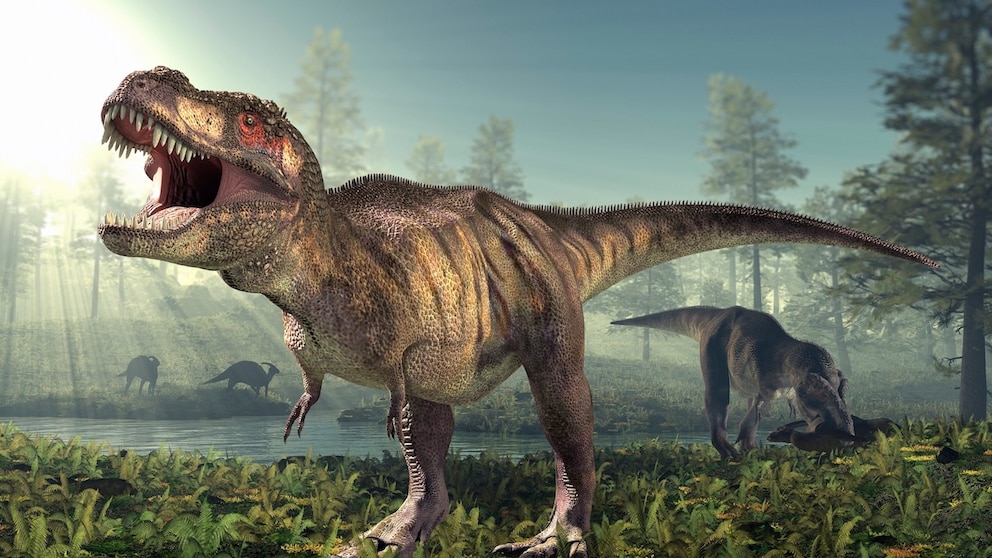
The Tyrannosaurus rex is among the most well-known dinosaurs. Huge skull, massive teeth, a body weighing tons—and then those tiny arms. Few features of the famous predator seem as odd at first glance. For a long time, this was considered an evolutionary curiosity. But researchers now believe the small arms were likely not a disadvantage but the result of an astonishing adaptation.
Why Did the T. Rex Have Such Small Arms?
Scientists from University College London and the University of Cambridge explored this question in a new study. They examined data from 82 different predatory dinosaurs, known as theropods. The surprising result: Small forearms developed independently multiple times—especially in species with particularly massive skulls.1
So, the T. rex was not an isolated case. Researchers suspect that large predators changed their hunting strategy over the course of evolution. Instead of holding prey with their forearms, they may have increasingly relied on their head and jaws.
The Skull Became More Important Than the Arms
The larger and stronger the skulls became, the less the animals apparently needed their arms. This is precisely the connection the scientists found in their analysis: The length of the forearms was more closely related to the robustness of the skull than to overall body size. Or simply put: The more powerful the bite, the less important the arms.
Study leader Charlie Roger Scherer explains on the science news website “Phys.Org“: “The head took over the role of the arms as the main weapon in an attack.”
Particularly intriguing: The development seems closely linked to the giant herbivores that populated the Earth at the time. Especially sauropods—long-necked giants with enormous body sizes—may have influenced the evolution of predatory dinosaurs.
After all, holding a plant-eater several dozen meters long with claws would have been difficult. Biting with powerful jaws, on the other hand, seems much more effective.
“Use It or Lose It”
The researchers describe the development with a well-known principle of evolution: “Use it or lose it,” meaning that what is not needed eventually diminishes. If the arms were hardly important for hunting, they ultimately only consumed energy. Over millions of years, they could have become increasingly smaller.
Interestingly, it is not only the T. rex that developed mini-arms. The scientists identified five groups of predatory dinosaurs with significantly shortened forelimbs:
- Tyrannosaurids
- Abelisaurids
- Carcharodontosaurids
- Megalosaurids
- Ceratosaurids
This suggests that this development was evolutionarily advantageous multiple times.
Some Dinosaurs Had Even Smaller Arms Than the T. Rex
Particularly extreme was the Carnotaurus, a predator from South America. Its forearms were even tinier than those of the T. rex. Smaller predators also developed this feature. An example is the Majungasaurus from Madagascar. It weighed only about one-fifth of a T. rex but also had a massive skull and very small arms.
For researchers, this is an important indication that body size alone was not decisive.

Why Birds Are Actually Reptiles

Why the Komodo Dragon Kills Like a Mythical Dragon
The T. Rex Had the Strongest Skull
For the study, the scientists also developed a new method to measure the stability of dinosaur skulls. They considered factors such as:
- the shape of the skull
- the connection of the skull bones
- the potential bite force
On this scale, the T. rex achieved the highest score. Right behind it was the Tyrannotitan—a gigantic predator from present-day Argentina.
The researchers, therefore, suspect a kind of evolutionary arms race: Herbivores grew larger, and predators developed increasingly stronger skulls and jaws to overpower this massive prey.
The Dino Puzzle Is Not Completely Solved Yet
Despite the new insights, the scientists emphasize that their study only shows correlations, not definitive proof.
However, they consider it very likely that the strong skulls developed first and the arms shrank afterward. Evolutionarily, it would make little sense for a top predator to lose its primary weapon before developing a better one.
What is certain, though, is that the tiny arms of the T. rex were likely much more than just a quirky trait. They could be an indication of how the most dangerous predatory dinosaurs in Earth’s history perfectly adapted to their gigantic prey.