


October 21, 2026, 4:00 am | Read time: 5 minutes
The African giant snail captivates as the silent star of the terrarium scene: huge, slimy, and fascinatingly different. On social media, these creatures are becoming cult figures–but their exotic appearance should not overshadow the fact that they are demanding pets. PETBOOK editor and biologist Saskia Schneider explains what these exotic mollusks are really about, why they are so popular yet controversial.
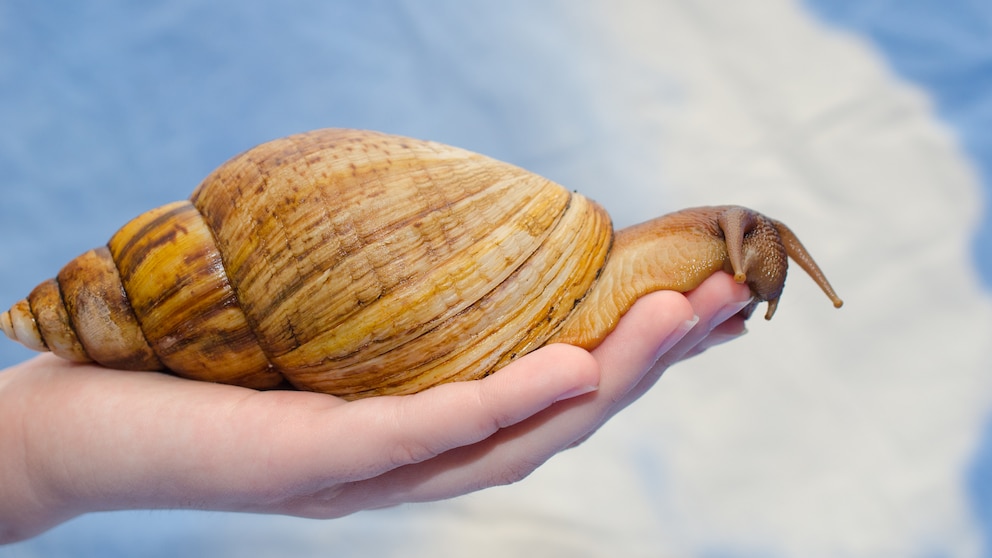
Large, slimy, and fascinatingly different. That sums up the impression these exotic animals leave on many. The African giant snail, also known as the Achatina snail (family Achatinidae), is among the largest land snails in the world. As a pet, the species Lissachatina fulica is particularly common, impressing with a shell length of up to 20 centimeters. Originally native to East Africa, it has spread to tropical regions worldwide due to human intervention–often with invasive consequences for local ecosystems. Its growing popularity as a pet leads to discussions not only about proper care but also about health risks: Studies show that these snails can potentially transmit pathogens like the rat lungworm. Despite their peacefulness and ease of care, responsible handling is crucial.
Origin
The original home of the African giant snail is south of the Sahara, particularly in East Africa, where it is found in coastal regions and humid forests. From there, it has been spread to nearly all tropical and subtropical continents through international trade and accidental introductions. Lissachatina fulica, in particular, is considered an invasive species in many of these areas, capable of displacing native fauna, damaging crops, and being a disease carrier. In countries like the U.S., Australia, and Canada, keeping this snail is therefore banned or strictly regulated. Importing them to Europe is allowed but requires knowledge of their care. The establishment of this species outside its native range poses a significant challenge for conservation, which is why the IUCN has listed it as a dangerous invasive species.
Appearance
African giant snails, particularly the species Lissachatina fulica, are characterized by a conically shaped shell that can reach a length of up to 20 centimeters in mature individuals. In certain species like Achatina achatina, lengths of up to 30 centimeters are possible. The shell tapers to a point at the apex and often has a reddish-brown base color with dark stripes or patterns, with coloration varying greatly due to breeding lines. The shell is typically twice as high as it is wide, with seven to nine whorls. The body of the snail consists, like all snails, of a strong foot for crawling, four tentacles–two for touch and smell, two with eyes–and the so-called radula, a rasping tongue with tiny teeth used to ingest food.
Behavior
African giant snails are considered gentle and calm animals. Their nocturnal activity phase usually begins at dusk, when they search for food and explore their surroundings. Due to their slow pace and lack of defense mechanisms like bites or claws, they seem harmless–yet they are very sensitive to stress. Even though many owners let the snails crawl over their hands, handling should be gentle. African giant snails are sensitive to touch, even over their shell, and may perceive it as a threat. As solitary animals, they show little social behavior but are still kept in groups, as they can otherwise develop stress and susceptibility to disease. Overall, they are curious but reserved and focused on their environment.
Pouched Rat: These Pets Can Even Detect Landmines
How to Keep the Plumed Basilisk in a Rainforest Terrarium
Diet
African giant snails are herbivores but also consume animal protein. Their diet is based on fresh vegetables (such as cucumbers, carrots, spinach), fruits (such as apples, berries), and occasionally plant waste like banana peels. Animal protein, such as fish flakes or soaked dog food, should only be given in small amounts. Foods with salt, copper, or additives should be avoided. Additionally, calcium should be provided for shell growth–for example, through cuttlebone, feed lime, or healing clay. Food should be offered fresh daily and evenly distributed, ideally on saucers to facilitate cleaning.
Proper Care & Maintenance
Keeping African giant snails requires a terrarium with sufficient space–at least 60 × 30 × 30 cm for three to five animals. The substrate should be 10 cm deep and consist of unfertilized, slightly calcareous soil to protect the shell. The animals need high humidity (80–90%) and temperatures between 21°C and 28°C, with heating mats recommended instead of heat lamps. A regulated day-night cycle can be established through lighting conditions. A water dish can be omitted with regular misting. Furnishings like cork branches or plants should be stable to prevent the animals from falling. Due to the risk of mold from food residues, daily cleaning is essential. The snails survive dry periods through a so-called dry rest, during which they withdraw and remain inactive.
Handling the snails requires caution. On one hand, because they can be easily injured if they fall. On the other hand, Swiss researchers warned against handling them, as their study found that African giant snails could theoretically transmit the rat lungworm, which can cause meningitis in humans. Therefore, they should not be allowed to crawl around the garden, where they can come into contact with pathogens more quickly. Also, because they are quite voracious and reproduce quickly.