

July 21, 2023, 2:36 pm | Read time: 8 minutes
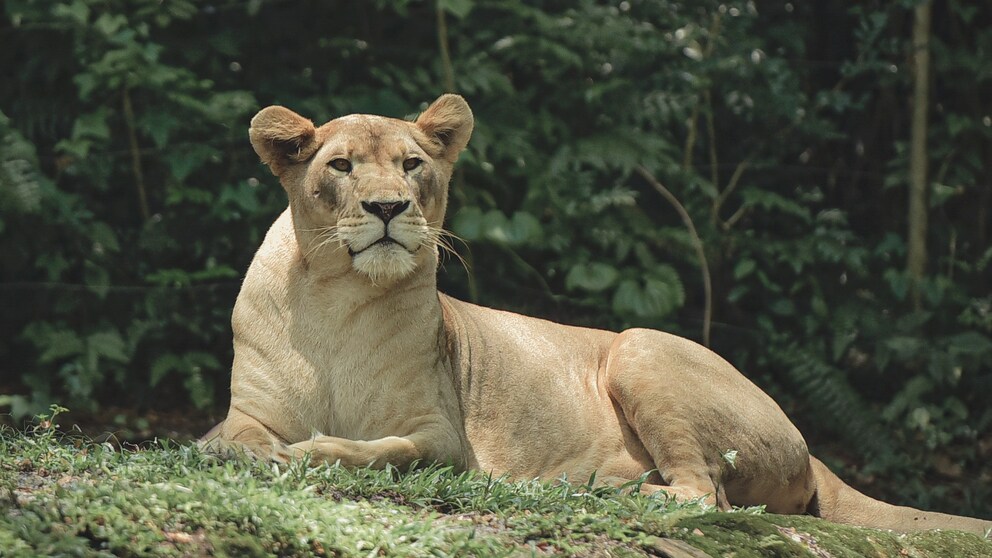
All of Berlin and Brandenburg were in an uproar on July 20 and 21 over a reportedly escaped lioness. There is widespread confusion about where the animal came from and whether it is truly a wildcat. Initially, this seemed quite possible. Unfortunately, it is indeed very easy to keep big cats in Germany.
On the night of July 20, 2023, police received a report of a supposed lioness roaming Kleinmachnow near Berlin. This put the community and surrounding cities on high alert for days. A big cat that seemingly no one missed and hunted a wild boar in the forest at night? Many wondered how it was possible for a non-native species to roam the woods, even though the authenticity of the report was soon doubted and proven false. It quickly became clear: “the lioness” had not escaped from a zoo or wildlife enclosure. It could have been an animal from private ownership. In fact, this is not so unlikely in Germany. There is no ban on keeping wild cats privately. What animal rights activists and wildlife researchers think about this.
Keeping Big Cats in Germany Is Legal Under Certain Conditions
Unlike in the U.S., there is no ban in Germany on keeping big cats as “pets.” It is generally allowed to have these animals in your garden or even your basement, especially if they come from captive breeding. As the animal rights organization Peta informs PETBOOK upon request, only nine federal states have a dangerous animal or poison law ordinance that restricts the keeping of dangerous wild animals. “In Berlin, there is such an ordinance, but not in Brandenburg,” says Dr. Yvonne Würz, Senior Specialist for Zoos and Circuses at Peta. The German Animal Welfare Federation explains that Germany is one of the largest markets for exotic animals worldwide. While it is prohibited to capture native wild animals within Germany, animal stocks in Asia, Africa, and South America can be plundered for the German pet market.
“Whether it was a dangerous big cat in this specific case or not doesn’t change the fundamental problem,” says Thomas Schröder, President of the German Animal Welfare Federation. The ‘lioness’ and the immense effort of this costly search operation are already a symbol of inconsistent and misguided policies in the area of wildlife trade and pet protection.
Dr. Yvonne Würz describes the situation in Germany as a veritable “patchwork of regulations.” This means that in Brandenburg, one can legally keep a lion as long as the legally prescribed conditions are met. For a lion, one only needs to provide a 200 square meter, well-structured, and escape-proof enclosure. “The acquisition is also legal, as long as it is not a wild-caught animal and species protection regulations are observed. For reasons of animal welfare and public safety, a nationwide pet protection law is finally needed, which, among other things, prohibits the private keeping of exotic wild animals.”
Also interesting: After Ban in the U.S. – What Happens to Big Cats in Private Ownership?
“Tigers and Lions Are Easily Legally Acquirable in Germany”
Moreover, the trade in wild animals is almost entirely unregulated, with the exception of a few strictly protected species. The protection of endangered species is regulated in the international treaty CITES, better known as the Washington Convention on International Trade in Endangered Species. This is supposed to regulate the trade in protected species but is unfortunately not very effective.
“Even tigers and lions are easily legally acquirable in Germany, provided they were born in captivity. Additionally, around 300,000 reptiles are imported into Germany from distant countries each year, many of which are wild-caught,” says Dr. Yvonne Würz. Another issue is: The more protected and rare an animal is, the greater the interest within the scene to keep this exotic animal in the living room. Studies also show that exotics like reptiles often suffer or die from diseases caused by improper care. Moreover, for about two decades, there have been increasing incidents of big cats, venomous snakes, and other wild animals escaping from private holdings and circuses.
“Despite countless warnings, the government has not reacted but has allowed the madness to run free and failed to restrict the keeping of exotic wild animals,” says Dr. Yvonne Würz. Therefore, Peta calls on Federal Minister Özdemir and the traffic light coalition to finally ban the keeping of exotic wild animals in private hands and circuses in the current revision of the Animal Welfare Act. Thomas Schröder can only agree. “In recent years, there have been repeated major operations by police, fire departments, and wildlife experts to capture and care for escaped venomous snakes, lion cubs, or other wild animals. The government must finally act to protect both animals and humans accordingly!”
Where Do the Captive-Bred Tigers and Lions in Private Hands Come From?
Nadine Ronco Alarcón, Federal Policy Officer at Vier Pfoten Germany, tells PETBOOK more about the breeding of big cats in Europe and the extent of the problem. In recent years, several cases have been noted involving lion and tiger cubs. These are said to have been bred in Southeast Europe and illegally traded. “The affected countries were Kosovo, North Macedonia, Serbia, Albania, and Montenegro.”
The Vier Pfoten Foundation for Animal Welfare has addressed this problem with local authorities in these countries and urged them to take measures to prevent the situation from getting out of control. This is particularly important in light of the EU’s Biodiversity Strategy for 2030. This calls on the EU to end the commercial trade in endangered species. Since 2018, the Vier Pfoten Foundation for Animal Welfare has also been dealing with the commercial breeding and trade of big cats in the Czech Republic.
“The assumption that the Czech Republic is a hotspot in Europe for the legal and illegal trade in tigers has increasingly solidified. The authorities recognized this and expressed to Vier Pfoten their willingness for the necessary changes,” Nadine Ronco Alarcón tells PETBOOK further. According to their own statements, Vier Pfoten played a role in developing new laws. These introduced stricter controls for private keeping and a moratorium on commercial breeding. In 2021, an EU Tiger Guide was also drafted to end commercial trade in and out of the European Union. The Czech Republic, together with Slovakia, successfully advocated for this at expert meetings of EU member states.
Also interesting: Liger – the Crossbreed of Lion and Tiger
Animal rights activists uncover cruel tiger trade in South Africa
After Ban in U.S. – What Happens to Privately Owned Big Cats?
Can Keeping Big Cats in Germany Ever Be Species-Appropriate?
The work of Vier Pfoten ultimately led to the adoption of the guidelines by the European Commission in April 2023. “The release of the EU guidelines for tigers will, if properly implemented by the member states, be a decisive step in better controlling the trade in captive-held tigers and their parts.” Vier Pfoten also hopes that the regulation will “essentially end the trade in tigers for commercial purposes, including private keeping.” Big cats are wild animals characterized by special needs and complex behaviors. Appropriate housing and care for these wild animals are hardly possible.
“Wild animals can never be kept in captivity in a way that meets their natural needs,” Dr. Yvonne Würz also assesses the situation for PETBOOK. Big cats are among the animal species that suffer particularly severely from inappropriate conditions. “Scientific studies confirm that predators often develop behavioral disorders and constantly pace the same paths in their confined enclosures (so-called ‘pacing’).”
Moreover, lions live in the wild in prides of 4 to 40 animals. Thus, typical social behavior cannot be fulfilled in captivity, nor can hunting behavior. “This massive animal suffering applies equally to zoo, circus, and private holdings. Peta therefore demands that wild animals like big cats should no longer be kept in captivity, except in recognized sanctuaries.”
Petition Against Keeping Big Cats in Germany Launched
Animal rights activist and influencer Victoria Müller also speaks out for PETBOOK against the keeping of wild animals in Germany. “As the name suggests, wild animals do not belong in the home or an enclosure. They should remain in their natural habitat. This is fundamentally different from domesticated animals like dogs. In Germany, it is relatively easy to keep wild animals privately, and this makes little sense for various reasons. For one, safety cannot be guaranteed, as these animals can escape, and there have already been major operations due to snakes or big cats in the past. Moreover, keeping them cannot be species-appropriate, as species-appropriate means freedom.”
PETBOOK also asked Victoria Müller about the petition against keeping big cats that she promptly launched. “I want the topic to receive fundamentally more attention. Many people are not even aware that there could be crocodiles in the neighborhood and that keeping these animals is not prohibited. I want to raise awareness and, of course, urge politicians to finally take action.”
Currently, an amendment to the Animal Welfare Act is pending. Relevant paragraphs could now be anchored here, Victoria Müller further tells PETBOOK. “I demand a ban on keeping wild and exotic animals, even from captive breeding, for private individuals. Additionally, there must be positive lists for pets in Germany. A positive list for pets is an official, legally regulated list of animal species considered safe and appropriate for keeping in private households. It cannot be that people keep animals that have no place in the living room, basement, or an enclosure.”