


February 11, 2026, 4:31 pm | Read time: 6 minutes
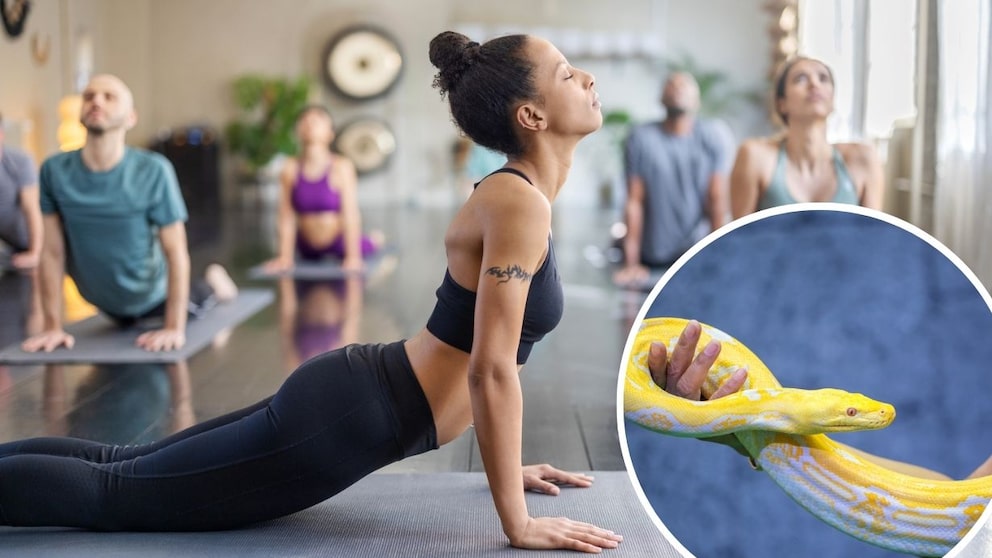
After “Puppy Yoga,” where real puppies scamper over the mats, comes “Snake Yoga.” And it’s exactly what it sounds like: yoga with snakes that not only slither over the mat but also around the arms, necks, and legs of participants. PETBOOK editor and biologist Saskia Schneider explains what this trend is all about and whether it also means deep relaxation for the snakes.
Why Yoga with Snakes?
Yoga with puppies, kittens, and even goats—while this idea still makes sense to many because it’s cute, cuddly, and fun, the latest trend is likely to send shivers down most people’s spines: yoga with snakes.
The idea is to give people a unique way to connect with these reptiles, who haven’t yet had the chance to get to know these wonderful creatures, as snake yoga instructor Katy Vanek explains in an Instagram reel from theorigonian. The reason many people don’t like snakes is mainly that they misunderstand them.
And if you already see yourself in downward dog with a boa around your neck, I have to disappoint you: The fun is currently only available in Oregon or California, where the Lxryoga studio in Costa Mesa also offers yoga with snakes.1
Mostly Pythons Slither Around Participants
While yoga students likely travel from all over the U.S. for the classes, the snakes are provided by a reptile shop in Portland, Oregon, aptly named “Hiss.”
It is mostly pythons that slither around the necks, legs, and arms of participants. But a few other reptiles, like bearded dragons, occasionally join in, as Dru Morales, owner of Hiss, explains. “Many people come here to overcome their fear of snakes,” he says.
Snakes as a Calming Component
Additionally, snakes seem to have a calming effect on many participants—at least according to the experiences of yoga instructors and reptile experts. Many people even keep snakes as “emotional support animals”—animals that emotionally support their humans in difficult situations. Usually, dogs, cats, or—if it gets really exotic—ponies do this job. But snakes?
Expert Evy Hall offers the following explanation in the video: For many, it feels like snakes are giving them a hug when they coil around them. Hall describes herself as a “wildlife educator,” someone who educates about wildlife, their conservation, and their life in captivity.
Behaviorally, it’s highly questionable whether snakes can form an emotional bond with their owners. At least the participants seem to feel connected to the reptiles when they slither from arm to arm or crawl over the mats. The calm and deliberate movements fit well with the yoga atmosphere, and the whole experience seems to be great for many participants—but what about the snakes?

Animals Appear Outwardly Healthy
Don’t get me wrong: I don’t doubt that the animals themselves are doing well. The snakes in the footage appear healthy and in good overall condition. According to owner Dru Morales, all interactions with the animals are voluntary and supervised by experts. It’s unlikely that participants will panic and inadvertently harm the animals.
Given how comfortably the snakes move during yoga, it’s also likely that they have been well-fed beforehand and that the experts know exactly what they’re doing. However, it must be questioned how beneficial the activity is for the snakes themselves.
Do Snakes Enjoy the Touch of Participants?
Pets like dogs and cats often love to be petted. This is even scientifically confirmed, as so-called happiness hormones are released during physical contact. But what about snakes? As reptiles, they are not exactly among the animals that enjoy touch—not instinctively, at least.2
In nature, touch primarily means one thing for a snake: “Something is attacking me.” The animals have no natural need for “physical interaction,” as we know it from some mammals. But they can get used to being handled. However, this mainly involves holding or carrying the animals—not grabbing or petting. This is also the case with yoga with snakes.
“Snakes Love to Explore Their Environment”
Snakes can definitely feel when we touch them. They probably enjoy the warmth of our skin more than the touch itself. Compared to mammals, physical stimuli are processed differently in reptiles. At least, no neural connections are known in reptiles that associate touch with affection or social bonds. Instead, they primarily react to physical stimuli instinctively—such as with flight or attack.3
If a snake remains very calm when being touched and held, it can be assumed that it simply tolerates the touches while either relaxing on the person’s arm or exploring new terrain. “Snakes love to explore their environment and wrap around things,” Evy Hall also explains in the video. But that doesn’t automatically mean the animals “enjoy” being part of a yoga class.

Slow worms are not snakes

Doing Yoga With Your Cat? Editor Offers Tips on Strengthening Your Bond
With Colubrids, It Would Probably Work Less Well
Because it can be extremely stressful for snakes to be removed from their familiar environment and placed in unfamiliar terrain. How exactly yoga with snakes works cannot be judged by a single video, of course. But if we assume that the yoga class takes place directly in the store and the snakes are allowed to explore the terrain and the contorting participants voluntarily, it could almost be considered “enrichment” in the reptiles’ daily lives.
However, it also strongly depends on the individual character of the animals and the snake species. Pythons, in particular, are suitable for interactions with humans, as they tend to be among the calmer species. With colubrids, it would probably work less well, as these species are generally much more active and tend to flee. At least, that’s my experience.
How Safe Is Yoga with Snakes?
Besides the ethical aspect, I see another danger: safety. Not the safety of the participants—unless someone gets the idea to offer snake yoga with cobras or use six-meter-long pythons or boas instead of smaller specimens. I’m more concerned about the safety of the reptiles. Because in yoga, you can quickly lose your balance.
Anyone who trains at home with animal guests like a dog or cat on the yoga mat knows how quickly accidents can happen. I almost stepped on my puppy when I lost my balance in the “dancer” pose, and she wasn’t even on the mat, just nearby.
Everything happens so quickly that even snake experts nearby would hardly have a chance to get their animals out of the danger zone. Not to mention the snake itself. For this reason alone, I would reject yoga with snakes. But here, it’s not primarily about the animals, as the video makes clear multiple times: It’s about the people and their experience. For me, yoga with snakes falls into the same category as taking photos with the animals or using them as “teaching tools” in reptile shows.