


March 12, 2026, 4:06 pm | Read time: 7 minutes
There’s a tiny hedgehog in the grass or wandering through the garden in broad daylight–and many people immediately switch to helper mode: pack it up, warm it, feed it, save it. Totally understandable. But this impulse in spring is often when well-intentioned help becomes a problem. Because not every small spiky creature is a helpless hedgehog baby. And if you collect one too hastily, you might separate a mother from her young–or “kidnap” a healthy young hedgehog from its environment. To help you react quickly and correctly, PETBOOK has a step-by-step guide here–including an age check and the answer to whether you can touch hedgehog babies.
Many believe they see hedgehog babies in spring–but is that true?
In spring, reports like “I found a hedgehog baby!” or “Offspring so early?” become more frequent. In reality, this is often a misunderstanding. A very small hedgehog in April or May is usually not a newborn.
Hedgehogs in this country mostly have their young in late summer, often in August or September. So if you discover a tiny animal in spring, it’s usually a young hedgehog from the previous year that has come out of hibernation too early–or an animal weakened by gardening, disturbances, or parasites.
Additionally, after winter, many hedgehogs appear smaller and slimmer than expected. This can quickly create the impression of a “baby,” even though it’s already several months old. That’s why it’s so important not to judge by size alone, but to pay attention to the developmental stage and behavior.
In short: A mini hedgehog in spring is usually not an infant. But every small hedgehog deserves a close look–before intervening.
Age Check: How young is the found hedgehog approximately
The Hedgehog Center Zurich points out: The developmental stage is more important than weight, as this can vary greatly. As a rough weekly check for baby hedgehogs, these features help:
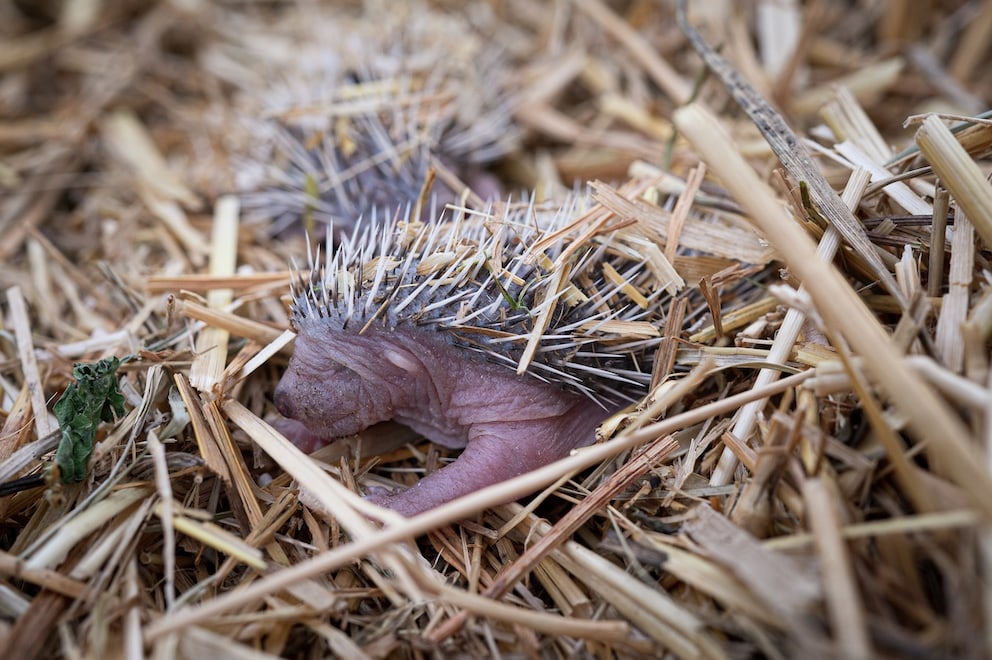
- Birth: pink skin, no visible spines, eyes/ears closed
- 1st week: first spines, eyes still closed
- 2nd week: darker spines, eyes opening
- 3rd week: fur visible, teeth emerging
- 4th week: denser fur, teeth complete
A young hedgehog, on the other hand, can already look quite “hedgehog-like” and still be small. And: The mother is often not constantly visible–this is normal.
Assess first, then act
The most important difference with hedgehog babies is: nest find or single animal?
Case 1: You find a nest with young animals
If you discover a nest with young hedgehogs while tidying up (leaf piles, compost, wood stacks, hedges), the rule is: don’t rescue, but protect. In practice, this means:
- Immediately cover the nest again carefully (with the existing material).
- Keep your distance, avoid disturbances.
- Keep dogs, mowers, curious children, and cats away as best as possible.
This approach is also emphasized by the hedgehog help pages of NABU: Cover the nest again and leave, so the mother can return.
Case 2: The “baby” is wandering or lying around alone
A single small hedgehog outside a nest is much more critical–now the condition of the animal is what matters.
These warning signs indicate a need for help
A hedgehog is very likely in need of help if it…
- is visibly injured or bleeding,
- appears apathetic, staggers, or barely responds,
- barely curls up,
- feels colder than your hand (hypothermia!),
- or you see fly eggs/maggots (acute emergency).
Important: Activity during the day alone is not proof. Hedgehogs are nocturnal, but especially young animals can be out briefly during the day in exceptional situations. The overall picture is decisive.
Is the hedgehog too thin?
A healthy hedgehog has a round, pear-shaped silhouette when viewed from above: narrower at the front, significantly wider at the back. The body line appears soft and curved. If this roundness is missing and the body appears elongated or almost sunken, it’s a warning signal.
Underweight is particularly evident in the so-called hunger fold–a visible indentation behind the head, like a small kink between the neck and body. It occurs when fat reserves are lacking. A pointed-looking head, sunken flanks, or clearly palpable bones can also indicate that the hedgehog doesn’t have enough substance. More on this topic can be found in this article: How to tell if a hedgehog is underweight?
Important: Open eyes, dense spines, and an overall “finished” appearance speak against an infant–even if the animal appears small. In this case, it’s less about an orphaned baby and more about an animal with too few reserves.
Can you touch hedgehog babies?
The short answer: As little as possible–but as much as necessary. The general rule is: You should not touch wild animals unnecessarily, as this causes stress and often leads to animals being “rescued” without need.
However, if a hedgehog is in need of help (hypothermic, injured, infant outside the nest), you must briefly touch it to secure and warm it. This is then necessary help.
Here’s how to do it right:
- Use gloves or a towel.
- Lift the hedgehog briefly and calmly–do not pet or “soothe.”
- Wash your hands afterward.
The widespread myth that a hedgehog mother would reject her young solely because of human scent persists–but this is not scientifically proven. The crucial point is another: disturbance. If a nest is repeatedly opened, young animals are removed, or the area is frequently entered, it can become problematic for the mother. In the worst case, she abandons the location because it no longer seems safe.
Therefore, despite everything: The smell is not the main problem–it’s the disturbance.
And that’s why the simple rule remains: Found a nest? Carefully cover it again–and walk away.
If help is needed–here’s how to act correctly
If the hedgehog clearly appears weak, hypothermic, or injured, the rule is: help briefly, calmly, and purposefully.
Secure
Place the hedgehog in a tall box or container (escape-proof), lined with a towel or kitchen paper/newspaper as nesting material. Keep it quiet and dark–stress costs energy.
Warmth before food
Many guides emphasize: Warmth is a priority. Hypothermia is quickly life-threatening for young animals. Simply wrap a lukewarm hot water bottle (or heat pad) in a cloth, place it in the box so the hedgehog can approach–without direct contact with a hot surface.
Then contact professionals immediately
Call a hedgehog help/wildlife rescue center or, in case of acute injuries, directly a veterinary practice that accepts wild animals. Legally in Germany: Wild animals may only be taken in if they are sick, injured, or helpless–and must be released back into the wild after care. A cute young hedgehog cannot become a pet.

Found an Injured Hedgehog? Here’s What to Do Now

Injured Hedgehog Found? How You Can Help Now
These “well-intentioned” mistakes happen frequently
Those who want to help hedgehogs mean well–but often make typical mistakes.
Don’t give milk: Milk for hedgehogs is a widespread myth–but harmful. Hedgehogs are lactose intolerant, and milk can lead to severe diarrhea.
Don’t “quickly feed something”: Hedgehogs are insectivores. Bread, fruit, or kitchen scraps are unsuitable. If anything, high-quality, meat-based cat food without sauce is an option–but only after consulting a hedgehog station or a knowledgeable veterinarian. Professional advice should always be sought before feeding.
Don’t collect preemptively: If a hedgehog appears fit, is active, and shows no injuries, it should not simply be taken. Not every animal needs help.
No self-treatment: Don’t bathe, don’t “deworm on suspicion,” and don’t use home remedies. If in doubt, contact a hedgehog station early.
Conclusion
A small hedgehog in the garden quickly arouses the desire to help. But not every supposed “hedgehog baby” needs support. The key factors are developmental stage, body shape, and behavior–not just size. If you discover a nest, it’s best protected by calm and distance. However, if an animal appears weak, hypothermic, or injured, quick but prudent action is required–with warmth and especially professional support.
Addresses of regional wildlife stations and more information can be found at Pro Igel e.V. at www.pro-igel.de or at Wildtierschutz Deutschland e.V. at www.wildtierschutz-deutschland.de/verletztes-wildtier-gefunden.